
Definition
The Open Charge Point Interface (OCPI) is an open, royalty-free REST API protocol that enables scalable, automated data exchange between Charge Point Operators (CPOs) and eMobility Service Providers (eMSPs). It standardizes the exchange of charging location data, real-time availability, tariffs, session events, charge detail records (CDRs), and token authorization — everything needed for an EV driver to seamlessly charge on a network other than their own. OCPI is developed and maintained by the EVRoaming Foundation, a non-profit, contributor-based organization. The specification is freely available and open to all.
On This Page
Origin & Governance
OCPI’s development began in 2014, initiated by a consortium of European EV charging companies including EV Box, NewMotion, ElaadNL, BeCharged, GreenFlux, and Last Mile Solutions.[1] The first public version, OCPI 2.0, was released in 2015. The protocol was created specifically to solve a problem that OCPP doesn’t address: how different operators’ backends talk to each other, not just how chargers talk to their own backend.
Since 2020, OCPI has been governed by the EVRoaming Foundation (EVRF), a non-profit organization that maintains the specification, manages contributions, and ensures the protocol remains vendor-neutral and freely available.[2] Governance operates through a contributor model — any organization can join the Foundation, and Full Contributors participate directly in protocol development.
The OCPI specification is freely available on GitHub and via the EVRoaming Foundation at evroaming.org. The current release is OCPI 2.3.0 (February 2025). OCPI 3.0 is in draft; a target release of mid-2025 was initially announced, but this is an evolving timeline. The 3.0 repository is accessible only to Foundation contributors.[3]
OCPI vs. OCPP: Two Complementary Protocols
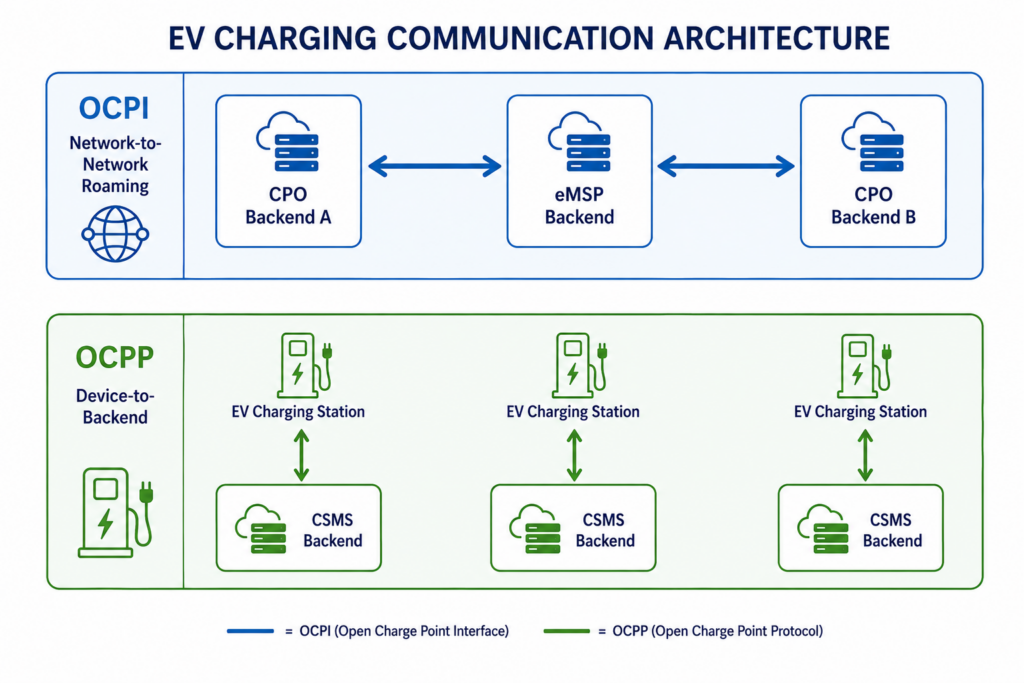
OCPI and OCPP are the two foundational protocols of the EV charging industry. They are routinely confused because their acronyms are similar — but they solve fundamentally different problems at different layers of the network.
| OCPI — Open Charge Point Interface | OCPP — Open Charge Point Protocol | |
| Governs | Data exchange between different operators’ backends (CPO ↔ eMSP; CPO ↔ CPO) | Communication between a charging station and its own CSMS backend |
| Direction | Horizontal — network-to-network | Vertical — device-to-backend |
| Core use cases: | • EV driver roaming across networks • Tariff sharing and price transparency • Location and availability data • CDR (billing record) exchange | • Remote start/stop charging • Meter data reporting • OTA firmware updates • Smart charging profiles |
| Transport | HTTPS / REST / JSON (stateless) | WebSocket / JSON (persistent connection) |
| Governed by | EVRoaming Foundation | Open Charge Alliance (OCA) |
| Current ver. | 2.3.0 (Feb 2025) | 2.1 (Jan 2025); 2.0.1 widely deployed |
The relationship is straightforward: OCPP manages the charger; OCPI manages the network connections between operators. A CPO needs both — OCPP to control their own hardware, and OCPI to connect their network to roaming partners. A small CPO may operate entirely on OCPP without OCPI for years; they only need OCPI when they want to open their chargers to drivers from other networks.
Protocol Modules
OCPI is organized into modular APIs. Each module defines a specific category of data exchange. Implementations can support subsets of modules depending on business needs — a CPO focused on public charging might implement Locations, Tariffs, Sessions, and CDRs before adding Commands or Smart Charging.
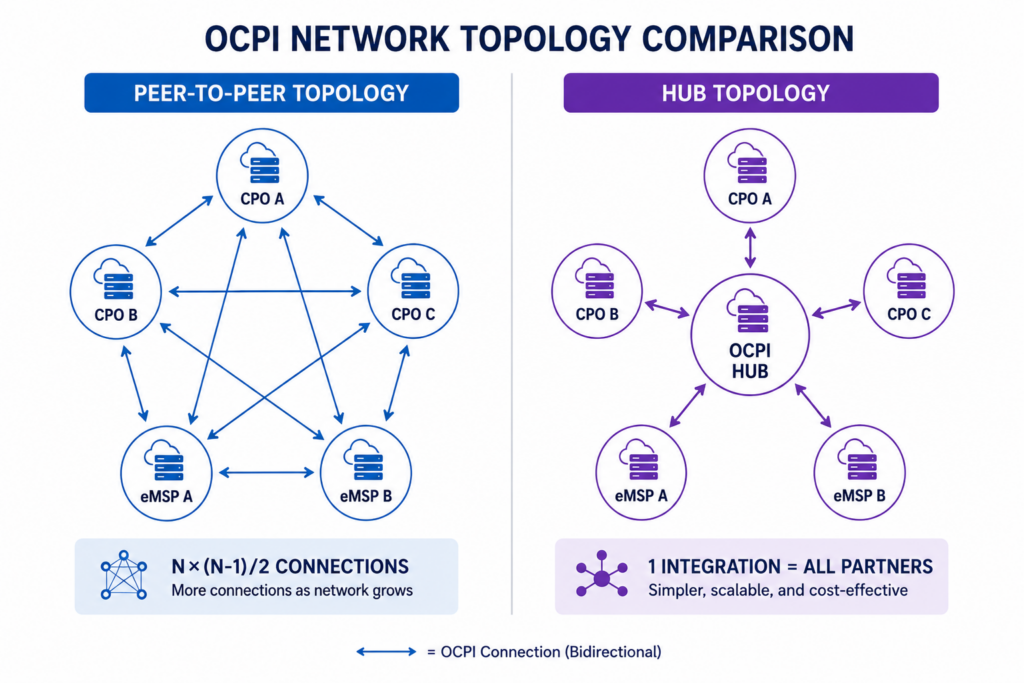
Communication Topology: Peer-to-Peer vs. Hub
OCPI supports two distinct network architectures. In practice, most large operators use both — direct peer-to-peer connections with major bilateral partners, and hub connections for broader network coverage.
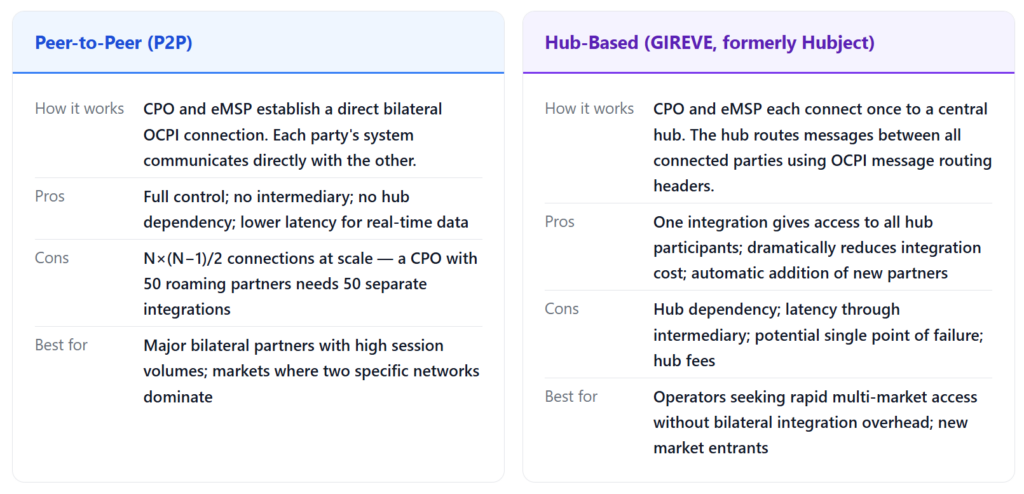
Unlike OCPP which uses persistent WebSocket connections, OCPI uses stateless HTTPS/REST requests. Two OCPI parties do not maintain a persistent connection — they make individual API calls when data needs to be exchanged (polling or push-based). This architectural choice makes OCPI more scalable for backend-to-backend communication but also means it’s not suitable for real-time device control (which is OCPP’s domain).
Version History
OCPI 2.0 | 2015
First public release. Established the core concept of CPO–eMSP data exchange for roaming. Included basic locations, sessions, CDRs, and token exchange. Superseded rapidly as adoption grew and requirements expanded.
OCPI 2.1.1 | 2017
The first version to achieve broad industry adoption. Focused on core roaming functionality and defined the foundational modules still used today. Established the dominant deployment baseline for several years.[6]
- Core module set: Locations, Sessions, CDRs, Tokens, Tariffs, Commands
- Peer-to-peer architecture only (no hub support)
- No smart charging profiles
Status: No longer officially supported by the EVRoaming Foundation as of 2025. Operators on 2.1.1 should plan migration.[7]
OCPI 2.2 / 2.2.1 | 2019 / 2021
A major advancement that added hub topology support — the key enabler for large roaming networks. Also introduced smart charging profiles, enabling demand response across network boundaries.[8]
- Hub support — message routing headers for multi-party hub networks
- Charging Profiles — smart charging commands from eMSP to CPO
- Enhanced CDR: Credit CDRs, VAT, session_id, CdrToken, tariff types
- Signed meter values in CDRs (Germany Eichrecht compliance)[9]
- Cancel Reservation command added
NEVI relevance: The US NEVI program mandates OCPI 2.2.1 for network-to-network interoperability at all federally funded charging sites.[10]
OCPI 2.3.0 | February 2025
Released by the EVRoaming Foundation in February 2025. The most significant update since 2.2, driven primarily by EU AFIR regulatory requirements and global scalability needs.[4][5]
- EU AFIR / NAP compliance — structured data fields for National Access Point reporting; required for operators in EU member states
- Direct Payment module — standardizes ad-hoc credit/debit payment flows (AFIR mandates contract-free access)
- Booking module — advance reservation of charging slots, especially for HDV fleet operators
- North American tax support — expanded CDR fields for US/Canada tax handling
- Plug & Charge compatibility indicators — alignment with ISO 15118 developments
- Expanded CdrToken with
country_codeandparty_idfor global unique identification - New
vehicle_typefields for location data (car, motorcycle, truck, bike)
OCPI 3.0 | In development (2025–2026)
OCPI 3.0 is a more substantial architectural revision under active development by EVRoaming Foundation contributors. Early discussions point to: real-time data streaming (replacing current poll/push hybrid); improved V2G support via energy_exported_kwh fields and V2G parameters from ISO 15118; tighter Plug & Charge integration; and GDPR-aligned contract management.[9] The 3.0 specification repository is accessible only to Foundation contributors.
Roaming Hubs & Market Scale
OCPI is now the protocol that underpins the largest EV roaming networks in the world. The pivotal moment came in September 2025, when Hubject — historically operating its own proprietary OICP protocol — joined the EVRoaming Foundation as a Full Contributor and committed to native OCPI support.[11]
“By aligning on a single global roaming protocol, the industry can reduce complexity and accelerate collaboration.”
— EVRoaming Foundation & Hubject Joint Press Release, September 3, 2025[11]

Major OCPI Roaming Hubs
| Hub | Protocol(s) | Scale | Geography |
|---|---|---|---|
| Hubject (intercharge) | OICP + OCPI (from late 2025)[11] | 1M+ charging points, 2,750+ B2B partners | 70+ countries — the world’s largest roaming network |
| GIREVE | OCPI (native) | 500,000+ charge points, 30+ countries[12] | Largest European roaming hub; strong in France, BE, NL, DE |
| OCN (Open Charging Network) | OCPI (native) | Decentralized hub — connects many operators | Global; blockchain-based registry for OCPI parties |
| Virta Hub | OCPI 2.2.1 | Manages 120,000+ chargers across 35+ countries[13] | Europe, Asia-Pacific, North America |
| e-clearing.net | OCPI (native) | European clearing house | EU — financial settlement layer for OCPI CDRs |
2025 Milestone: Hubject’s September 2025 announcement closed the last major gap in OCPI’s global dominance. Previously, operators choosing between GIREVE (OCPI) and Hubject (OICP) had to implement two protocols or pick a side. With Hubject now supporting OCPI natively, all major global roaming hubs align on a single open protocol. The fragmentation era — competing proprietary and open roaming standards — has effectively ended.[11]
EU AFIR Regulation & OCPI Compliance
The EU Alternative Fuels Infrastructure Regulation (AFIR) took effect in April 2024, imposing strict requirements on publicly accessible EV charging stations across EU member states.[14] OCPI is the primary technical mechanism through which CPOs meet these requirements.
| AFIR Requirement | How OCPI Enables Compliance | OCPI Version |
|---|---|---|
| Price transparency | Tariffs module — prices (per kWh, per minute, per session) shared in real-time with eMSPs and displayed to drivers before session start | 2.2.1+ |
| Ad-hoc (contract-free) access | Direct Payment module — standardizes how bank card payments at physical terminals flow through backend systems | 2.3.0+ |
| National Access Point (NAP) reporting | Locations module with AFIR-required data fields — feeds charger data (location, availability, power, connector types) to each EU country’s NAP | 2.3.0+ |
| Interoperability | Core OCPI roaming — a driver’s RFID card or app token works on any OCPI-connected network via Token exchange | 2.1.1+ |
| Accessibility data | Locations module with vehicle_type fields and accessibility attributes (added in OCPI 2.3.0) | 2.3.0 |
For EU operators, OCPI 2.3.0 is the compliance baseline — not optional. The vast majority of new public chargers installed in Europe throughout 2025 have their data flowing through OCPI-based systems.[5] Operators still on OCPI 2.1.1 face growing regulatory pressure to upgrade. OCPI 2.3.0 is also the first version to include structured support for North American tax handling, beginning the protocol’s expansion beyond its European origins.
US NEVI Program Requirement
The US National Electric Vehicle Infrastructure (NEVI) Formula Program — funded at $5 billion under the 2021 Bipartisan Infrastructure Law — mandates OCPI as part of its interoperability stack for all federally funded charging sites.[10]
NEVI Interoperability Stack (23 CFR 680)All NEVI-funded DCFC sites must implement:
OCPP 2.0.1 — charger-to-CSMS communication
OCPI 2.2.1 — network-to-network roaming (CPO ↔ eMSP)
ISO 15118-2 — Plug & Charge vehicle-to-charger communicationTogether, these three protocols form the complete interoperability stack that allows any NEVI-funded charger to be accessed by any EV driver, via any network, with any compatible vehicle.
OCPI 2.2.1 was selected specifically (not 2.3.0) because 2.2.1 was the stable, widely implemented version at the time the NEVI Final Rule was issued. As OCPI 2.3.0 matures in deployment, future NEVI guidance may reference it — particularly given its North American tax support and NAP features.
Ecosystem Relationships
| Standard / Component | Relationship to OCPI |
|---|---|
| OCPP 2.0.1 | Complementary, not competing. OCPP governs the charger-to-backend layer (vertical); OCPI governs the backend-to-backend roaming layer (horizontal). A complete interoperable network needs both. |
| ISO 15118 (Plug & Charge) | ISO 15118 handles vehicle-to-charger authentication. OCPI’s Token module handles the backend-level authorization that ISO 15118 Plug & Charge ultimately depends on. OCPI 2.3.0 adds compatibility indicators for ISO 15118, and OCPI 3.0 plans deeper integration. |
| OICP (Open InterCharge Protocol) | Hubject’s historically proprietary roaming protocol. OICP and OCPI served the same purpose (network-to-network roaming) but were competing standards. Since Hubject’s September 2025 commitment to OCPI, OICP is in managed decline for new implementations. |
| CPO (Charge Point Operator) | CPOs are one of the two primary OCPI parties. They publish location data, receive and validate tokens, push session data and CDRs, and receive remote commands — all via OCPI. |
| eMSP (eMobility Service Provider) | eMSPs are the other primary OCPI party. They push their drivers’ tokens to CPO networks, receive session and CDR data for billing, and issue remote commands on behalf of their drivers. |
| BESS / Smart Energy | OCPI’s Charging Profiles module enables smart charging commands across network boundaries — a CPO can receive demand response signals via eMSP that originate from a grid operator, enabling cross-network grid services participation. |
Joint’s MPO platform (white-label CPMS) supports OCPP 2.0.1 and is designed for OCPI 2.2.1 integration, satisfying the full interoperability stack required for NEVI-funded US deployments and EU AFIR-compliant European deployments. For CPO partners deploying JointCharging hardware across multiple markets, the MPO platform’s OCPI support enables connection to roaming hubs (GIREVE, intercharge) and bilateral partner networks without proprietary integration overhead.
See Also
- EV Charging Glossary
- DC fast charging (DCFC)
- Electric Vehicle Supply Equipment (EVSE)
- EV Charger Manufacturer
- Open Charge Point Protocol (OCPP)
- AE J3400
Sources & References
- [1] OCPI 2.2.1 Specification, EVRoaming Foundation: “Initiators are EV Box, New Motion, ElaadNL, BeCharged, GreenFlux and Last Mile Solutions. An international group of over 400 companies supports OCPI.” evroaming.org
- [2] EVRoaming Foundation, “OCPI — current version 2.3.0”: “OCPI is developed and maintained via the Work Group OCPI Development from the EVRoaming Foundation.” evroaming.org/ocpi/
- [3] GitHub, OCPI repository: “The latest release is OCPI 2.3.0. Development of the next version (OCPI 3.0) is done in the ocpi-3 repository, accessible only to Contributors of the EV Roaming Foundation.” github.com/ocpi/ocpi
- [4] EVRoaming Foundation, OCPI Downloads: “OCPI 2.3.0 is developed to support latest legislation in the world, incl EU AFIR (National Access Points) and US taxes. It also includes the latest Direct Payment module.” evroaming.org/ocpi-downloads/
- [5] GreenFlux, “2025: The Year OCPI Unified the EV Charging Industry” — documents OCPI 2.3.0 release (February 2025), Booking Module (June 2025), and Hubject announcement (September 2025). greenflux.com
- [6] Spirii Glossary, “OCPI”: “OCPI 2.1.1: This is the most widely adopted version of the standard, which focuses on core roaming functionalities.” spirii.com
- [7] ocpi-protocol.com / EVRoaming Foundation: “Version 2.1.1 is not supported anymore.” ocpi-protocol.com
- [8] EVRoaming Foundation, “Official release OCPI version 2.2” (February 2019): Hub Client Info, Charging Profiles, enhanced CDRs, Cancel Reservation. evroaming.org
- [9] Idaho National Laboratory / ChargeX Consortium, “OCPI Recommendations,” June 2025: “OCPI 2.2.1 (2021) introduced signed meter values for regulatory compliance (e.g., Germany’s Eichrecht).” inl.gov
- [10] NARUC / Joint Office of Energy and Transportation, NEVI Brief: “Network-to-Network Communication: OCPI 2.2.1” listed as an interoperability requirement under Title 23 CFR 680.
- [11] Hubject / EVRoaming Foundation Joint Press Release, September 3, 2025: “Hubject operates the world’s largest cross-provider charging network, connecting over 1,000,000 charging points and more than 2,750 B2B partners across 70+ countries.” evroaming.org
- [12] OCPPLab, “What Is OCPI?”: “GIREVE, the largest European roaming hub, connects over 500,000 charge points across 30+ countries through OCPI.” ocpplab.com
- [13] Virta Global, “OCPI Protocol Explained”: “Virta enables OCPI (version 2.2.1) to support seamless peer-to-peer connections.” Managing 120,000+ chargers across 35+ countries. virta.global
- [14] EU Alternative Fuels Infrastructure Regulation (AFIR), effective April 2024: mandates ad-hoc access, price transparency, and interoperability for public charging infrastructure in EU member states.
