
Definition
Vehicle-to-Grid (V2G) is a bidirectional energy transfer technology in which an electric vehicle (EV) — while connected to a compatible charging station — can export stored DC battery energy back to the AC power grid. V2G is the most advanced form of Vehicle-to-Everything (V2X) bidirectional charging. It requires a V2G-capable EV, a bidirectional EVSE, a communication protocol (ISO 15118-20 or CHAdeMO), and a utility agreement or aggregator program. When active, the EV battery functions as distributed energy storage — a grid asset that can provide frequency regulation, demand response, and energy arbitrage services.
On This Page
The V2X Spectrum: V2L, V2H, V2B, V2G
V2G is one of four bidirectional energy modes grouped under the umbrella term V2X (Vehicle-to-Everything). Each mode differs in the destination of the exported energy and the infrastructure required. They represent increasing levels of complexity, grid integration, and regulatory involvement.
V2L
Vehicle-to-Load
Typically 1.5–3.6 kW
Powers external devices (appliances, tools) directly from the EV. No charger required — uses a standard outlet adapter. Simplest form; many current EVs support this.
V2H
Vehicle-to-Home
Typically 6–10 kW
Powers an entire home during outages or peak tariff periods. Requires a bidirectional charger and home transfer switch. No grid export — operates in island mode.
V2B
Vehicle-to-Building
Typically 10–50 kW
Supplies a commercial building or facility. Used for peak demand shaving — reduces demand charges without exporting to the grid. Common in fleet depot applications.
V2G
Vehicle-to-Grid
Up to 350+ kW (DC)
Exports energy to the public grid. Most complex — requires utility agreement, grid-connected bidirectional EVSE, communication protocol, and regulatory approval.
V2H does not export to the grid. It operates in “island mode” — the vehicle powers the home when grid power is unavailable or during peak tariff periods. V2G, by contrast, involves the utility grid as a transaction counterparty: the grid operator can draw energy from the vehicle and compensates the owner. V2G requires explicit utility program participation; V2H typically does not.
How V2G Works
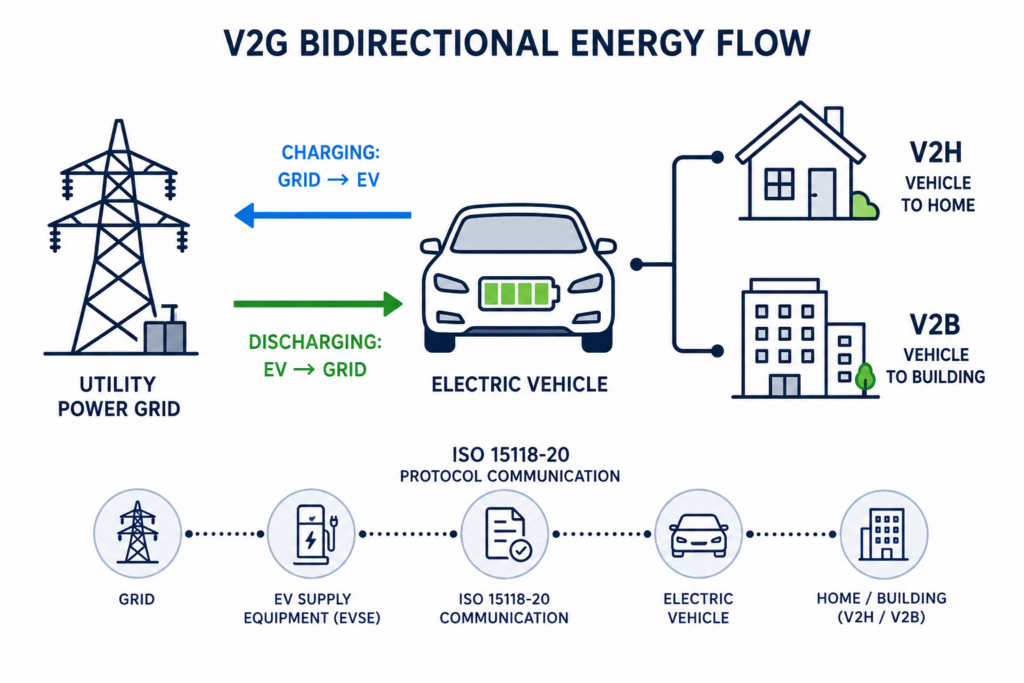
In standard (unidirectional) EV charging, power flows in one direction only: grid AC → charger electronics → battery DC. V2G reverses this flow on demand.
The bidirectional charger contains a four-quadrant inverter capable of both AC-to-DC conversion (charging) and DC-to-AC inversion (export). When the grid operator or energy management system signals a discharge event, the charger draws DC from the vehicle battery, inverts it to AC matching the grid’s voltage and frequency, and exports it to the grid — or building, or home — depending on the application.
The entire process is governed by the communication protocol negotiated between the vehicle and the charger at plug-in. The vehicle’s Battery Management System (BMS) continuously reports state of charge, temperature, and maximum discharge limits. The charger respects these limits — the driver always retains control over minimum battery reserve (e.g., “never discharge below 30%”).
Technical Requirements
V2G requires the simultaneous alignment of five independent components. A gap in any one of them prevents the system from working — which is a key reason V2G has been slow to reach mainstream deployment.
V2G-capable EV
The vehicle must have a bidirectional onboard charger (OBC) or DC-coupled battery architecture that supports energy export. Most EVs currently are unidirectional-only. V2G capability must be present in the vehicle hardware and enabled by the OEM. A software-only update cannot add V2G to hardware that was not designed for it.
Bidirectional EVSE (charger)
The charging station must contain four-quadrant power electronics capable of both AC→DC and DC→AC conversion. Standard Level 2 AC chargers and most current DC fast chargers are unidirectional only. Bidirectional DC chargers include Wallbox Quasar 2, Fermata FE-20, and emerging commercial units. Bidirectional AC chargers (for V2H) include Ford Charge Station Pro and select OEM-specific units.
Communication protocol
The vehicle and charger must negotiate bidirectional power transfer parameters using a compatible protocol: ISO 15118-20 (for CCS / NACS / ChaoJi systems) or CHAdeMO protocol (for legacy CHAdeMO systems, which natively supported V2G from version 1.x). ISO 15118-20 was published in April 2022 and defines the full communication interface for AC and DC bidirectional power transfer.[1]
Grid interconnection compliance
For energy export to the utility grid, the system must comply with applicable grid interconnection standards: IEEE 1547 (US, distributed energy resource interconnection), IEC 61727 (international), or country-specific grid codes. Anti-islanding protection is mandatory — the system must disconnect immediately if grid power is lost, to protect line workers.
Utility agreement or aggregator program
Full V2G — with compensation for exported energy — requires an agreement with the local utility or participation in an aggregated V2G program via an energy services company. Without this, the vehicle can discharge (V2H, V2B) but cannot receive payment for grid exports. Regulatory frameworks vary significantly by country and US state.
Communication Protocols for Bidirectional Charging
| Protocol | Used With | V2G Support | Key Notes |
|---|---|---|---|
| ISO 15118-20 | CCS1/CCS2, NACS/J3400, ChaoJi | ✓ Full — AC BPT + DC BPT | Published April 2022. Defines bidirectional power transfer (BPT) for both AC and DC. Required for OCPP 2.1 V2G support. The primary pathway for mainstream V2G on CCS/NACS hardware.[1] |
| ISO 15118-2 | CCS1/CCS2, NACS/J3400 | ~ Basic relay only | Covers Plug & Charge and basic power negotiation. Does not specify bidirectional power transfer — that is ISO 15118-20’s domain. OCPP 2.0.1 supports 15118-2; full V2G requires OCPP 2.1 + 15118-20. |
| CHAdeMO protocol | CHAdeMO / ChaoJi connectors | ✓ Native — from version 1.x | CHAdeMO has supported V2G natively from its earliest versions — a key differentiator over CCS/NACS. The Nissan Leaf (CHAdeMO) has been used in V2G deployments since 2018. CHAdeMO 2.0 supports up to 400 kW; ChaoJi targets 900 kW with V2G.[2] |
| OCPP 2.1 (Bidirectional Block) | CSMS-to-charger layer | ✓ New functional block | Released January 2025. Adds a dedicated bidirectional charging functional block that enables CSMS to command V2G dispatch, DER control, and ISO 15118-20 communication relay. Required for network-level V2G management at scale.[3] |
V2G-Compatible Vehicles (2025–2026)
As of mid-2026, the list of vehicles with demonstrated V2G or V2H capability is still limited — but growing rapidly. The distinction between V2G (grid export), V2H (home backup), and V2L (portable power) is critical when evaluating a vehicle’s bidirectional capability.
| Vehicle | V2L | V2H | V2G | Protocol / Connector | Max Export |
|---|---|---|---|---|---|
| Nissan Leaf (all generations) | — | ✓ | ✓ Commercial | CHAdeMO protocol | 6 kW (V2H) / up to 50 kW (V2G with DC charger) |
| Ford F-150 Lightning | ✓ 9.6 kW | ✓ (Ford Charge Station Pro) | ✓ Via Sunrun integration[4] | CCS1 / Ford proprietary | 9.6 kW (V2H); expanding to V2G |
| Hyundai Ioniq 5 / 6 | ✓ 3.6 kW | ✓ Select markets | ~ Pilots underway | CCS2 / ISO 15118 | 3.6 kW V2L; V2H up to ~7 kW |
| Kia EV9 | ✓ | ✓ | ✓ With Wallbox Quasar 2[4] | CCS / ISO 15118 | V2H up to ~9 kW |
| Volkswagen ID.4 / ID.Buzz | — | ✓ Select markets (77 kWh) | ~ ISO 15118 rollout | CCS2 / ISO 15118-20 | V2H capable in EU markets |
| Volvo EX90 | — | ✓ Standard from 2025 | ~ ISO 15118-20 ready | CCS2 / ISO 15118-20 | V2H standard; V2G via software[5] |
| BYD Dolphin (UK) | ✓ | ✓ | ✓ Octopus Energy bundle[6] | CCS2 / ISO 15118 | V2G enabled via Zaptec charger |
| Tesla Cybertruck | ✓ | ✓ PowerShare | ✗ V2H only currently | NACS / J3400 | 11.5 kW (V2H via PowerShare) |
| GM (Silverado EV, Blazer EV) | — | ✓ GM Energy hardware | ~ Select pilots | CCS1 / Ultium platform | V2H via GM Energy PowerShift Charger |
| Tesla Model 3/Y/S/X | — | ✗ No official support | ✗ No official support | NACS / J3400 | — |
Many vehicles listed above support V2H (home backup) but not V2G (grid export). These are different capabilities. V2H is typically a one-way arrangement with no utility agreement or compensation. Full V2G — where energy is exported to the grid and the owner is compensated — requires a utility program, compatible hardware, and a supported protocol. Always verify which mode a specific vehicle/charger combination supports before assuming V2G capability.
Grid Services V2G Can Provide
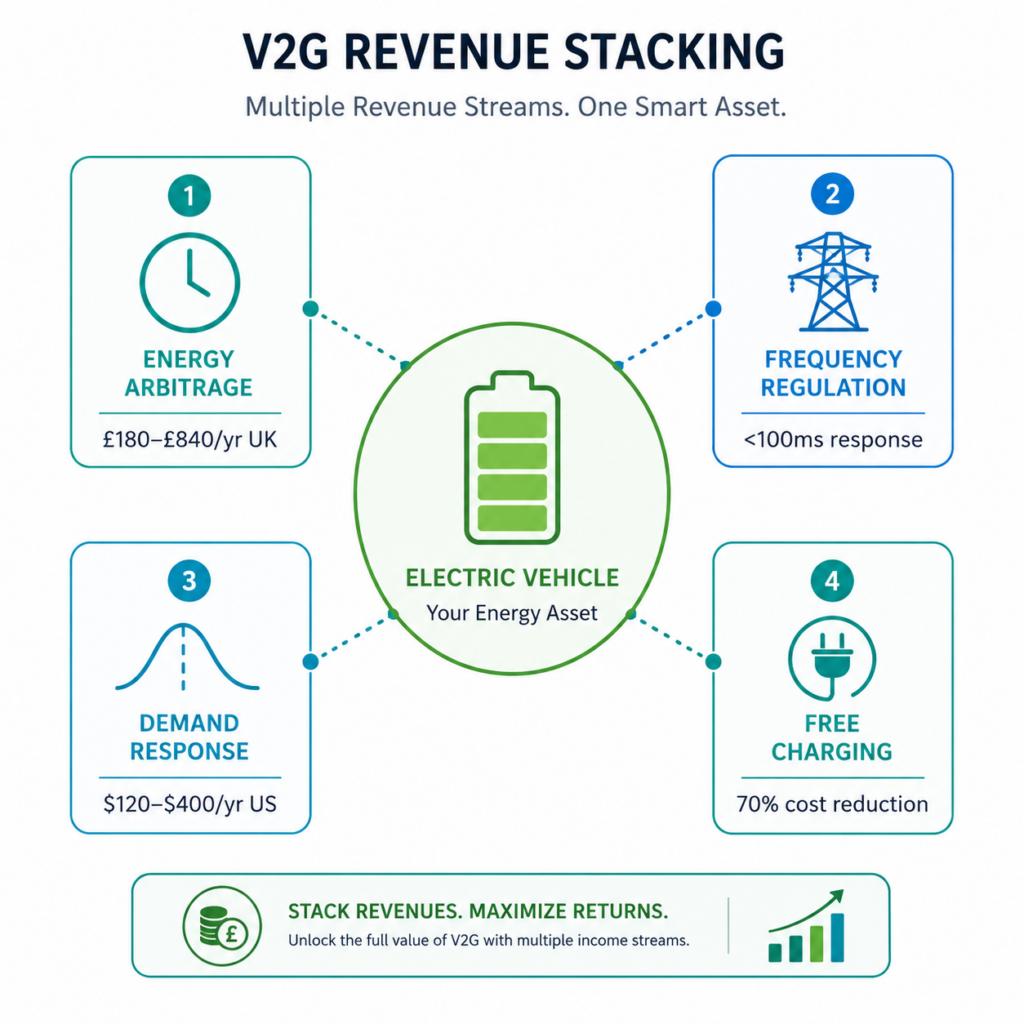
An EV connected via V2G is, from the grid operator’s perspective, a controllable distributed energy resource (DER). Depending on the power level, response time, and aggregation scale, V2G-capable fleets can participate in multiple grid services markets simultaneously — a strategy known as value stacking.
| Grid Service | Description | Response Requirement | V2G Advantage |
|---|---|---|---|
| Frequency Regulation | Inject or absorb power to maintain grid frequency (60 Hz / 50 Hz) within tolerance | <4 seconds (FCR); <30 seconds (FRR) | EV batteries respond in <100 ms — far faster than gas turbines or hydro |
| Demand Response | Reduce or shift load on utility request during peak demand events | <10 minutes | Controllable load that can reduce draw or export energy; compensation via DR programs |
| Energy Arbitrage | Charge during low-price periods (off-peak, solar surplus); discharge during high-price periods | Hours-scale optimization | Revenue depends on price spread and battery size; requires time-of-use tariff |
| Spinning Reserve / Capacity | Standby power held ready for sudden generation loss | <10 minutes to full output | Aggregated EV fleet can provide guaranteed MW of backup capacity |
| Voltage Support | Reactive power injection to maintain distribution voltage levels | <1 second | Modern bidirectional inverters can provide reactive power without discharging battery |
| Renewable Firming | Store solar/wind surplus during generation peaks; release during generation troughs | Minutes-to-hours | Aggregated EV fleet effectively acts as distributed battery storage for renewable integration |
Revenue & Economic Potential
V2G economics depend heavily on local electricity market structures, tariff designs, and whether grid services participation is available. The numbers below reflect early commercial deployments — not theoretical projections.

UK: The Most Advanced Commercial V2G Market
The UK has emerged as the most commercially mature V2G market globally, driven by high electricity price volatility, a liberalized energy market, and active utility participation.
| Program / Offering | Provider | Details |
|---|---|---|
| Power Pack tariff | Octopus Energy (launched Feb 2024) | UK’s first mass-market V2G tariff. Provides free EV charging for owners who plug in ~6 hours/day. Octopus uses the vehicle battery for energy arbitrage during high-price periods. Participants can save up to £180/year vs. smart TOU charging, or up to £840/year vs. unmanaged flat-rate charging (10,000 miles/year assumption).[10] |
| BYD Dolphin V2G bundle | Octopus Energy + BYD + Zaptec (June 2025) | UK’s first complete V2G product bundle: BYD Dolphin + Zaptec bidirectional wallbox + Octopus smart tariff. Combined in a single commercial offer.[6] |
| Large-scale V2G trial | OVO Energy / Nissan / Kaluza (2018–2022) | The largest domestic V2G trial to date at the time. Demonstrated benefits for both customers and the grid. OVO has since continued with commercial V2G programs.[8] |
“EV drivers using Vehicle-to-Grid technology could slash their annual charging costs by as much as 70% while potentially earning an additional £320 per year by 2030.”— Cornwall Insight analysis, cited in UK market research, October 2025[11]
Revenue Ranges by Market Segment
| Segment | Revenue Mechanism | Approximate Annual Range | Caveats |
|---|---|---|---|
| Residential (UK, EU) | Energy arbitrage + free charging | £320–£840 / year[10][11] | Requires CHAdeMO or CCS V2G hardware; plug-in time discipline required |
| Residential (US, basic DR) | Demand response credits | $120–$400 / year[12] | Highly program-dependent; utility participation varies by state |
| Residential (US, premium capacity markets) | Capacity + frequency regulation | Up to $9,000 / year[12] | Requires access to wholesale capacity markets; not available in most states |
| Commercial fleet (UK) | Frequency regulation + arbitrage | £320+/vehicle/year by 2030 (projected)[11] | Larger aggregated capacity; more consistent plug-in patterns; better economics |
Commercial Deployment Status (2025–2026)
V2G has transitioned from laboratory trials to early commercial deployment in a small number of markets. The pace of deployment varies dramatically by country, driven by utility market structure, regulatory framework, and available hardware.
| Market | Status | Key Players / Programs |
|---|---|---|
| United Kingdom | Most advanced globally. Commercial V2G tariffs live since early 2024. | Octopus Energy Power Pack (mass-market launch Feb 2024); OVO Energy; Kaluza aggregation platform; Nissan/CHAdeMO vehicles dominant in early deployments |
| Netherlands | Commercial pilots and regulated V2G programs active | Hyundai Ioniq 5 pilots via ISO 15118; energy utility partnerships; progressive regulatory framework for DER compensation |
| Japan | Mature CHAdeMO V2G ecosystem; V2H widely deployed | Nissan Leaf V2G/V2H widespread; Mitsubishi PHEV V2H; V2G electricity trading via smart aggregators; expanding with ChaoJi |
| United States | V2H commercially available; V2G in utility pilots | Ford F-150 Lightning + Sunrun (V2G); Kia EV9 + Wallbox Quasar 2 (V2G); GM Energy (V2H); state-level utility programs (California, New York most active) |
| Germany | Pilot stage; regulatory framework developing | Volkswagen V2H pilots; The Mobility House aggregation; regulatory work on feed-in compensation for EVs ongoing |
| China | V2G trials via GB/T; growing rapidly with BYD | BYD vehicles with bidirectional capability; State Grid Corporation V2G pilot projects; ChaoJi as next-gen V2G standard |
Milestone: Octopus + BYD, June 2025In June 2025, Octopus Energy launched the UK’s first complete V2G product bundle — combining the BYD Dolphin EV, a Zaptec bidirectional wallbox, and Octopus’s smart tariff into one consumer package. This marked the first time a major energy retailer offered a fully integrated V2G product to mainstream consumers, not just trial participants.[6]
Barriers to Broader Adoption
| Barrier | Current Status |
|---|---|
| Limited V2G-capable vehicle supply | Most EVs sold through 2024 are unidirectional. OEM adoption of bidirectional OBCs is accelerating but still a minority of the market. Volvo’s commitment to make all future platforms bidirectional-capable is a significant signal.[5] |
| Hardware cost | Complete bidirectional charging systems (vehicle inlet + charger + home integration) range from $5,000–$15,000 installed, compared to $500–$2,000 for standard Level 2 chargers. Cost is declining but remains a barrier for mass adoption.[12] |
| Battery degradation concern | Frequent deep V2G cycling can accelerate capacity fade, particularly in NMC batteries. LFP batteries are significantly more tolerant of deep discharge cycles. Degradation impact is manageable with smart BMS control (limiting depth of discharge, temperature management) but requires careful operator education. Most programs set floor limits (e.g., never below 20–30% SoC). |
| Regulatory fragmentation | V2G compensation frameworks (how utilities pay for exported energy) vary widely — even within the US, state utility commission rules differ substantially. Many jurisdictions have no clear mechanism for residential grid export compensation. EU AFIR and emerging smart charging regulations are creating a more coherent framework in Europe. |
| Connector/protocol fragmentation | CHAdeMO vehicles (Nissan Leaf) had native V2G from early; CCS/NACS vehicles are now gaining V2G capability via ISO 15118-20, but deployment is still limited. A driver needs a charger compatible with their specific vehicle protocol — cross-compatibility is not yet guaranteed. |
| OEM warranty concerns | Some OEMs restrict or void battery warranties for V2G use. This is improving as V2G becomes part of OEM-designed products (Ford, Kia, Volvo now design V2G in from the start rather than as an afterthought), but older vehicles may face warranty limitations. |
🔌 JointCharging ContextJointCharging’s EVD series DC fast chargers are designed with V2G-readiness in mind. The platform supports OCPP 2.1‘s bidirectional charging functional block and is preparing ISO 15118-20 support in line with market deployment timelines. As V2G regulations mature in EU, UK, and US markets — and as compatible vehicles become more prevalent — JointCharging’s hardware stack is positioned to support fleet V2G programs without hardware replacement. V2G-capable DC chargers are increasingly integrated alongside BESS in JointCharging’s PV+ESS+EVSE deployments, creating site-level energy systems where EV batteries, stationary storage, and solar generation are optimized together.
See Also
- EV Charging Glossary
- CPO (Charge Point Operator)
- DC fast charging (DCFC)
- Open Charge Point Protocol (OCPP)
- Battery Energy Storage System (BESS)
Sources & References
- [1] ISO 15118-20:2022, “Road vehicles — Vehicle to grid communication interface — Part 20: 2nd generation network layer and application layer requirements.” Published April 2022. Defines bidirectional power transfer (BPT) for both AC and DC. ISO 15118-20
- [2] CHAdeMO Association: CHAdeMO 2.0 enables V2G up to 400 kW (400A × 1,000V); CHAdeMO 3.0 / ChaoJi targets 900 kW with V2G. Native V2G from version 1.x. chademo.com
- [3] Open Charge Alliance, “OCPP 2.1 — New functional block on bidirectional charging; ISO 15118-20 support,” released January 23, 2025. openchargealliance.org
- [4] bidirectional.energy, “What Cars Support V2G?”: Ford F-150 Lightning with Ford Charge Station Pro + Sunrun (V2G); Kia EV9 with Wallbox Quasar 2 (V2G) available in US. bidirectional.energy
- [5] TMH Energy / Mobility House, “Which Cars Are V2G Capable? 2026 Guide”: “Volvo has announced that all new platforms will be bidirectional-capable. The Volvo EX90 will be delivered from 2025 with V2H functions as standard.” mobilityhouse-energy.com
- [6] Kings Research / Market data: “In June 2025, Octopus Energy partnered with BYD to launch the UK’s first vehicle to grid bundle, combining a V2G-capable BYD Dolphin, bidirectional charger, and smart energy tariff.” kingsresearch.com
- [7] UK V2G Market Report: “EV owners can earn £400–£800 annually through grid services” via Octopus Energy and OVO Energy commercial programs. marksparksolutions.com
- [8] Smart Energy International, “Opportunities and barriers for unlocking V2G” (May 2024): “Research by Kaluza found V2G could realise up to £3.5 billion of grid investment savings per year in the UK.” Cites 2018 Nissan/OVO/Kaluza/Cenex trial. smart-energy.com
- [9] Astute Analytica / GlobeNewswire, December 2025: “The global vehicle to grid market was valued at US$6.27 billion in 2025 and is expected to reach US$65.84 billion by 2035, growing at a CAGR of 26.50%.” globenewswire.com
- [10] Octopus Energy Powerloop trial data / uSwitch: “Participants could save up to £180 per year compared to standard smart charging on a TOU tariff, or up to £840 per year compared to unmanaged flat-rate charging (10,000 miles/year).” Octopus Power Pack launched February 2024. uswitch.com
- [11] Sustainable Times / Cornwall Insight analysis, October 2025: “EV drivers using V2G technology could slash annual charging costs by as much as 70% while potentially earning an additional £320 per year by 2030.” sustainabletimes.co.uk
- [12] SolarTechOnline / bidirectional.energy: “V2G revenue ranges from $120–$400 for basic demand response to up to $9,000 for premium capacity programs. Complete systems range from $5,000–$15,000 including equipment and installation.” solartechonline.com
