
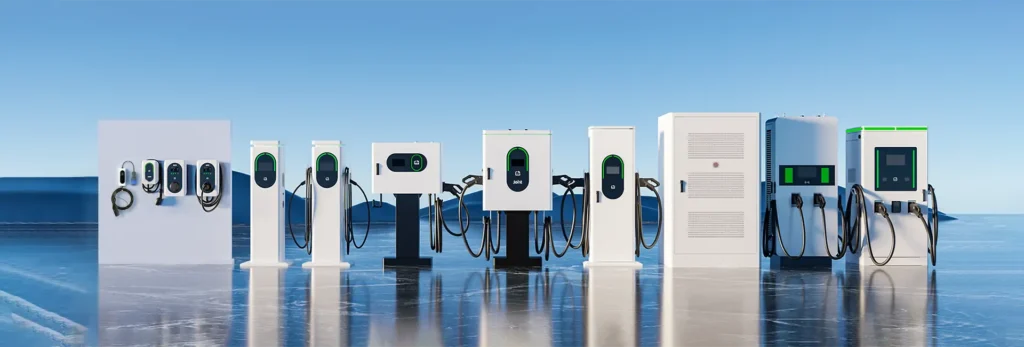
The global electric mobility chargers market was valued at $18.13 billion in 2025 and is projected to reach $59.96 billion by 2030—a compound annual growth rate of 26.9%.Within this, the smart EV charger segment alone grew from $7.34 billion in 2025 to $9.19 billion in 2026, a 25.2% increase, with forecasts reaching $22.45 billion by 2030
These are not speculative numbers. They reflect real demand driven by government mandates, fleet electrification, and consumer adoption of EVs. For businesses, this market growth creates an opportunity: Build an EV charger brand your own.
“I don’t manufacture EV chargers. Can I still build my own brand?”
Sure, it’s called “private label EV charger“—sourcing chargers from a manufacturer and selling them under your own brand.
Whether you are a distributor looking to launch your own line, an electrical equipment company expanding your portfolio, an e-commerce seller entering a new category, or an installer wanting to offer a turnkey solution under your own brand, this guide will help you know how to build an EV charger brand without manufacturing in 2026.
Table of Contents
TL;DR — Key Points
- Private label models: white label (fastest), ODM (most common for brand builders), and OEM (for companies with R&D capacity).
- The EV charger market is growing at ~25% CAGR — but brand differentiation matters more than price as the market matures.
- You can customize hardware, firmware, packaging, and accessories — but safety-critical components are locked for certification reasons.
- AC charger white-label MOQ typically starts at 300 units; DC chargers can start from 1 unit on project-driven orders.
- Certification strategy (shared, transferred, or fresh) depends on your target market and customization depth.
- Choosing the right manufacturing partner is the single most important decision.
Already clear on the market opportunity but unsure how to position your brand against competitors? See our EV charger brand positioning guide — how to stand out in a crowded market before you commit to a product direction.
What Is a Private Label EV Charger — and Why It’s Not the Same as OEM or ODM?
A private label EV charger is any charger manufactured by a third party and sold under your brand name. That’s the short answer. The longer answer is that “private label” is an umbrella term covering three different manufacturing arrangements, each with its own cost structure, customization depth, and IP implications.
The three models — white label, ODM, and OEM — are often used interchangeably online, but they mean different things and lead to very different business outcomes. Here’s the distinction:
- White label: You take an existing, off-the-shelf charger and add your logo and colors. No structural changes. Fastest to market, lowest cost, least differentiation.
- ODM (Original Design Manufacturer): The manufacturer has a proven hardware platform. You customize it — enclosure design, firmware interface, packaging, accessories — within that platform’s architecture. Most brand builders choose this path.
- OEM (Original Equipment Manufacturer): You own the design. You bring the engineering specs; the manufacturer builds to those specs. You own the IP. Highest control, highest cost, longest timeline.
| Dimension | White Label | ODM | OEM |
|---|---|---|---|
| Customization depth | Logo + color only | Enclosure, firmware, packaging | Full design control |
| Time to market | 4–8 weeks | 12–20 weeks | 18–36 months |
| NRE / tooling cost | USD 0 | USD 3,000–15,000 | USD 50,000–200,000+ |
| IP ownership | Manufacturer owns | Shared / negotiated | Brand owner |
| MOQ (AC charger) | 300 units | 50–200 units | 500+ units |
| Best for | Fast market entry, distributors, e-commerce | Brand builders wanting differentiation | Automakers, large electrical OEMs |
For a deeper look at how these three models compare across more dimensions, see our complete white label vs ODM vs OEM EV charger comparison.
Is There Still a Market Opportunity for New EV Charger Brands in 2026?
Yes — but the window for undifferentiated entry is closing. The market is large enough for new brands, but growing fast enough that buyers are becoming more selective. Here’s what the numbers show:
The EV charging infrastructure market was valued at USD 40.2 billion in 2025 and is projected to grow at a CAGR of 25–27% through 2033, reaching between USD 238 billion and USD 457 billion depending on the forecast model (Grand View Research; Precedence Research, 2026). That’s not a niche — it’s one of the fastest-growing infrastructure categories globally.
Three structural reasons why new private label brands still win
- Regional distribution gaps. Global brands don’t serve every channel. Distributors in Southeast Asia, the Middle East, and Eastern Europe are actively looking for manufacturers who can serve their markets with local certifications and local support.
- Price isn’t the only lever. As the market matures, buyers are paying a premium for brands that offer recognizable design, responsive after-sales support, and consistent quality — not just the lowest unit price.
- NEVI and AFIR are creating new demand. US federal NEVI funding (driveelectric.gov) and Europe’s AFIR mandate (EU Commission) are forcing rapid infrastructure deployment — and procurement officers often prefer to work with established brands, not anonymous manufacturers.
For a detailed breakdown of market segments, growth by region, and where private label brands are taking share, see our EV charger private label market analysis.
Business Models to Consider Before Building Your EV Charger Brand
Before choosing a manufacturing model, choose a revenue model. The two decisions are connected — and most brand builders get the order wrong. They pick ODM first, then realize the revenue model they want requires a different product architecture.
There are three primary revenue models for EV charger brands:
1. Hardware Sales
You sell chargers to distributors, installers, or end buyers at a margin. The simplest model. Margin depends entirely on how much you can differentiate — a white-label product competes on price; an ODM product with strong design and brand recognition commands 15–35% higher ASPs. This model works best for distributors and e-commerce operators who already have a sales channel.
2. Hardware + Software (SaaS)
You sell the charger and charge a monthly fee for the management platform — access control, energy reporting, billing, remote diagnostics. This model requires OCPP-compliant chargers with a CSMS (Charge Station Management System) integration, but it dramatically improves customer retention and lifetime value. CPOs and fleet operators increasingly expect this bundled offering.
3. Full Turnkey Solution
You supply charger + software + installation + maintenance under a single contract. This model has the highest margin and the highest barrier to entry. It works for installers and system integrators who are already close to the end customer and can control the full deployment.
| Revenue Model | Who It Suits | Margin Profile | Requires |
|---|---|---|---|
| Hardware sales | Distributors, e-commerce brands | 10–30% gross margin | Competitive product, distribution channel |
| Hardware + SaaS | CPO-focused brands, fleet solutions | 25–45% blended margin | OCPP-compliant charger, software platform |
| Turnkey solution | Installers, system integrators | 35–55% project margin | Installation capability, service contracts |
The decision that follows: if you’re building a hardware-only brand, white label or basic ODM is fine. If you want SaaS revenue or turnkey positioning, you need a charger with open OCPP compliance and API access — which narrows your manufacturer shortlist considerably.
White Label, ODM, or OEM — Which Brand Model Fits Your Business?
For most companies entering the EV charger market without an engineering team, ODM is the right starting point. White label gets you to market fastest but leaves you undifferentiated. OEM gives full control but requires 18–36 months and significant upfront investment. ODM sits in the middle: you get a battle-tested hardware platform, customized to your brand, with a realistic 12–20 week timeline.
That said, the right answer depends on four variables:
- Technical capacity: Do you have engineers who can write firmware or review hardware schematics? If not, white label or ODM. If yes, ODM or OEM.
- Budget: OEM tooling alone can run USD 50,000–200,000 before a single unit ships. White label requires no NRE. ODM sits between USD 3,000 and 15,000 in tooling costs.
- Time: Need to launch in 8 weeks? White label. Can invest 6 months in product development? ODM. Willing to wait 2+ years? OEM.
- Differentiation goal: Competing on price? White label. Competing on brand and design? ODM. Building a proprietary platform with full IP ownership? OEM.
See our full EV charger customization options guide to understand exactly what you can and cannot change under each model before committing to a path.
What Can You Actually Customize on a Private Label EV Charger?
More than most buyers expect — but not everything. Customization on an ODM EV charger works in four layers, and the depth of each layer affects your tooling cost and timeline.
Layer 1 — Hardware (Enclosure & Industrial Design)
- Enclosure color (RAL matching or custom CMF specification)
- Logo placement: embossed, debossed, screen-printed, or backlit
- Cable color and length
- LED indicator style and breathing light pattern
- Display screen size and position (on models that support screens)
- Mounting bracket and pedestal design
Layer 2 — Firmware & Software
- User interface language and screen layout
- Branded mobile app (white-label app wrapper)
- OCPP backend URL (point your charger to your own or a third-party CSMS)
- Payment gateway integration (NFC, QR code, credit card reader)
- Load management parameters and RFID access rules
Layer 3 — Packaging
- Box artwork, color, and logo
- User manual design and language
- Brand insert cards and QR code stickers
- Packaging must meet ISTA 6-Amazon standards if you’re selling through e-commerce channels
Layer 4 — Accessories
- Holster design and cable management
- Protective cover style
- Installation hardware kit branding
What you cannot customize: The internal power electronics, safety relay, and earth fault protection circuitry are fixed. These components have been tested and certified as a system — any modification would invalidate the certification and require a full re-test.
JointCharging’s award-winning EVM002 (Red Dot Award 2025) is an example of what’s possible with deep ODM customization: custom CMF finish, branded LED breathing light, and full firmware white-labeling — all delivered with existing CE and ETL certification intact.
For cost breakdowns and MOQ implications per customization layer, see our EV charger customization options guide.
EV Charger Certifications for Private Label Brands: What You Need and What You Can Share
Certification is the single most common thing that delays a private label launch — and it doesn’t have to be. Most buyers assume they need to get their own certification from scratch. In reality, you have three options, and two of them don’t require starting from zero.
Option 1 — Share the Manufacturer’s Certification
If your customization is cosmetic only (logo, color), the existing certification typically covers your branded product. The charger is physically the same unit — only the branding has changed. This works for white-label programs where the manufacturer holds the CE marking or ETL certification and grants you permission to use their mark.
Limitation: You don’t own the certification. If you switch manufacturers, you lose it.
Option 2 — Certification Transfer
The manufacturer transfers the certificate to your company name. You become the certificate holder. This requires the certifying body (Intertek, SGS, UL) to conduct a brand change review — typically 2–4 weeks and USD 1,000–3,000. This is the most common path for ODM programs where the hardware is unchanged but the brand owner wants to hold their own certification.
Option 3 — Fresh Certification
If your ODM program involves hardware changes — new enclosure, new display, new cable management — the existing certification may not cover the modified product. You’ll need a new test report for the changed components. This is a partial re-test, not a full re-test, if the power electronics are unchanged. Cost and timeline depend on how much has changed.
| Market | Required Certifications | Optional / Beneficial | Typical Cost Range |
|---|---|---|---|
| North America | ETL or UL 2202, FCC/IC | ENERGY STAR, CTEP | USD 15,000–60,000 |
| Europe | CE (LVD + EMC + RED) | UKCA (UK), MID | USD 8,000–40,000 |
| Southeast Asia | SG TR25, MY SIRIM, TH PEA/MEA (by country) | — | Varies by market |
| Global interoperability | OCPP 2.0.1 OCA certification | ISO 15118 Plug & Charge | Included in product |
JointCharging operates an accredited satellite testing lab in partnership with Intertek and SGS, and holds China’s first ETL certification covering both AC and DC commercial chargers. OCPP 2.0.1 compliance is verified by the Open Charge Alliance (OCA).
For a full breakdown of certification strategies by market, see our EV charger certification strategy guide for private label brands.
MOQ, Cost, and Lead Time — The Real Numbers Behind Each Brand Model
The three questions every buyer asks first — and rarely gets a straight answer on. Here are the real numbers, without the usual “contact us for pricing” deflection.
Minimum Order Quantities
- AC charger white label: 300 units minimum per SKU
- AC charger ODM: 50–200 units for first order (tooling amortization affects this)
- DC charger: From 1 unit on project-driven orders — DC procurement is typically project-by-project, not stock-based
- Annual framework agreements: Available for buyers committing to 1,000+ units per year across AC or DC lines
Cost Components
Unit price is the smallest variable. The real cost of launching a private label brand includes:
- Unit cost: Varies by model, power level, and customization depth — get a formal quote; avoid ballpark figures
- NRE / tooling fees: USD 3,000–15,000 for ODM (mold, tooling, firmware customization); USD 50,000–200,000+ for OEM from scratch
- Certification: USD 8,000–60,000 depending on market and whether you’re sharing, transferring, or filing fresh
- First inventory: MOQ × unit cost — plan for 90 days of working capital
- Logistics: Sea freight typically USD 200–600 per unit depending on charger size and route
Lead Times
| Stage | White Label | ODM | OEM |
|---|---|---|---|
| Design confirmation | 1–2 weeks | 2–4 weeks | 8–16 weeks |
| Tooling / sample production | — | 4–8 weeks | 12–20 weeks |
| Sample approval | 1–2 weeks | 2–3 weeks | 4–8 weeks |
| Mass production | 3–4 weeks | 4–6 weeks | 6–10 weeks |
| Total (ex-factory) | 4–8 weeks | 12–20 weeks | 30–54 weeks |
For a full cost model including working capital requirements and first-year budget planning, see our EV charger ODM MOQ, cost, and lead time breakdown.
Important: NRE (Non-Recurring Engineering) fees are a one-time charge. They do not recur on subsequent orders of the same SKU. Factor them into your cost-per-unit calculation across the full production run, not just the first order.
Which Market Should Your Private Label EV Charger Brand Target First?
Market selection determines your certification requirements, your product spec, and your competitive landscape — in that order. Get this wrong and you’ll spend money on certifications for a market you can’t reach, or spec a product that doesn’t meet local connector standards.
North America
High margins, aggressive NEVI funding (USD 5 billion committed), and a buyer base that’s increasingly sophisticated. Requirements: ETL or UL 2202 for the charger, FCC/IC for wireless components, and NACS connector support for new deployments. Competition is intense in the CPO segment but wide open in the commercial property and fleet segments.
Europe
CE marking is mandatory. AFIR regulation mandates high-power charging stations every 60 km along major highways by 2025 — and that deadline has created a procurement wave that’s still running (EU Commission, AFIR). CCS2 connector is standard. Type 2 for AC. UK requires UKCA post-Brexit. Competition: high in Western Europe, lower in Eastern Europe and Nordics.
Southeast Asia
Fastest-growing market for new brands. Lower certification barrier (country-by-country, no single regional standard like CE). Singapore, Malaysia, Thailand, and Indonesia are all deploying charging infrastructure at pace. Competition from established brands is lower here than in North America or Europe. Connector standard varies — do your homework per country.
Middle East & Africa
Early-mover advantage is real. Saudi Arabia, UAE, and South Africa are investing in EV infrastructure ahead of EV adoption curves. Certification requirements are typically CE or CB scheme. Very low competition from established Western brands. The catch: volumes per project are smaller, so unit economics need to work at lower MOQ.
| Market | Cert Barrier | Competition | Growth Rate | Best For |
|---|---|---|---|---|
| North America | High | High | Very high | Brands with ETL and NACS capability |
| Europe | Medium–High | High (West), Medium (East) | High | Brands targeting fleet / commercial property |
| Southeast Asia | Low–Medium | Low–Medium | Very high | New brands wanting fast market entry |
| Middle East / Africa | Low | Low | High | Early movers willing to work with smaller volumes |
For a full decision framework including how your market choice determines your product spec, see our EV charger private label market selection guide.
How to Choose the Right EV Charger Manufacturing Partner
This is the decision that determines everything else. A weak manufacturer means late deliveries, inconsistent quality, certification problems, and after-sales headaches your customers blame on your brand — not theirs. Here are the eight criteria that separate reliable partners from risky ones.
Product certifications
Verified, not claimed. Ask for the actual certificate number and verify it on the certifying body’s public database. ETL certificates are verifiable at Intertek’s database. CE declarations of conformity should be available on request. OCPP certification is listed on the OCA website.
OCPP compliance
Demonstrate it, don’t just claim it. Ask the manufacturer to show you a live OCPP connection to a third-party CSMS. If they can’t demo it in 30 minutes, it’s not production-ready.
Quality control process.
A serious manufacturer runs IQC, IPQC, and FCT on every unit, plus a minimum 48-hour burn-in test before shipment. Ask them to walk you through their QC flowchart.
Production capacity and OTD record.
What’s their annual capacity? What percentage of orders ship on time? Ask for data, not assurances.
R&D capability.
Do they have engineers who can support firmware updates and product iterations? A factory that only assembles is a dead end when you need to evolve your product.
After-sales support structure.
Who handles warranty claims? What’s the RMA process? Do they stock spare parts? For chargers deployed in the field, after-sales responsiveness is a brand reputation issue.
Reference customers — with verifiable deployments.
Ask for 2–3 customers who have been running their products in the field for at least 12 months. Call them. Ask about fault rates and support response times.
Factory openness.
Will they let you visit — in person or virtually? A manufacturer who resists a factory tour has something to hide.
Red flags that mean walk away: can’t produce a certificate number; refuses to demo OCPP live; no reference customers with operational deployments; price is 30%+ below market with no explanation; changes payment terms after you’ve started the process.
For a complete supplier evaluation framework including a downloadable scorecard, see our guide on how to choose an EV charger OEM/ODM manufacturing partner. For an even deeper evaluation methodology covering factory audits, contract negotiation, and first-order inspection, see our complete EV charger supplier evaluation framework.
Is Building a Private Label EV Charger Brand Worth the Investment?
It depends on your revenue model, your market, and how seriously you approach the product. Here’s an honest look at the economics.
Where the money comes from
A private label EV charger brand earns more than a plain distributor because you control the brand relationship with the end buyer. That brand equity compounds — customers who trust your brand reorder, refer others, and are less price-sensitive. A distributor selling someone else’s brand has none of that.
Gross margin on branded hardware typically runs 20–35% at scale, compared to 8–15% for pure distribution. If you add a SaaS software layer, blended margins can reach 35–50%.
The three cost phases
- Launch phase (Year 1): NRE fees + certification + first inventory + logistics + marketing. Expect USD 80,000–250,000 depending on model choice and target market.
- Scale phase (Years 2–3): Inventory carrying cost, after-sales setup, potential second certification for a new market. Cost as a percentage of revenue drops sharply here.
- Sustain phase (Years 4–5): Product refresh cycle, firmware updates, expanded SKU range. Main cost is opportunity cost — do you invest in new markets or deeper penetration of existing ones?
When it doesn’t make sense
Building a private label brand is the wrong move if: you’re testing demand with fewer than 100 units; you need revenue in 4 weeks; you don’t have a distribution channel ready to receive branded inventory; or your target customer doesn’t care about the brand on the box (some fleet and government procurement is purely spec-driven).
For a full 5-year financial model with conservative and optimistic scenarios, see our private label EV charger brand 5-year ROI model.
The ODM Order Process: From First Inquiry to First Shipment
The process has six stages. Knowing them in advance prevents the two most common mistakes: paying tooling fees before specs are confirmed, and expecting mass production quality from a first sample.
- Initial inquiry + NDA (Week 1–2). Share your requirements — target market, power level, connector type, customization scope, volume forecast. Sign an NDA before sharing anything proprietary. Get a ballpark quote and a timeline estimate.
- Quotation + specification confirmation (Week 2–4). Review the detailed quote line by line: unit price, NRE fees, certification scope, packaging cost, lead time. Confirm the technical specification sheet before paying anything.
- Tooling + sample production (Week 4–12). NRE fees are paid here. Molds and firmware customizations are built. First samples (typically 3–5 units) are shipped for your review and approval.
- Certification filing (Parallel to sampling). If you’re filing for certification transfer or fresh testing, this runs in parallel with sampling to avoid adding weeks to the timeline. Don’t wait for samples to arrive before starting cert paperwork.
- Mass production + QC (Week 12–18 for ODM). After sample approval, mass production begins. Each unit goes through IQC, IPQC, FCT, and a 48-hour burn-in test. Request a pre-shipment inspection report.
- Shipping + customs clearance (Week 18–22). Sea freight is standard for full container loads. Air freight for urgent small batches. Ensure your customs broker has the correct HS code and that your CE or ETL documentation is in order before the shipment departs.
For the complete process including what to check at each stage and common delays to watch for, see our complete EV charger ODM order process guide.
How to Build Your Brand and Go-to-Market After Your First Order
Getting the product manufactured is half the work. Getting it sold is the other half — and most first-time brand builders underinvest here.
Before your first shipment arrives
- Your website needs product pages, not just a homepage. Buyers will search for your brand before replying to your outreach. If they find nothing, they won’t reply.
- Prepare your compliance documentation package. Buyers — especially CPOs, installers, and procurement officers — will ask for CE declaration, ETL certificate, OCPP test report, and installation manual before placing an order. Have these ready in a shared drive or a download page.
- Set up your after-sales process. Who handles warranty claims? What’s your turnaround time? Buyers will ask this in the first conversation. Not having an answer kills deals.
Where new EV charger brands find their first customers
- Your existing relationships. If you already have a distribution channel, a contractor network, or an equipment supply relationship — those contacts are your first buyers. They know you. Brand trust transfers.
- Industry trade shows. PlugIn, The Smarter E, EVS, and regional equivalents put you in front of buyers who are actively looking. One good show can seed a pipeline that runs for 12 months.
- Targeted digital outreach. LinkedIn outreach to procurement managers at CPOs, fleet operators, and installers in your target market. Your content cluster (this page and its sub-pages) will support inbound inquiries over time — but outbound gets you customers faster at launch.
- OEM partners. Some automakers and property developers prefer to work with a single brand for all their charging deployments. Getting onto one OEM program — even a small one — gives you volume, reference credibility, and a reason to exist.
Positioning your brand: what actually differentiates in this market
In a crowded field, four things move buyers: design quality (does the charger look premium in a hotel lobby or a fleet depot?), support responsiveness (what happens when something breaks?), certification completeness (do you have the right papers for their market?), and lead time reliability (can you actually ship when you say you will?). Pick two of these to be genuinely excellent at. Trying to win on all four as a new brand is a resource trap.
See our EV charger private label brand launch guide for a full post-factory checklist covering import logistics, compliance documentation, and first-90-days go-to-market steps.
Before You Sign Anything: A Private Label EV Charger Partner Checklist
The manufacturer’s contract protects the manufacturer. Your checklist protects you. Before signing an ODM or OEM agreement, confirm these five categories are covered in writing.
Intellectual Property
- Who owns the tooling (molds, firmware customizations)? You should own anything you paid NRE fees for.
- Is there an exclusivity clause? If not, can your manufacturer sell the same design to a competitor?
- What happens to your tooling if you switch manufacturers?
Certifications
- Who holds the certification — you or the manufacturer?
- If the manufacturer holds it, what are your rights to use it?
- What happens to your certification rights if the manufacturer changes the product design?
Quality & Warranty
- What’s the warranty period? (Minimum 2 years; 3 years is industry standard for commercial chargers)
- Does the warranty cover the power module? (This is the most expensive component — some manufacturers exclude it)
- What’s the RMA process? Does the manufacturer support cross-shipping to avoid customer downtime?
- Are spare parts guaranteed for at least 5 years after product launch?
Commercial Terms
- What are the payment milestones? (Avoid paying more than 30% deposit before samples are approved)
- Is the MOQ firm, or can it flex based on demand?
- What’s the mechanism for price adjustment — is there a notice period and a cap?
Technical Support
- What’s the firmware update policy? Are OTA updates included or charged separately?
- What’s the guaranteed response time for technical support tickets?
- Is there dedicated account management for your brand, or do you go through a general support queue?
For the full 20-item checklist with specific contract language to look for, see our private label EV charger partner checklist.
Key Takeaways
- Private label EV charger = white label + ODM + OEM under one umbrella. Choose your model based on budget, timeline, technical capacity, and differentiation goal — not on what the manufacturer recommends.
- The EV charger market is growing at ~25% CAGR. New brands can still enter — but undifferentiated products compete on price, and that’s a race to the bottom.
- Decide your revenue model before your manufacturing model. Hardware-only, hardware+SaaS, and turnkey solutions require different charger specs and different manufacturer capabilities.
- Certification strategy has three paths: share, transfer, or re-certify. Your customization depth and target market determine which path is viable.
- The manufacturer you choose is more important than the product you launch with. Vet them on certifications, OCPP compliance, QC process, reference customers, and contract terms.
- Plan your go-to-market before the first shipment arrives — documentation, website, after-sales process, and first-customer outreach should all be ready when the container lands.
Ready to Build Your EV Charger Brand?
JointCharging manufactures AC EV chargers for global markets and DC fast chargers (30–400 kW) with full ODM and white-label programs. Our products are deployed in 70+ countries and hold ETL, CE, and OCPP 2.0.1 OCA certifications. Contact us to discuss your first private label program.
Frequently Asked Questions
What is the minimum order quantity for a private label EV charger?
For AC chargers on a white-label program, the MOQ is typically 300 units per SKU. ODM programs for AC chargers can start from 50–200 units depending on the tooling investment. DC chargers are project-driven and can start from 1 unit. Buyers committing to 1,000+ units per year across their product line are typically eligible for annual framework agreements with improved pricing and lead times.
Can I use the manufacturer’s CE or ETL certification for my private label EV charger brand?
It depends on your customization depth and target market. For cosmetic-only changes (logo, color), the manufacturer’s existing certification usually covers the branded product. For hardware changes, you’ll need a partial re-test or a certification transfer. A certification transfer — where the certifying body moves the certificate into your company name — typically takes 2–4 weeks and costs USD 1,000–3,000. We recommend confirming this in writing with both the manufacturer and the certifying body before committing to a customization scope.
What is the difference between white label and ODM EV chargers?
White label means you take an existing off-the-shelf charger and brand it with your logo and colors — no structural changes to the hardware or firmware. ODM (Original Design Manufacturer) means you customize an existing hardware platform: changing the enclosure design, firmware interface, packaging, and accessories. ODM products are more differentiated and command higher prices, but require NRE investment (USD 3,000–15,000) and a longer development timeline (12–20 weeks vs 4–8 weeks for white label).
How long does it take to launch a private label EV charger brand?
White label: 4–8 weeks from specification confirmation to first shipment. ODM: 12–20 weeks including tooling and sample approval. OEM (full custom design): 18–36 months. Certification timelines run in parallel and should not add to the overall timeline if started at the right stage. Logistics (sea freight) adds 3–6 weeks depending on the destination.
Which market should I target first for my private label EV charger brand?
That depends on your existing distribution relationships, budget for certification, and risk tolerance. Southeast Asia and the Middle East offer the lowest certification barriers and lowest competition — good for brands that want fast first revenue. North America and Europe offer the highest margins but require ETL or CE certification and significant working capital. Most first-time brand builders are better served by picking one market, getting certified, proving the model, then expanding — rather than trying to be global on day one.
