

“Do I need my own CE certification — or can I just use the manufacturer’s?”
That’s one of the first questions most private label EV charger buyers ask. And the answer matters more than you’d think. Get it wrong, and you’ll find out when it hurts the most — when a customer asks for the certificate, or when customs stops your shipment.
This guide walks you through how certification works for private label EV charger brands — what each market requires, the three paths you can take, and how to pick the right one without spending money you don’t need to.
Part of our Private Label EV Charger Complete Guide. If you haven’t settled on a brand model yet, read the white label vs ODM vs OEM comparison first — your customization depth directly affects which certification path is available to you.
Table of Contents
Why Do So Many Brands Get Certification Wrong?
Most buyers either overcomplicate it or ignore it until it’s too late. Here’s what usually happens:
A company sources an EV charger from a factory in China. The factory shows them a CE certificate and says “already certified, you’re good to go.” The buyer puts their logo on the box and starts selling. Three months later, a customer in Germany asks for the Declaration of Conformity with the brand’s name on it. The manufacturer’s DoC has the manufacturer’s name — not the brand’s. The brand can’t provide what the customer needs. Deal falls through.
Or the opposite: a buyer gets told by someone that they need to file fresh certification for everything, budgets USD 80,000 and six months for certification, and later realizes most of that wasn’t necessary.
The reality sits in the middle. Whether you need your own certification — and what kind — depends on three things:
- How much you’ve changed the hardware
- Which market you’re selling into
- Who your customer is
What Certifications Does an EV Charger Need?
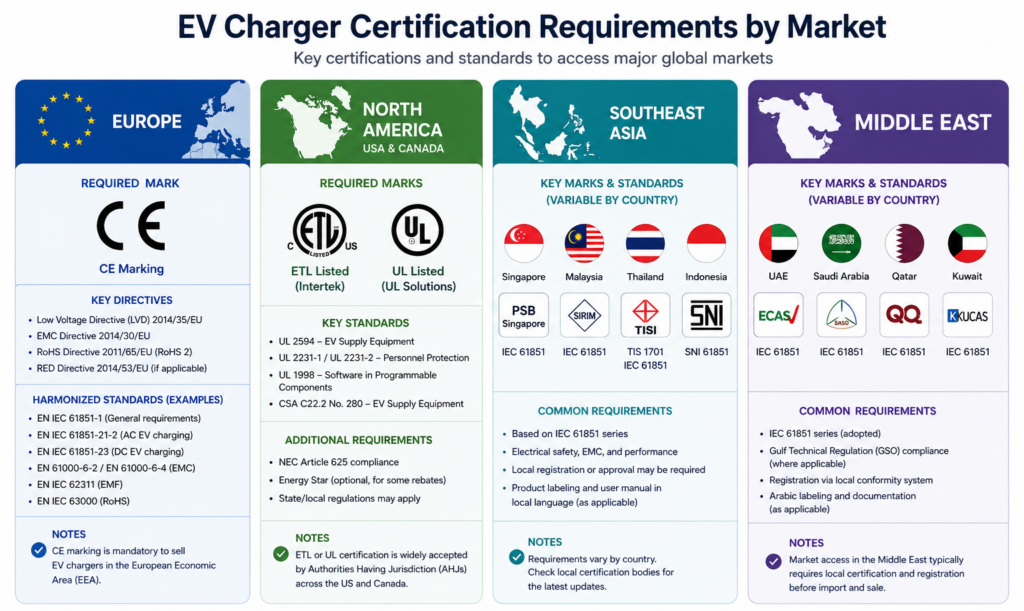
Before getting into the three paths, it helps to know what certifications are actually required. There are two separate things here — product safety certifications and protocol certifications — and most buyers mix them up.
Product safety certifications — by market
| Market | Required | Useful to Have | Who Checks |
|---|---|---|---|
| Europe / EEA | CE marking (LVD + EMC + RED directives) | UKCA (UK post-Brexit), TÜV mark, MID | Customs, distributors, end customers |
| United Kingdom | UKCA (since Jan 2025, CE no longer accepted) | — | Customs, installers, local authority |
| North America (US) | ETL or UL listing (NRTL), FCC Part 15 | ENERGY STAR, CTEP (for public billing accuracy) | AHJ (Authority Having Jurisdiction), utility programs, NEVI-funded projects |
| Canada | CSA or equivalent NRTL listing | — | Electrical inspectors, provincial AHJ |
| Southeast Asia | Country-specific: SG TR25 (Singapore), SIRIM (Malaysia), TISI/PEA (Thailand) | CB scheme (used as basis for local certs) | Customs, local utility or regulator |
| Middle East | ESMA (UAE), SASO (Saudi Arabia) — both accept CB + CE as basis | — | Customs, project owner |
| Australia / NZ | RCM mark (combines safety + EMC) | — | Electrical regulators, installers |
One thing buyers often get wrong: CE and ETL/UL are completely separate. A CE certificate doesn’t work in North America. ETL doesn’t work in Europe. If you’re selling in both markets, you need both.
OCPP certification — what it is and why it matters
OCPP certification is issued by the Open Charge Alliance (OCA) and confirms that the charger’s communication stack correctly implements the OCPP protocol. It has nothing to do with electrical safety — it’s a software interoperability certification.
Why it matters for your brand: as of September 2025, only 68 charger models globally held formal OCA OCPP 2.0.1 certification — in a market with thousands of models. “OCPP 2.0.1 ready” and “OCPP 2.0.1 certified” are not the same thing. NEVI-funded projects in the US and AFIR-compliant deployments in Europe require certified OCPP 2.0.1, not just “ready.”
For your brand, here’s the key takeaway: OCPP certification stays with the firmware version — not the company name. Slapping your logo on the enclosure doesn’t affect it. But change the firmware? Even if it’s just a branding change that touches the OCPP stack? That triggers re-certification.
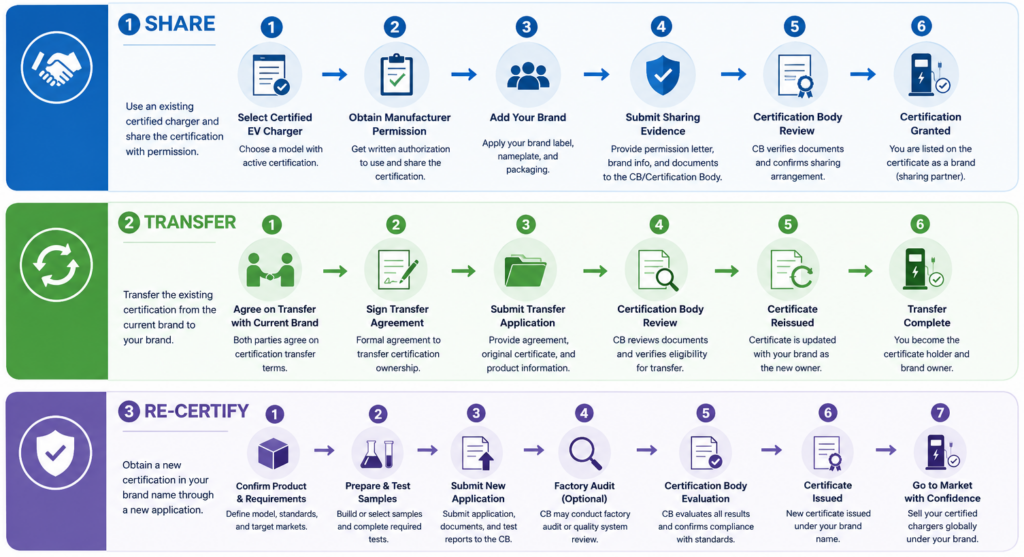
3 Ways to Handle Certification: Share, Transfer, or Re-File
Path 1: Share the manufacturer’s certification
This is where most white-label programs start. The manufacturer holds the CE or ETL certificate. You get permission to use their certification mark on your product because the physical product is identical — same hardware, same firmware version, same everything. You’re just selling it under your brand name.
When it works:
- Your customization is cosmetic only — logo, color, packaging
- The manufacturer’s certificate covers the exact model you’re selling
- The manufacturer explicitly grants you permission to use their mark (get this in writing)
- Your customers don’t require the certificate to be in your company name
When it doesn’t work:
- Your customer asks for a Declaration of Conformity (DoC) with your brand name — the manufacturer’s DoC has their name, not yours
- A tender or procurement process requires the certificate to name your company as the responsible party
- You switch manufacturers — the certification stays with the original manufacturer, you lose it entirely
- The manufacturer’s certificate lapses and they don’t renew it
Bottom line: Sharing works fine for getting started and for markets where buyers don’t scrutinize the certificate holder. It becomes a problem as soon as an institutional buyer, government tender, or utility program gets involved — they will check.
Path 2: Transfer the certificate to your name
The manufacturer transfers the existing certificate into your company name. You become the listed certificate holder. The certifying body (Intertek, SGS, UL Solutions, Bureau Veritas, etc.) conducts a “brand name change” or “Multiple Listing” review — confirming that the product hasn’t changed and that you’re now the responsible party.
What the process looks like:
- You and the manufacturer contact the certifying body together
- The certifying body confirms the product hasn’t changed from the certified version
- A new certificate is issued in your company name (or a Multiple Listing is added)
- You now own the certificate and can provide it to customers as the responsible party
Cost and timeline: Typically USD 1,000–3,500 per certificate, 2–4 weeks. Much faster and cheaper than re-certifying from scratch.
When it works:
- You need the certificate in your name for customer or tender requirements
- The hardware hasn’t changed from the certified version
- You want certification security — if the manufacturer’s relationship with the certifying body lapses, your certificate stays active
When it doesn’t work:
- You’ve made hardware changes that differ from the certified product — the certifying body will flag this and require re-testing
- The manufacturer won’t cooperate with the transfer (this happens — it’s a red flag)
Bottom line: For most ODM programs where the hardware is largely unchanged, certificate transfer is the right path. It’s fast, cheap, and gives you full certificate ownership. This is what JointCharging recommends for most brand partners.
Path 3: File your own certification
You submit the product for full testing and receive a new certificate entirely in your name, based on current test results. This is required when:
- Your hardware changes go beyond cosmetic — new enclosure shape, new display, new power configuration
- The existing certificate is outdated and the standards have been updated (e.g., moving from old CE directives to new EU regulations)
- You’re entering a market with no existing certification (e.g., the manufacturer has CE but no ETL, and you need North America)
- You’re doing a full OEM program and there is no existing certificate to transfer
Cost and timeline by certification:
| Certification | Market | Typical Cost (fresh filing) | Timeline |
|---|---|---|---|
| CE marking (LVD + EMC) | Europe / EEA | USD 8,000–25,000 | 8–16 weeks |
| UKCA | United Kingdom | USD 5,000–15,000 | 8–14 weeks |
| ETL listing (AC charger) | North America | USD 15,000–35,000 | 10–18 weeks |
| ETL listing (DC charger) | North America | USD 25,000–60,000 | 14–24 weeks |
| FCC Part 15 | United States | USD 3,000–8,000 | 4–8 weeks |
| OCPP 2.0.1 OCA certification | Global | USD 2,000–5,000 | 4–8 weeks |
| SG TR25 (Singapore) | Singapore | USD 3,000–8,000 | 6–10 weeks |
| RCM (Australia / NZ) | ANZ | USD 5,000–12,000 | 8–12 weeks |
Important note on timing: Certification testing should start in parallel with sample production — not after. If you wait for samples to arrive before filing, you add 10–16 weeks to your launch timeline unnecessarily. Start the certification paperwork as soon as the product spec is confirmed.
How to Choose the Right Certification Path for Your Brand
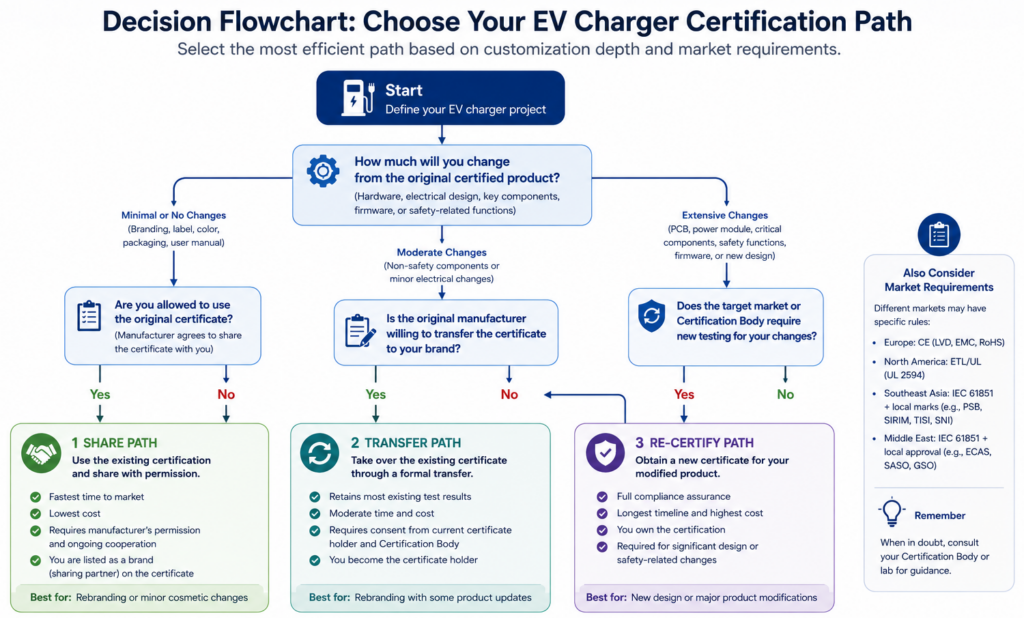
Use this as your starting point:
- Logo and color changes only + customers don’t scrutinize the certificate holder → Share the manufacturer’s certification. Get explicit written permission from the manufacturer.
- Logo and color changes only + customers (or tenders) need the certificate in your name → Transfer. Fast, cheap, protects your brand relationship with the certificate.
- Hardware changes (new enclosure, new display, new power config) → Partial re-test. The certifying body will test the changed components; unchanged components are covered by the original test data.
- Entering a market where the manufacturer has no existing certificate → Fresh filing. No shortcut here — budget the time and money properly.
- Full OEM program — you own the design → Fresh filing, in your name from day one.
What About OCPP Certification?
OCPP certification is handled differently from product safety certifications — and it catches a lot of buyers off guard.
Here’s what you need to know in plain terms:
- OCPP certification belongs to a specific firmware version, not to a company name. When the manufacturer gets OCA OCPP 2.0.1 certification, it’s for firmware version X.X.X of product model Y.
- If you change the firmware (even just changing the CSMS URL or adding a language), the certifying body may require re-testing if the change touches any OCPP-protocol code.
- Purely cosmetic firmware changes — startup logo, LED pattern, UI colors — don’t touch the OCPP stack and don’t require re-certification.
- You can verify any manufacturer’s OCPP certification claim for free on the OCA website. If the product isn’t listed there, it isn’t certified — regardless of what the manufacturer’s datasheet says.
For your private label program: confirm with the manufacturer exactly which firmware changes require OCPP re-testing and which don’t. Get this in writing. A trustworthy manufacturer will have a clear answer. One who hedges should be asked again — and if they can’t give a definitive answer, that’s worth factoring into your supplier evaluation.
How JointCharging Handles Certification for Partners
We hold ETL certification for both AC and DC commercial chargers — one of the first manufacturers in China to achieve this for both product types. We also hold CE marking across our commercial lineup, and our chargers carry OCA OCPP 2.0.1 certification.
For ODM partners, our standard process:
- Logo and color-only programs → We provide written permission to use our certification marks, and can initiate a Multiple Listing / certificate transfer with Intertek or SGS within 2–4 weeks.
- Hardware customization programs → We coordinate partial re-testing through our in-house Intertek and SGS satellite lab. Because we have an on-site testing capability, we can typically run delta tests faster than going through an external lab independently.
- New market certifications → If you need a certification we don’t currently hold (e.g., RCM for Australia, SIRIM for Malaysia), we can coordinate the filing jointly. Timeline and cost depend on the specific standard.
One thing we always tell partners: decide your target market before your product spec, not after. The connector type, power configuration, and even the enclosure material requirements can vary by market. Getting the market right first means your certification path is clean from day one.
3 Certification Mistakes That Delay Your Launch
Mistake 1: Assuming CE covers the UK
It used to. Since January 2025, the UK requires UKCA marking — CE is no longer accepted for new products placed on the UK market. If you’re selling in both the EU and UK, you need both marks. Budget and timeline for both from the start.
Mistake 2: Starting certification after samples arrive
Test labs book out. The paperwork takes time. If you wait until you’ve approved your samples to start the certification process, you’re adding 8–16 weeks to your launch — time you could have saved by starting the filing in parallel with sample production. The spec doesn’t need to be final for most certification paperwork; it needs to be stable.
Mistake 3: Not checking your specific configuration is covered
A manufacturer might hold ETL certification for their 7kW single-phase AC charger — but not for the 22kW three-phase version. Or they might hold CE for a model with a Type 2 socket, but the variant with an attached cable has a different test status. Always ask: “Does this certificate cover the exact model, power level, cable configuration, and connector type I’m ordering?” and ask to see the certificate scope, not just the front page.
Key Takeaways
- Whether you need your own certification depends on your customization depth, your target market, and what your customers actually ask for. Most ODM programs can work with certificate transfer rather than fresh filing.
- CE (Europe) and ETL/UL (North America) are completely separate certification systems. One does not substitute for the other.
- OCPP certification is separate from product safety certification. It belongs to a specific firmware version, not a company name. Verify it on the OCA website — don’t take a manufacturer’s word for it.
- Certificate transfer (Path 2) is usually the best move for ODM programs: fast (2–4 weeks), cheap (USD 1,000–3,500), and gives you full certificate ownership.
- Start certification in parallel with sample production — not after. Waiting costs you 8–16 weeks unnecessarily.
- UK now requires UKCA, not CE. If you’re selling in both EU and UK, budget for both.
Next Steps
Certification requirements are tied to which market you’re targeting first. If you haven’t settled on that yet, our market selection guide walks through North America, Europe, Southeast Asia, and the Middle East — including the certification burden, competition level, and growth potential in each.
If you’re ready to discuss certification paths for your ODM program, contact JointCharging. We’ll tell you exactly which path applies to your program and what the timeline looks like — usually within one working day.
Frequently Asked Questions
Can I sell EV chargers in the EU using the manufacturer’s CE certificate?
Yes — if your customization is cosmetic only (logo, color, packaging) and the manufacturer gives you written permission to use their CE mark. The product needs to be physically identical to the certified version. However, if a customer asks for a Declaration of Conformity with your company name on it, the manufacturer’s DoC won’t satisfy that requirement. In that case, you need a certificate transfer — which takes 2–4 weeks and costs USD 1,000–3,500 through the certifying body.
If I share the manufacturer’s certification, does my brand appear on the certificate?
No. The certificate lists the certificate holder—the manufacturer. Your brand doesn’t appear on the certificate itself. If a customer asks for a Declaration of Conformity with your company name, the manufacturer’s DoC won’t satisfy that. You can operate under their mark for many sales channels, but for government tenders or institutional procurement, you’ll likely need a transfer.
Is ETL the same as UL for EV chargers?
Yes, functionally. Both ETL (from Intertek) and UL (from UL Solutions) are Nationally Recognized Testing Laboratories (NRTLs) approved by OSHA. They test EV chargers against exactly the same standards — UL 2202, UL 2231-2, and UL 2594. Inspectors, AHJs, and insurers treat ETL and UL listings as equivalent. ETL is often faster and less expensive, which is why many manufacturers choose it. JointCharging holds ETL certification for its commercial AC and DC charger lineup.
Does changing the logo or color affect CE or ETL certification?
No — cosmetic changes to the enclosure (color, logo printing, packaging) do not affect product safety certification. The electrical performance and safety characteristics of the product are unchanged. What does affect certification: changes to the enclosure shape that alter thermal dissipation, changes to internal components, or changes to the power configuration. If you’re unsure whether a specific change affects certification, ask the manufacturer to confirm in writing before production starts.
What is the difference between “OCPP 2.0.1 ready” and “OCPP 2.0.1 certified”?
“OCPP 2.0.1 ready” means the manufacturer claims their firmware implements the protocol — but it has not been independently verified. “OCPP 2.0.1 certified” means the product has been tested by an OCA-approved laboratory and the certificate is publicly listed on the Open Charge Alliance website. For NEVI-funded projects in the US and AFIR-compliant deployments in Europe, certified is required — “ready” is not enough. Always verify on the OCA website before committing to a supplier.
What’s the difference between CE marking and the CB Scheme?
CE marking is mandatory for selling in the EU and confirms compliance with European directives (LVD, EMC). The CB Scheme, on the other hand, is a voluntary international system. Testing to IEC standards under CB can be used as a foundation for certification in 50+ countries—including CE, UKCA, and many Asian markets . Think of CB as a “one test, multiple markets” starting point. CE is market entry for Europe specifically.
How long does EV charger certification take?
Certificate transfer (putting an existing certification in your name): 2–4 weeks, USD 1,000–3,500. Fresh CE filing: 8–16 weeks, USD 8,000–25,000. Fresh ETL filing for AC chargers: 10–18 weeks, USD 15,000–35,000. Fresh ETL for DC chargers: 14–24 weeks, USD 25,000–60,000. OCPP 2.0.1 OCA certification: 4–8 weeks, USD 2,000–5,000. Start certification in parallel with sample production — not after — to avoid adding these timelines to your launch schedule.
How long does a CE or ETL certificate stay valid?
Product safety certifications don’t have a fixed expiry date, but they do require ongoing maintenance. The manufacturer must pass regular factory audits (typically annual for ETL) to keep the certification active. If the manufacturer changes component suppliers or production processes without notifying the certifying body, the certificate can be invalidated. Always check with the manufacturer how they handle surveillance audits and component change control.
