
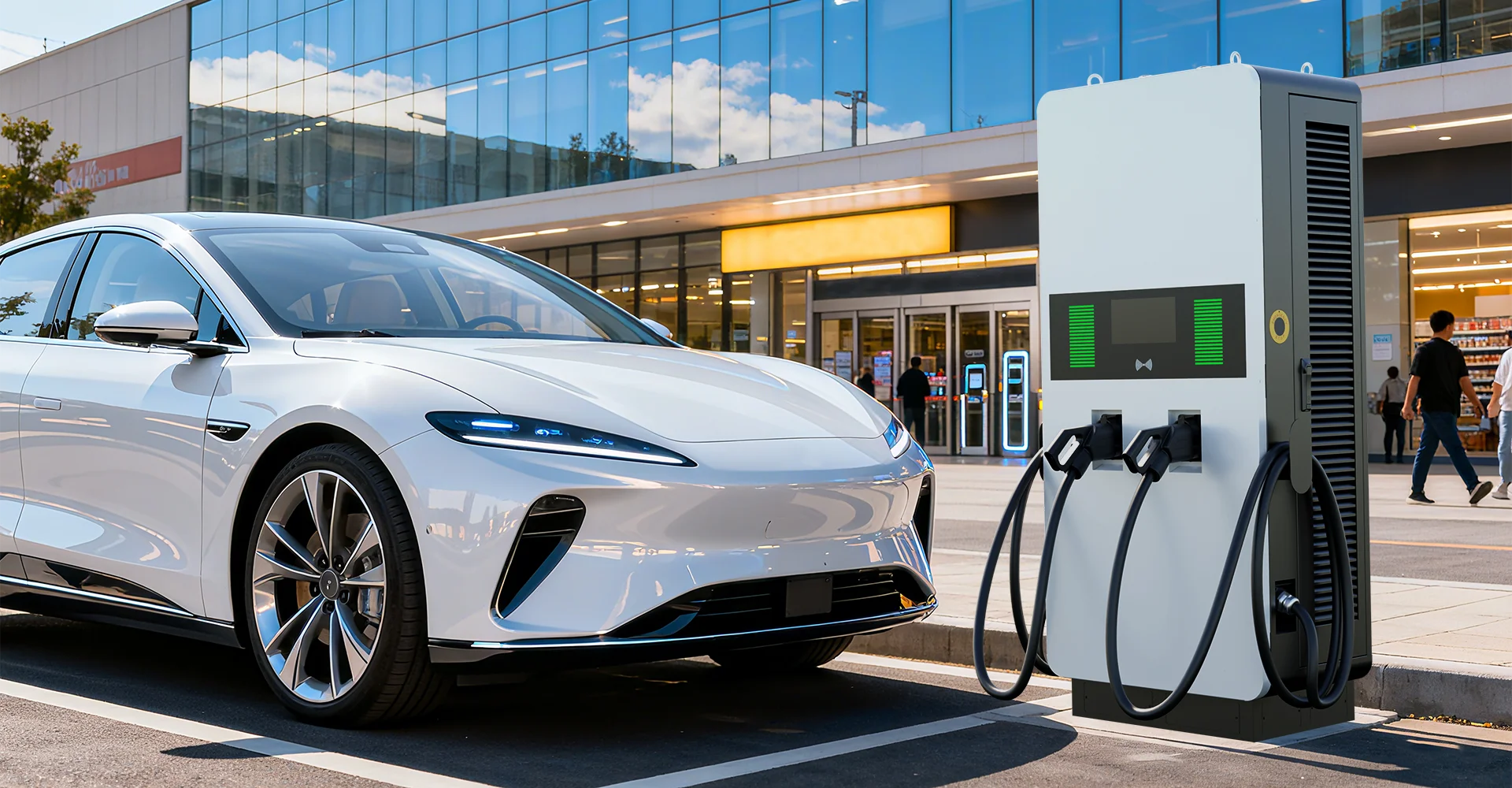
DC fast chargers (DCFC), also known as Level 3 chargers in North America. It is the fastest way to recharge an electric vehicle by delivering high-power direct current (DC) directly to the battery, significantly reducing charging time compared to Level 1 and Level 2 chargers.
What is a DC Fast charger? vs AC EV charger
Explained on a physical level, the core principle of EV charging involves converting alternating current (AC) from the grid, which oscillates back and forth, into direct current, which flows steadily in one direction. This process is called rectification.
1. AC EV Charger
When rectification occurs within the vehicle, the onboard charger (OBC) converts AC to DC for battery storage. In this scenario, the external AC charging station primarily supplies stable AC power while managing charging control and protection functions. Due to limited vehicle space and constrained cooling conditions, onboard chargers typically have lower power ratings, resulting in relatively slower charging speeds. This is commonly referred to as an AC EV Charger.
2. DC EV Charger
When rectification occurs within the charging station itself, the high-power rectifier housed in this large charging cabinet directly converts grid AC power into DC power. This bypasses the vehicle’s OBC, charging the battery directly. This type of charging station is known as a DC EV Charger. Due to its larger size and superior heat dissipation capabilities, it can deliver significantly higher power than onboard chargers, enabling much faster charging speeds. Typically, it can charge the battery to 80% capacity within a few dozen minutes.
DC EV Charger vs. AC EV Charger: A Technology and Physical Level Analysis.
| Charging Type | Rectification Location | Charging Process | Power Level | Charging Speed | Advantages | Limitations / Drawbacks | Typical Device Name |
| AC Charging | On-Board Charger (OBC) inside the vehicle | AC power → OBC → DC → Battery | Typically 3–22 kW | Slower (4–10 hours to full, depending on vehicle and power) | – Lower requirements for vehicle and grid- Lower cost- Suitable for home or small workplace | – Limited by vehicle’s OBC power- Slow charging- Not ideal for high-speed or high-traffic scenarios | AC EV Charger / Level 1 & 2 Charger |
| DC Charging | Inside the charging station | AC power → DC converter in charger → DC → Battery (bypasses OBC) | 30–480+ kW | Fast (20–60 minutes to 80% charge) | – Much faster charging- Suitable for public stations and high-traffic locations- High power and good heat dissipation | – Large and costly equipment- High grid requirements- Complex installation | DC EV Charger / Level 3 / DCFC |
Read more about Pros & Cons of DC Charging and AC Charging.
How Fast Is a DC Fast Charger?
A DC fast charger can typically charge an electric vehicle to about 80% in 20–60 minutes, depending on several factors such as the charger’s power output, the vehicle’s battery size, and the vehicle’s maximum charging capability.
Typical DC Fast Charging Speeds
| 30–50 kW | 45–90 minutes to 80% | Urban fast charging, small fleets |
| 60–100 kW | 30–60 minutes to 80% | Public charging hubs, retail sites |
| 120–150 kW | 20–40 minutes to 80% | Highway corridors |
| 250–350 kW | 15–30 minutes to 80% | High-power highway fast charging |
*Charging time varies by vehicle and battery condition.
Why DC Fast Charging Slows Down After 80%
Most EVs reduce charging speed once the battery reaches around 80% state of charge (SOC).
This is to:
- Protect battery health
- Prevent overheating
- Extend battery lifespan
As a result, the last 20% often takes almost as long as the first 80%.
What Affects DC Fast Charging Speed?
- Charger power rating (kW)
- Vehicle’s maximum DC charging capability
- Battery size and temperature
- State of charge when charging starts
Even if a charger supports very high power, the vehicle will only draw what it can safely accept.
Which EVs Support DC Fast Charging?
DC fast charging is primarily supported by battery electric vehicles (BEVs).
Most plug-in hybrid electric vehicles (PHEVs) do not support DC fast charging, as their smaller batteries are designed for AC charging only.
DC fast charging compatibility also depends on the charging connector standard, which varies by region and vehicle manufacturer.
Common DC Fast Charging Connectors
- CCS (Combined Charging System)
Widely used in North America and Europe, supporting a broad range of DC fast charging power levels. - CHAdeMO
Found mainly on older Japanese EV models. While still in use, it is gradually being phased out in many markets. - NACS (North American Charging Standard)
Originally developed by Tesla and increasingly adopted by other manufacturers in North America.
DC Fast Charging Connectors by Region
| Region | Common DC Fast Charging Connectors |
| North America | CCS1, NACS |
| Europe | CCS2 |
| Japan | CHAdeMO |
| China | GB/T (DC) |
| Other Markets | Depends on local standards |
Common DC fast Charging connectors
Regional Differences to Consider
Charging standards vary by market, so not all EVs can use every DC fast charger.
For example, CCS and NACS dominate in North America, while CCS is the primary standard in Europe. Drivers should always confirm vehicle compatibility before using a DC fast charger.
Where Are DC EV Chargers Needed?
Thanks to their high power output and fast charging capability, DC EV chargers are best suited for locations where quick turnaround, high utilization, or limited parking time is critical. Below are the most common and practical application scenarios.
1. Locations Requiring Fast Charging Within 15–45 Minutes
These locations support long-distance travel and require drivers to recharge quickly before continuing their journey.
Typical locations include:
- Highway corridors and travel routes
- Highway rest areas
- Service plazas
- Fuel stations along major routes
2. High-Turnover Locations with Limited Parking Time
In urban environments where parking space is limited and vehicle turnover is high, fast charging is essential to maximize utilization.
Typical locations include:
- Public charging hubs
- Urban fast-charging stations
- City charging hubs
- Municipal parking facilities
- On-street fast-charging locations
3. Commercial Locations Focused on Increasing Dwell Time and Foot Traffic
DC fast charging can turn short customer visits into meaningful charging sessions, helping businesses attract EV drivers and increase on-site spending.
Typical locations include:
- Shopping malls
- Supermarkets
- Convenience stores
- Restaurants
4. Operational and Service-Driven Applications
For fleets and public services, vehicles must return to operation quickly, making fast and reliable charging a necessity.
Typical applications include:
- Fleet depots and logistics centers
- Delivery fleets
- Ride-hailing fleets and taxis
- Corporate vehicle fleets
- Electric buses and electric trucks
- Municipal and transit fleets
- Airports (short-term parking)
- Train stations
dc charging station vs AC EV Charging — Simple Location Guide
| Location | Typical Parking Time | Recommended Charger |
| Home | Overnight | AC (Level 2) |
| Workplace / Office | Full workday | AC (Level 2) |
| Hotel | Overnight | AC (Level 2) |
| Retail / Supermarket | 30–90 minutes | DC Fast Charger |
| Convenience Store | 15–45 minutes | DC Fast Charger |
| Highway Rest Area | 20–45 minutes | DC Fast Charger |
| Public Charging Hub (Urban) | 30–120 minutes | DC Fast Charger |
| Fleet Depot | Short breaks / Between shifts | DC Fast Charger |
| Bus / Truck Depot | Opportunity charging | High-Power DC |
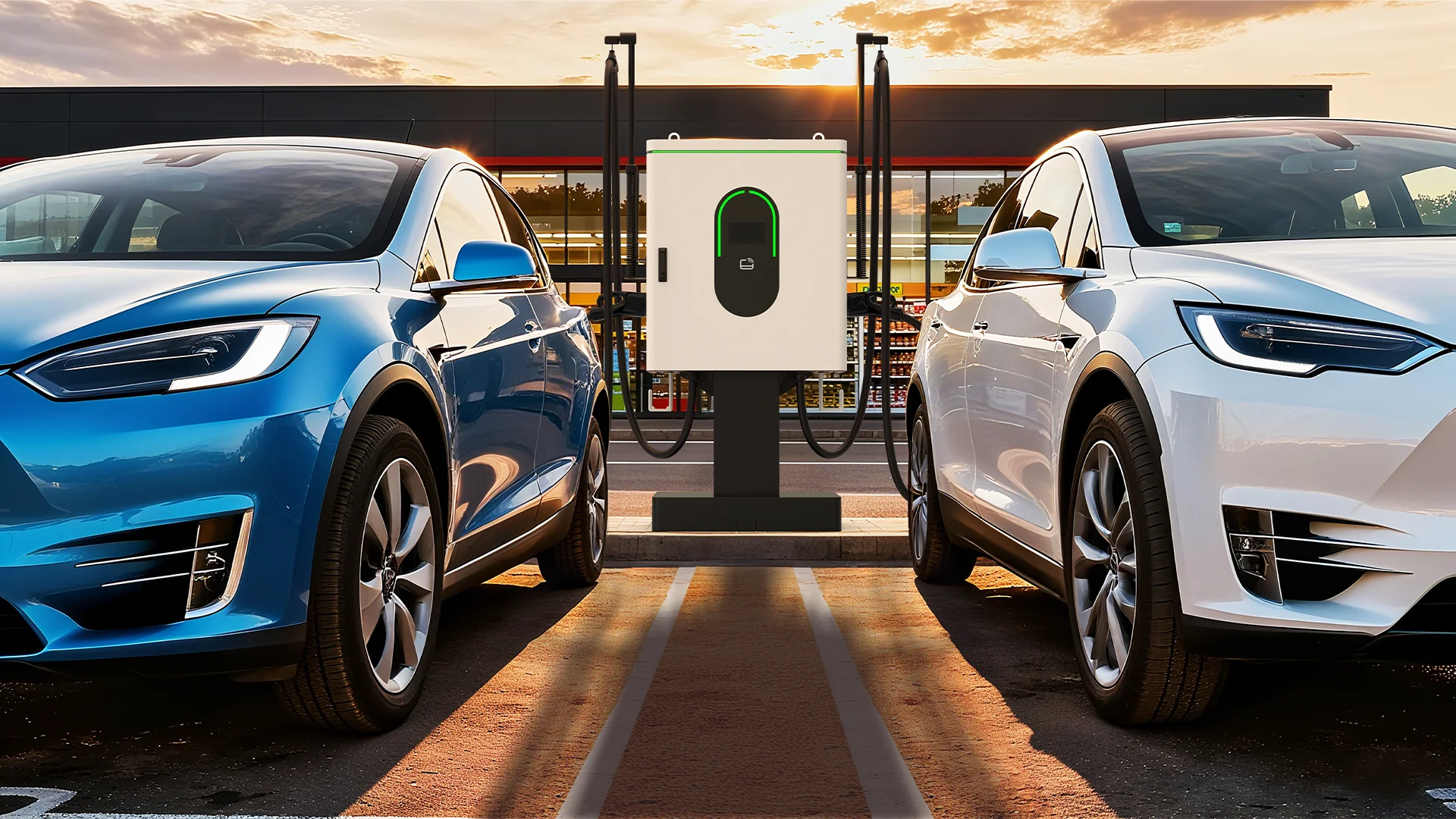
Which Customers Are a Good Fit for Our Type of DC Fast Charger?
Not every DC fast charger is designed for every site.
Our DC fast charging solutions are best suited for customers who value flexibility, scalability, and long-term operational reliability rather than one-size-fits-all deployments.
Below are the customer profiles that typically benefit most from our DCFC solutions.
| 1. Public Charging Operators & CPOs | Multi-site charging operators | Need reliable, high-uptime chargers; require OCPP-based network integration; flexible connector options | OCPP-compliant architecture; multiple power options; remote monitoring & diagnostics |
| 2. Commercial Site Hosts with High Turnover | Retail centers, convenience stores, fuel stations, highway service areas | Limited dwell time; attract EV drivers; support revenue & customer retention | Fast charging performance; compact/modular design; user-friendly payment & access |
| 3. Fleet Operators & Logistics Companies | Delivery fleets, ride-hailing fleets, corporate vehicle fleets | Vehicles must return to service quickly; predictable schedules; minimize downtime | High reliability; scalable power; centralized backend management |
| 4. Municipalities & Public Sector Projects | City governments, public parking operators, transit authorities | Future-proof infrastructure; regulatory compliance; long-term operation | Compliance with local regulations; long service life; expandable system design |
| 5. System Integrators & EV Charging Solution Providers | ODM/OEM partners | Require flexible integration; value customization in hardware/software | Decoupled hardware-software architecture; customizable configurations; strong engineering & manufacturing support |
Our DC fast charging solutions are designed for professional operators and businesses that need scalable, reliable, and flexible charging infrastructure.
Finally
If you’re planning a DC fast charging deployment and want to evaluate whether this type of solution fits your site or fleet, our team can help you assess power requirements, configuration options, and long-term scalability.
