
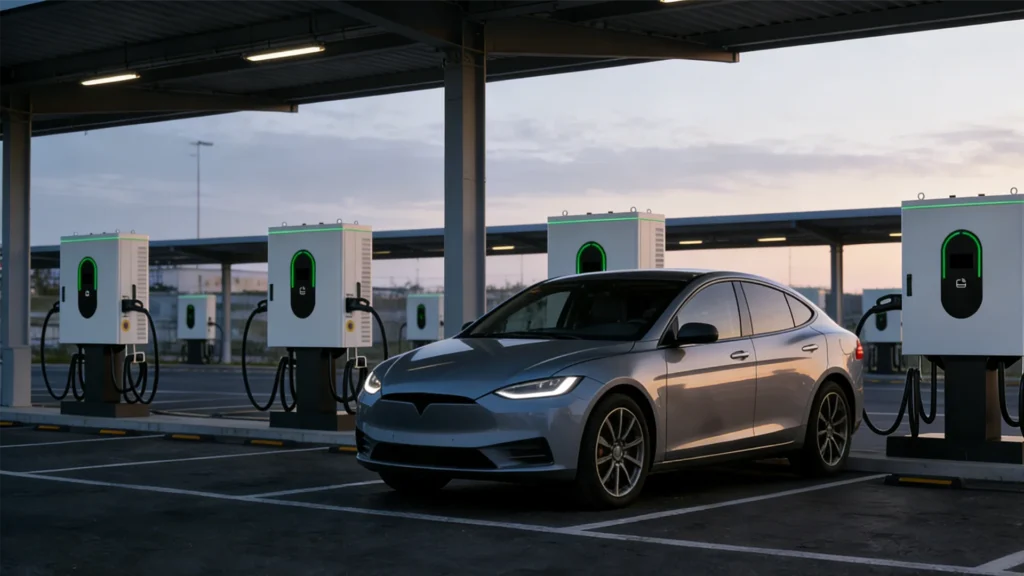
One of the first things anyone asks when they’re considering a private label EV charger program is: how much does it actually cost? And the frustrating answer you usually get from manufacturers is “it depends” — followed by a request to fill in a contact form before they’ll tell you anything useful.
This page gives you the real numbers upfront. Not a quote for your specific product — that requires knowing your exact specs, target market, and customization scope — but the ranges and structure you need to know before you start talking to manufacturers. That way you can tell immediately whether a quote you receive is reasonable, inflated, or suspiciously low.
We cover three things: minimum order quantities (MOQ), what goes into the total cost of an ODM program, and realistic timelines from first inquiry to first shipment.
Part of our Private Label EV Charger Complete Guide. If you haven’t decided on your customization scope yet, read our customization options guide first — your customization choices directly affect your NRE cost and MOQ.
Table of Contents
MOQ: What’s the Minimum You Need to Order?
MOQ varies by product type and program type. Here’s what the numbers actually look like for commercial EV chargers in 2026:
AC chargers (Level 2, 7–22kW)
- White label (logo and color only): 300 units minimum per SKU. This is the threshold at which most manufacturers are willing to run a dedicated production batch for your brand without requiring a tooling investment from you.
- ODM (customization beyond logo): 50–200 units for the first order, depending on the extent of customization. If you’re paying for a new enclosure mold, the manufacturer typically allows a lower first-order MOQ because the tooling cost partially offsets the smaller batch margin. If you’re doing firmware-only customization with no tooling, expect the MOQ to sit closer to 200.
- Annual framework agreements: Buyers who commit to 1,000+ units per year across their AC product line can typically negotiate framework agreements — better unit pricing, guaranteed production slots, and more flexibility on minimum per-batch quantities. This is worth discussing from the start if your business case supports that volume.
DC fast chargers (30–400kW)
- Both white label and ODM: DC chargers are almost always project-driven. MOQ starts at 1 unit for most manufacturers, because DC deployments are site-specific — a CPO building a 4-gun fast charging station orders 4 units, not 300. There’s no white-label vs ODM distinction on MOQ for DC; the economics work at small quantities because the unit value is significantly higher.
- Consistent volume: If you’re procuring DC chargers on a recurring basis — for example, a CPO rolling out 3–5 new stations per quarter — discuss an annual framework agreement. The consistency of demand is more valuable to the manufacturer than a single large order.
One thing buyers miss on MOQ: the minimum order quantity applies per SKU, not per order. If you’re building a product line with three AC charger models (7kW, 11kW, 22kW) under your brand, you need to hit MOQ on each one separately. A common mistake is planning a broad product line without the budget to hit MOQ across all SKUs — it’s better to launch one SKU properly than three SKUs at insufficient volume.
What Does an ODM Program Cost?
The unit price is the smallest variable in your first-order budget. The real cost has five components, and most buyers only budget for one or two of them at the start.
Unit cost: what you’re actually paying for
This is the per-unit price you pay at your agreed MOQ. It covers materials, labor, quality control, and the manufacturer’s margin. We’re not going to publish specific unit prices here because they vary too much by product spec, power level, connector type, and order volume — and any number we publish would be either misleading or out of date by the time you read this. Request a formal quote with your specific specs.
What we will say: if a quote looks 30–40% cheaper than other quotes you’ve received for the same spec, ask why. Either they’re quoting on cheaper components, skipping certification, or planning to make up the margin elsewhere (usually in shipping or change-order fees). Quality commercial EV chargers have minimum cost floors below which the product simply can’t be built properly and certified.
NRE and tooling: one-time fees, explained
NRE (Non-Recurring Engineering) fees cover the engineering and tooling work done specifically for your product. They’re paid once, upfront, and don’t repeat on subsequent production orders of the same SKU.
| Customization Type | Typical NRE Range | What You’re Paying For |
|---|---|---|
| Logo screen print / pad print | USD 0–500 | Artwork setup, print tooling |
| Custom spray color (existing enclosure) | USD 800–2,500 | Color matching, spray tooling setup |
| Embossed or debossed logo | USD 1,500–4,000 | Mold modification for logo cavity |
| Firmware / UI customization | USD 500–3,000 | Development hours, firmware build and testing |
| White-label mobile app | USD 3,000–8,000 | App wrapper development, branding integration |
| New enclosure mold | USD 5,000–15,000 | Full injection mold design and manufacture |
| Custom pedestal / accessory mold | USD 3,000–10,000 | Pedestal mold design and manufacture |
| Packaging design + print tooling | USD 800–2,500 | Artwork, dieline, box tooling |
For a typical first ODM program — custom color, screen-printed logo, firmware UI customization, and branded packaging — budget USD 3,000–8,000 in NRE fees. For a more ambitious program with a new enclosure mold and white-label app, budget USD 12,000–25,000.
Critical point on NRE ownership: any tooling you pay for should be owned by you. Get this in writing before the NRE invoice is issued. See our partner checklist for the exact contract language.
Certification: the cost most buyers underestimate
Certification is the cost most buyers underestimate. The range is wide because it depends entirely on which market you’re targeting and whether you’re transferring an existing certificate or filing fresh.
| Certification Path | Market | Cost Range | Timeline |
|---|---|---|---|
| Certificate transfer (brand name change) | CE / ETL | USD 1,000–3,500 | 2–4 weeks |
| Fresh CE filing (AC or DC) | Europe | USD 8,000–25,000 | 8–16 weeks |
| Fresh ETL filing (AC charger) | North America | USD 15,000–35,000 | 10–18 weeks |
| Fresh ETL filing (DC fast charger) | North America | USD 25,000–60,000 | 14–24 weeks |
| Country localization (SG TR25, SIRIM) | Southeast Asia | USD 3,000–8,000 per country | 6–10 weeks |
| OCPP 2.0.1 OCA certification | Global | USD 2,000–5,000 | 4–8 weeks |
For a full breakdown of certification paths and when each one applies, see our EV charger certification guide for private label brands.
Logistics and customs
Getting product from the factory to your warehouse is not cheap, and it’s often not fully accounted for in early budget planning.
- Sea freight (FCL — full container load): The most cost-effective option for volumes above roughly 200 AC chargers. Transit time from South China to Europe is 25–35 days; to the US East Coast is 30–40 days; to Southeast Asia is 7–14 days.
- Sea freight (LCL — less than container load): For smaller first orders, you share a container with other cargo. Cost per unit is higher than FCL, but you avoid paying for space you don’t need.
- Air freight: Used for urgent small batches or samples. 8–12 times the cost of sea freight per unit. Generally not viable for commercial quantities of commercial EV chargers given the size and weight.
- Import duties: Vary by destination country and HS code. The US currently applies Section 301 tariffs on many Chinese-manufactured goods — confirm the applicable rate for your specific product HS code with your customs broker before you finalize your budget. This can add meaningfully to landed cost.
- Local customs handling and delivery: Port handling, customs brokerage, and last-mile delivery to your warehouse are additional line items that a shipping quote from the factory typically doesn’t include.
Working capital: budgeting for your first inventory
Your first order is a working capital commitment. You’re paying for product before you’ve sold it. Budget for:
- The deposit (typically 30–50% of the order value) due before production starts
- The balance payment due before shipment
- 90–120 days of inventory on hand before you’ve converted the first units to customer revenue
Working capital is the single most common constraint that slows down first-time private label programs. Being honest about your cash position before committing to an MOQ saves a lot of pain later.
What Does a Realistic First-Order Budget Look Like?
Here’s a worked example for a typical first AC charger ODM program targeting Europe, to make the numbers concrete. This is illustrative — your actual numbers will differ based on your specific product and supplier.
| Cost Item | Scenario A: Basic ODM (logo + color + firmware, 200 units) | Scenario B: Full ODM (new enclosure + app + packaging, 100 units) |
|---|---|---|
| Unit cost × MOQ | USD [unit price] × 200 | USD [unit price] × 100 |
| NRE / tooling fees | USD 3,000–5,000 | USD 12,000–20,000 |
| CE certificate transfer | USD 1,500–3,000 | USD 8,000–15,000 (partial re-test if hardware changed) |
| Sea freight (LCL to EU) | USD 3,000–6,000 | USD 2,000–4,000 |
| Customs + handling | USD 800–1,500 | USD 500–1,000 |
| Non-unit costs total | USD 8,300–15,500 | USD 22,500–40,000 |
What this tells you: for a basic ODM program, the non-unit costs add USD 8,000–15,000 to your total budget on top of the product cost. For a more ambitious program with new tooling and partial re-certification, that rises to USD 22,000–40,000 before you’ve bought a single unit. Budget these costs into your working capital plan from day one — not as an afterthought once you’ve already committed to a production order.
Lead Times: How Long Does It Take from Order to Delivery?

The most common timeline question is: “If I place an order today, when can I have product in my warehouse?” The honest answer has six stages, and the total time depends on how much is already in place when you start.
Stage 1 — Inquiry and NDA (Weeks 1–2)
You submit your requirements, the manufacturer responds with initial feasibility feedback, and you sign an NDA before sharing any proprietary brand materials. This stage takes 1–2 weeks in a normal back-and-forth cadence. It takes longer if either party is slow to respond or if the initial brief is too vague to evaluate.
Stage 2 — Specification confirmation and quotation (Weeks 2–4)
The manufacturer reviews your customization scope, confirms what’s possible on their platform, and issues a formal quotation. You review line by line — unit price, NRE breakdown, certification scope, lead time commitments, warranty terms — and negotiate as needed. Don’t rush this stage. Misunderstandings at the specification stage become expensive problems at the production stage.
Stage 3 — Tooling and sample production (Weeks 4–12)
After signing the contract and paying the NRE deposit, tooling work begins. For firmware-only customization, this stage is shorter — 4–6 weeks. For programs involving new mold production, 8–12 weeks is more realistic. First samples (typically 3–5 units) are produced and shipped to you for review.
Run certification paperwork in parallel here. If you’re doing a certificate transfer, submit the request to the certifying body at the same time you approve the tooling. If you’re filing for new certification, submit samples to the test lab as soon as they’re available. Every week of delay in starting certification is a week added to your total launch timeline.
Stage 4 — Sample approval (Weeks 12–14)
You receive the samples, test them, and either approve or request revisions. Common feedback at this stage: color doesn’t match exactly, LED behavior needs adjustment, packaging dimensions are wrong. Give yourself one round of revisions in your timeline. If the manufacturer is good, one round is usually enough.
Stage 5 — Mass production and QC (Weeks 14–20)
After sample approval, mass production begins. Each unit goes through the manufacturer’s quality control process — incoming inspection (IQC), in-process quality control (IPQC), final circuit test (FCT), and a 48-hour burn-in test. Request a pre-shipment inspection report before approving the shipment — this gives you data on the batch quality before it leaves the factory.
Stage 6 — Shipping and delivery (Weeks 20–26)
Sea freight transit times: China to Europe 25–35 days; China to US East Coast 30–40 days; China to Southeast Asia 7–14 days. Add customs clearance time at the destination (typically 3–7 days for routine shipments). Air freight reduces shipping time to 5–10 days but at 8–12× the cost.
Total timeline summary
| Program Type | Ex-Factory (China) | Landed Europe | Landed North America |
|---|---|---|---|
| White label (logo + color only) | 4–8 weeks | 9–15 weeks | 10–16 weeks |
| ODM — firmware only | 8–14 weeks | 13–21 weeks | 14–22 weeks |
| ODM — new tooling | 14–22 weeks | 19–29 weeks | 20–30 weeks |
| OEM (full custom) | 36–54 weeks | 41–61 weeks | 42–62 weeks |
Note: These timelines assume certification runs in parallel with production. If certification is started after samples arrive (the most common mistake), add 8–24 weeks to the above depending on which certificate you’re filing.
What Makes Timelines Slip — and How to Avoid It
The most common causes of delay in EV charger ODM programs are predictable and avoidable:
1. Spec changes after tooling has started
If you change the enclosure design after the mold has been cut, the mold needs to be reworked or replaced. That’s additional cost and 3–6 weeks of delay. Confirm every specification detail before approving tooling. Print out the spec sheet, check every line, and sign off explicitly. Don’t leave anything to “we’ll figure it out later.”
2. Not deciding on the OCPP backend early enough
The CSMS endpoint URL needs to be configured during firmware build. If you haven’t decided which CSMS platform you’ll use by the time firmware development starts, your production units get built with a placeholder backend that needs to be updated later — either via OTA or by re-flashing in the field. Decide your CSMS platform before you sign the production order.
3. Starting certification after samples arrive
Covered above, but worth repeating: start the certification paperwork as soon as the product spec is confirmed. You don’t need finished samples to begin the certification filing — the test lab needs specs first, samples later. Running certification in sequence with production rather than in parallel is the single most common cause of launch delays.
4. Payment delays
Most manufacturers will not start tooling until they’ve received the NRE deposit. They will not release the production order to the factory floor until they’ve received the production deposit. Delays in payment processing — wire transfer hold times, approval chains, budget authorization — directly delay production start. Know your internal payment process and factor it into the timeline.
5. Customs surprises
Products held at customs due to incorrect HS code classification, missing documentation, or tariff classification disputes add 2–4 weeks to delivery — at minimum. Work with a licensed customs broker in your destination country and confirm the correct HS code and required documentation before the shipment departs.
How to Negotiate Better Terms on a First Order
A few things that actually work when negotiating with an ODM manufacturer on your first order:
- Show a credible volume roadmap, not just the first order. Manufacturers care about the long-term relationship. If you can show a realistic business plan suggesting 1,000+ units per year within 2–3 years, that changes your negotiating position on the first order’s pricing and MOQ more than any other single factor.
- Ask for a lower first-order MOQ in exchange for a committed second order. Some manufacturers will accept a lower MOQ on the first order if you commit (in writing) to a second order of a specified quantity within a defined timeframe. This works best when your first order is for market validation — you’re testing, not hedging.
- Don’t negotiate the unit price in isolation. The total package matters more than the unit price line item. A manufacturer who offers better lead time reliability, faster certification support, and a more accessible RMA process is worth more than one who’s 5% cheaper per unit but takes 4 weeks longer to respond to quality issues.
- Don’t accept verbal commitments on tooling ownership, exclusivity, or warranty. These are contract items. If a manufacturer says “of course the tooling is yours” but it’s not in the contract, it doesn’t count. Get everything that matters in writing before paying anything.
Key Takeaways
- AC charger white-label MOQ is typically 300 units per SKU. ODM programs can start at 50–200 units. DC chargers start at 1 unit and are project-driven.
- The total cost of a first ODM program has five components: unit cost, NRE fees, certification, logistics, and working capital. Most buyers only budget for one or two at the start.
- NRE fees are one-time. For a typical first ODM program, budget USD 3,000–8,000. For a new enclosure mold plus app, budget USD 12,000–25,000. All tooling you pay for should be owned by you — confirm in writing.
- ODM lead times run 8–22 weeks ex-factory depending on customization depth. Add 5–6 weeks for sea freight to Europe or North America. Add 8–24 weeks if certification runs in sequence rather than in parallel.
- The single most avoidable source of delay is starting certification after samples arrive instead of in parallel with production.
- Don’t negotiate unit price in isolation. Lead time reliability, certification support, and after-sales responsiveness are worth more than a 5% price reduction.
Next Steps
With the cost and timeline picture clear, the next step is choosing the right manufacturer to work with. Not all ODM manufacturers are equal — and the differences that matter most aren’t the ones on the spec sheet. See our guide on how to choose an EV charger OEM/ODM manufacturing partner for the 8-point evaluation framework and the red flags that experienced buyers watch for.
If you’re ready to get actual numbers for your specific program, contact JointCharging with your product spec, target market, and volume estimate. We’ll come back to you with a formal quote — including unit price, NRE breakdown, certification pathway, and lead time — within 5 business days.
Frequently Asked Questions
What is the minimum order quantity for a private label EV charger?
For AC Level 2 chargers on a white-label program (logo and color only), the typical MOQ is 300 units per SKU. For ODM programs with hardware or firmware customization, first-order MOQs are often lower — 50–200 units — because the tooling investment changes the economics for the manufacturer. DC fast chargers are project-driven and start from 1 unit. Buyers committing to 1,000+ units per year typically qualify for framework agreements with improved pricing.
Are NRE fees refundable if the project doesn’t go ahead?
Generally no. NRE fees cover work that’s already been done — engineering hours, tooling production, firmware development. Once that work has started, the costs have been incurred. Some manufacturers will refund a portion of NRE if the project is cancelled before tooling is cut, but this is the exception. Confirm the NRE refund policy explicitly in the contract before paying, and make sure you know exactly what triggers each NRE payment milestone.
How long does a first EV charger ODM order take from start to delivery?
For a typical ODM program with firmware customization and no new tooling: 8–14 weeks ex-factory, plus 5–6 weeks sea freight to Europe or North America, giving 13–22 weeks total from contract signing to delivery. If the program includes new mold production, add 6–8 weeks. If certification runs in parallel correctly, it doesn’t add to the timeline. If certification is started after samples arrive (common mistake), add 8–24 weeks depending on the certification type.
What’s the difference between certificate transfer and filing fresh?
A certificate transfer puts an existing certification (CE or ETL) into your company name — it’s a paperwork process that takes 2–4 weeks and costs USD 1,000–3,500. Filing fresh means submitting the product for full testing and getting a new certificate in your name. That takes 8–24 weeks and costs significantly more. Which path you take depends on whether the hardware has changed, what certifications you need, and whether your target market requires your name on the certificate. See our EV charger certification guide for the complete breakdown.
Why are some EV charger quotes much cheaper than others?
Usually one of four reasons: cheaper components that don’t meet the same quality or longevity standard; certification is not actually included (they’re quoting an uncertified product); the MOQ is much higher than the competition; or the quote doesn’t include NRE, packaging, or other items that will be added later. A quote that’s 30–40% cheaper than comparable quotes for the same spec deserves a detailed line-by-line explanation before you accept it.
Can I reduce my MOQ by paying more per unit?
Sometimes. Some manufacturers will accept a lower first-order MOQ at a higher unit price — effectively charging you for the production inefficiency of a smaller batch. Whether this makes sense depends on whether the higher unit price is worth the lower inventory commitment for your specific cash position. It’s worth asking directly. More effective is combining a lower first-order MOQ with a committed second-order quantity — that gives the manufacturer confidence without requiring you to carry excess inventory upfront.
