
Table of Contents
You’ve decided to build a private label EV charger brand. You’ve picked your brand model. Now comes a question that trips up more new brands than almost anything else: which market do you go into first?
It seems like a marketing question. It’s actually a product question, a certification question, and a logistics question all rolled into one. The connector type on your charger, the safety certifications you need, the firmware language settings, the power configuration — all of these change depending on where you sell. Get the market wrong first and you’ve built the wrong product.
This guide covers the four main markets for private label EV charger brands — North America, Europe, Southeast Asia, and the Middle East — with honest numbers on growth, competition, certification burden, and what kind of brand actually wins in each one. At the end, there’s a simple decision tool to help you figure out where to start.
Part of our Private Label EV Charger Complete Guide. If you haven’t sorted out certification strategy yet, read our EV charger certification guide for private label brands alongside this one — the two decisions are closely linked.
The Decision Your Market Choice Actually Makes For You
Most buyers think about market selection as a sales and distribution question. It’s actually a product specification question first.
Before you can sell in a market, your charger needs to have the right connector, the right power configuration, and the right certifications for that market. Change the market, and you might need a completely different SKU. Here’s what shifts:
| If you sell in… | Your AC connector must be… | Your DC connector must be… | Your safety cert must include… |
|---|---|---|---|
| Europe / EEA | Type 2 (IEC 62196) | CCS2 or CHAdeMO | CE marking (LVD + EMC) |
| United Kingdom | Type 2 | CCS2 | UKCA (not CE since Jan 2025) |
| North America (US) | J1772 or NACS (SAE J3400) | CCS1 or NACS | ETL or UL listing + FCC |
| Canada | J1772 or NACS | CCS1 or NACS | CSA or NRTL equivalent |
| Southeast Asia | Type 2 (most markets) | CCS2 or CHAdeMO | Country-specific (SG TR25, SIRIM, TISI) |
| Middle East (UAE, SA) | Type 2 | CCS2 | CE or CB scheme accepted; ESMA / SASO |
| Australia / NZ | Type 2 | CCS2 | RCM mark |
Bottom line: a European product (Type 2, CE) won’t work in the US. You’d need new connectors and ETL certification. Doing both at once? That’s two SKUs, two certs, twice the cost — not a first-move strategy. Pick one market, get it right, then expand.
North America: High Margin, High Barrier, High Competition
North America is where most private label brands want to go — and for good reason. The combination of NEVI federal funding, strong commercial property demand, and a buyer base willing to pay for certified, reliable hardware makes it one of the highest-margin markets globally. North America accounted for 16.7% of the global EV charging infrastructure market in 2025 and is projected to reach USD 41.8 billion by 2033 at a CAGR of 25.6% (Grand View Research, 2026).
What makes it attractive
- NEVI funding is real and ongoing. The US federal government committed USD 5 billion through the National Electric Vehicle Infrastructure program. Projects funded by NEVI require OCPP 2.0.1-certified chargers and open network access — which effectively filters out low-quality suppliers. If your product is properly certified, NEVI procurement opens doors that are closed to competitors who cut certification corners.
- Commercial property and fleet segments are underserved. While the CPO (public charging) space is competitive, hotels, multifamily residential, fleet depots, and retail properties are still early in their EV charging deployments. These buyers care about support, reliability, and ease of installation more than price.
- Buyers pay for trust. A US distributor or CPO who has been burned by an uncertified supplier will pay a meaningful premium for a brand with verified ETL certification and a track record. Price sensitivity is lower here than in Southeast Asia or the Middle East.
What makes it hard
- ETL / UL certification is non-negotiable — and expensive. ETL for an AC charger runs USD 15,000–35,000 and 10–18 weeks. For DC, USD 25,000–60,000 and 14–24 weeks. This is the biggest single barrier for new brands.
- The NACS transition is still happening. North America is mid-transition from CCS1 (J1772 / Combined Charging System Type 1) to NACS (SAE J3400, originally Tesla’s standard). Most major automakers have committed to NACS. If you’re building for North America in 2026, you need to decide whether to support CCS1, NACS, or both — and that decision affects your hardware spec and certification scope.
- Competition from established players is real. ChargePoint, Blink, EVgo, and Enel X are all well-funded and well-known. A new private label brand needs a clear reason to exist beyond the brand name — a specific segment, a specific geography within North America, or a specific service model.
What works in North America
Brands that hold ETL certification (not just claim they’re working on it), support OCPP 2.0.1, have English-language support, and focus on a specific buyer type — fleet depots, commercial property managers, or hospitality — rather than trying to be everything to everyone.
Europe: Regulated Market, Strong Demand, Diverse Requirements
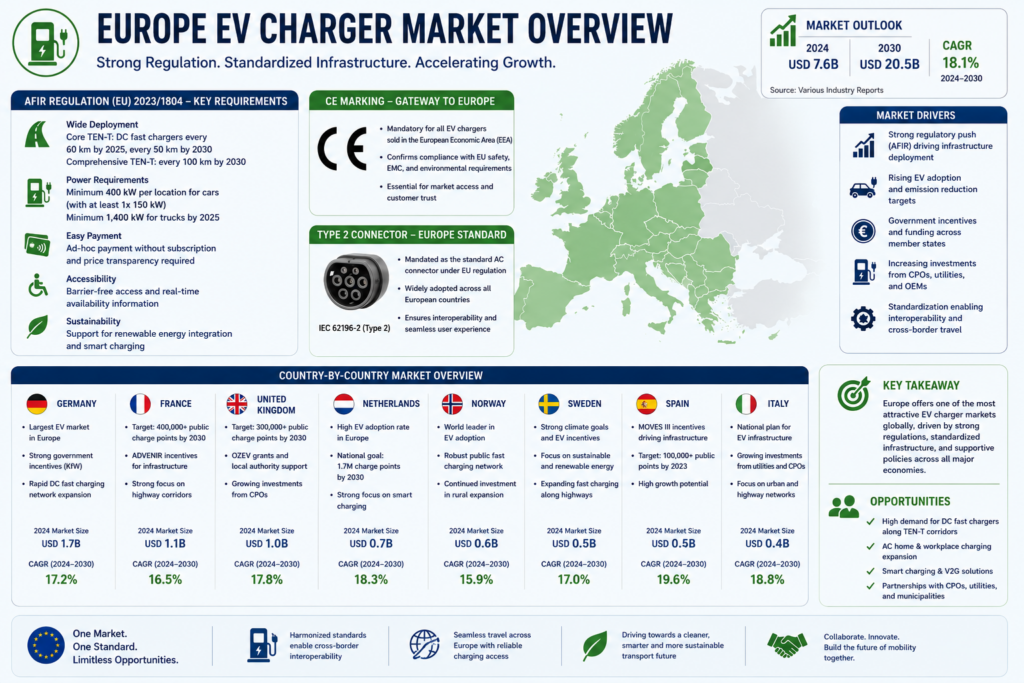
Europe is the world’s most regulated EV charging market. For properly certified brands, that’s a competitive advantage — the rules filter out competition. Europe is the fastest-growing regional EV charging market in 2026 (Coherent Market Insights, 2026), driven largely by the AFIR mandate.
What makes it attractive
- AFIR is creating a procurement wave. The EU’s Alternative Fuels Infrastructure Regulation mandates high-power public charging stations along all major TEN-T network corridors. This isn’t optional — it’s legally required, and the timelines are running. CPOs and governments across Europe are actively procuring chargers to meet these requirements. A CE-certified brand with OCPP 2.0.1 is well-positioned to participate.
- Western Europe buyers are sophisticated — which means they filter fast. If your product is properly certified and your support is responsive, you move quickly from “unknown brand” to “approved supplier.” European procurement officers don’t need you to be famous; they need you to have the right papers and a working product.
- Eastern Europe, Nordics, and Southern Europe are less saturated. Western European countries (Germany, Netherlands, UK, Norway) are competitive. Poland, Czech Republic, Romania, Greece, Portugal — less so. Same CE certification applies across the EEA.
What makes it hard
- UK is now separate from EU. Since January 2025, the UK requires UKCA marking — CE is no longer accepted for new product placements. If you want both EU and UK, budget for both certifications.
- Country-by-country nuances matter. While CE covers the product safety requirement across the EEA, local grid connection standards, payment system requirements, and procurement processes vary by country. Germany has different installer requirements than Spain. France has different public procurement rules than Denmark.
- GDPR and data handling requirements apply to any charger that processes user payment or session data. If your CSMS backend isn’t GDPR-compliant, you have a problem with commercial deployments in Europe.
Who wins in Europe
Brands with CE and OCPP 2.0.1 OCA certification, Type 2 / CCS2 connectors, and a clear focus on either a specific country cluster (e.g., DACH, Nordics, BeNeLux) or a specific use case (fleet, hospitality, retail). Starting with one country and expanding with the same CE is more manageable than trying to serve all 27 EU members from day one.
Southeast Asia: Fast Growth, Lower Barriers, Right Timing

Southeast Asia is where most first-time brands should start. The market is growing fast, the certification barriers are lower than North America or Europe, and the competition from established Western brands is lighter than buyers expect.
Asia-Pacific regions excluding China are expected to account for 35% of global EV growth by 2030, per IEA projections (Market Data Forecast citing IEA, 2026). Southeast Asia specifically — Singapore, Malaysia, Thailand, Indonesia, Vietnam — is at an early infrastructure buildout phase, which means buyers are still establishing supplier relationships rather than renewing existing ones.
What makes it attractive
- Lower certification barrier per market. Each country has its own standard (SG TR25, MY SIRIM, TH TISI/PEA, ID SNI), but most accept CE or CB scheme as a testing basis — meaning you’re doing localization of an existing test report, not a full re-test from scratch. Cost per country certification runs USD 3,000–8,000 rather than USD 15,000–60,000.
- Competition is fragmented. Most suppliers are Chinese manufacturers without a brand story, plus a few European brands that are expensive for local buyers. A private label brand with a clear identity, decent design, and responsive local support stands out more easily here than in North America or Germany.
- First-mover credibility compounds. In markets that are still choosing their infrastructure suppliers, getting in early and doing a good job creates reference deployments that are hard to displace. A brand that had 200 chargers running in Bangkok hotels in 2024 is the obvious first call when a new hotel group is making purchasing decisions in 2026.
- Type 2 connector dominates (with the exception of some older Japanese-influenced markets that use CHAdeMO). If your product is built for Europe (Type 2, CCS2), it’s largely ready for Southeast Asia with a certification localization step — no hardware redesign needed.
What makes it hard
- Country-by-country certification means fragmentation. You can’t sell a Singapore-certified charger in Thailand without Thai certification. Each country needs its own process. This isn’t as expensive as North America certification, but it multiplies the administrative load if you’re trying to cover five countries at once.
- Payment infrastructure varies. QR code payment is dominant in Thailand and Indonesia; credit card NFC in Singapore; mixed in Malaysia. If your charger firmware only supports one payment method, you’re limited to one country’s payment culture.
- Volumes per project are smaller. A Southeast Asian CPO or hotel group deploying charging will typically start with 5–20 units, not 50–200. Your sales cycle is longer per unit of revenue, which affects how you need to structure your local sales effort.
Who wins in Southeast Asia
Brands that pick 1–2 countries to start (Singapore and Malaysia are natural starting points due to English-language market and higher price tolerance), build a local reference base, and have OCPP 2.0.1 and multi-language firmware ready. Singapore buyers are particularly receptive to brands with CE and a clear sustainability story.
Middle East: The Underrated Market for New Brands
The Middle East is the most underrated EV charger market in 2026. Government investment in EV infrastructure is accelerating ahead of EV adoption curves — which means the infrastructure is being built now, before the competition arrives in force.
What makes it attractive
- Government projects are large and funded. Saudi Arabia’s Vision 2030 includes significant EV infrastructure targets. The UAE has a national EV charging network buildout plan across Emirates. These are government-backed procurement programs with real budgets — not aspirational roadmaps.
- Competition from Western brands is lighter here than in Europe or North America. Most established European and North American EV charger brands haven’t prioritized the Middle East. The field is more open for a private label brand that shows up with proper CE or CB certification, Type 2/CCS2 connectors, Arabic language support, and a local agent relationship.
- Certification path is relatively simple. UAE requires ESMA certification; Saudi Arabia requires SASO. Both accept CE and CB scheme test reports as a basis. The process is comparable in cost to Southeast Asian country certifications — USD 3,000–8,000 — and faster than North American ETL.
- Climate requirements are specific — but manageable. Chargers need to operate reliably in ambient temperatures up to 50°C and handle high UV exposure. Most commercial-grade chargers from serious manufacturers are already rated for this, but confirm the operating temperature range in the spec sheet. IP55 minimum for outdoor installations in sandy environments.
What makes it hard
- Relationship-driven procurement. The Middle East EV market runs on personal relationships and local agent networks. A brand without a local representative struggles to get into government tenders or large property group procurement lists. Finding the right local agent is as important as having the right product.
- Arabic language requirement for some markets. Consumer-facing displays and user manuals need Arabic in Saudi Arabia and UAE for retail-facing deployments. If your firmware doesn’t support Arabic, you’re limited to back-of-house or commercial fleet deployments where English is the operational language.
- Payment integration is project-specific. Public charging payment infrastructure in the Middle East is still developing. Many deployments are access-controlled (RFID or app) rather than open-pay, which simplifies the payment integration requirement but means your CSMS needs to handle access management cleanly.
Who wins in the Middle East
Brands with CE certification (accepted as basis for ESMA/SASO), Type 2 and CCS2 connectors, IP55 or IP65 outdoor rating, Arabic language firmware support, and a local agent or distributor in the UAE or KSA. Hospitality brands targeting hotel car parks and fleet brands targeting logistics operators are both well-positioned segments.
Four Markets Compared: Which One Fits Your Brand?
At a Glance: How the Four Markets Compare
| Dimension | North America | Europe | Southeast Asia | Middle East |
|---|---|---|---|---|
| Market size (2026) | ~USD 8.4B, CAGR 25.6% | Fast-growing, AFIR-driven | 35% of Asia-Pacific ex-China EV growth by 2030 | Government-funded, early stage |
| Certification barrier | High (ETL/UL, USD 15K–60K) | Medium (CE, USD 8K–25K) | Low–Medium (per country, USD 3K–8K) | Low (CE/CB accepted basis, USD 3K–8K) |
| AC connector | J1772 / NACS | Type 2 | Type 2 (most markets) | Type 2 |
| DC connector | CCS1 / NACS | CCS2 | CCS2 / CHAdeMO | CCS2 |
| Competition level | High | High (West), Medium (East) | Low–Medium | Low |
| Price sensitivity | Low–Medium | Medium | Medium–High | Medium (project-dependent) |
| Language requirement | English | Local (EN widely accepted) | English + local | English + Arabic |
| Best entry segments | Fleet, commercial property, NEVI CPO | CPO, fleet, hospitality, retail | Hospitality, CPO (SG/MY first) | Hospitality, government fleet, mall CPO |
| Best for brands with… | ETL certification + US distribution | CE certification + European agent | CE or CB + regional distribution | CE or CB + local agent in UAE/KSA |
How to Pick Your First Market: Four Questions
Don’t try to pick the “best” market on paper. Pick the one that fits your situation right now. These four questions will help you narrow it down.
Question 1: What certifications does your manufacturer already hold?
This is the fastest filter. If your manufacturer has CE and OCPP 2.0.1, you can transfer or share that certification and be in Europe, Southeast Asia, or the Middle East without filing fresh certification. If they have ETL and no CE, North America is your natural starting point. Don’t fight the certification you already have access to — use it.
Question 2: Do you already have a distribution relationship in any of these markets?
The fastest path to first revenue is a market where you already have someone who can place orders, handle customs, and sell the product. A decent product with a good local distributor will outperform an excellent product with no market access. If you have a relationship in Singapore or Dubai, start there — even if the “numbers” suggest North America is bigger.
Question 3: What connector does your target product already support?
If you’re buying an ODM product that comes in Type 2 / CCS2 as standard, you’re naturally aligned with Europe, Southeast Asia, and the Middle East. Trying to get NACS or CCS1 added will require hardware changes, new connectors, and fresh North American certification — a significant additional investment. Go with the connector you have first.
Question 4: How long can you wait for certification?
If you need revenue in 6 months: Southeast Asia or Middle East (lower certification cost and timeline). If you can invest 12–18 months in the certification process: North America is viable. Europe sits in between — CE filing takes 8–16 weeks if you’re starting fresh, but can be as fast as 2–4 weeks if you’re transferring an existing certificate.
Can You Launch in Multiple Markets ?
Technically yes. Practically, it splits your focus and your cash. The brands that try to launch globally on their first product usually end up with partial certification in several markets, mediocre local agent coverage everywhere, and no real market position anywhere.
The smarter move: pick one market, get in, build references, get your certification right, and use that market’s cash flow to fund the next one. Most successful private label EV charger brands that are now operating in 5–10 countries started in one.
The one exception: if your manufacturer already holds CE for Europe AND ETL for North America, and you can transfer both certificates without additional testing cost, launching in both simultaneously is low-risk — you’re just doing distribution, not dealing with parallel certification processes.
Key Takeaways
- Market selection is a product decision first — connector type, power config, and certification change by market. Build the wrong product for the wrong market and you’re stuck.
- North America has the highest margin and the highest barrier. ETL certification alone costs USD 15,000–60,000 and takes 10–24 weeks. Best for brands with an existing US distribution relationship and a CE product they can adapt.
- Europe is AFIR-driven and fast-growing. CE gets you across the EEA. UK now requires separate UKCA. High competition in the West, much lower in Eastern Europe and Southern Europe.
- Southeast Asia is the most accessible entry point for new brands — lower certification cost per country, less competition from established players, and Type 2 connectors align with European ODM products.
- Middle East is underrated. Government-funded procurement, low competition from Western brands, CE/CB accepted as certification basis. Needs a local agent and Arabic firmware support.
- The fastest path to first revenue: go with the market where you already have certification access and distribution relationships — not the market with the biggest headline number.
Next Steps
Once your market is confirmed, the next practical question is cost — how much does the full ODM program actually cost, what’s the MOQ, and how long does it take to get product on the ground? See our EV charger ODM MOQ, cost, and lead time guide for the real numbers.
JointCharging’s products are deployed in 60+ countries and hold CE, ETL, and OCPP 2.0.1 OCA certification. If you’re evaluating which market to enter and want to know which certification path is fastest for your specific program, contact us — we can usually answer the certification question within one working day.
Frequently Asked Questions
Can I sell a CE-certified EV charger in the US?
No. CE certification covers the EU/EEA market. North American installations require ETL listing or UL listing from an OSHA-approved Nationally Recognized Testing Laboratory (NRTL). These are completely separate certification systems — CE does not satisfy North American requirements. If you want to sell in both markets, you need both certifications, and your product hardware needs to support both the North American connector standard (J1772 / NACS) and the European standard (Type 2 / CCS2).
What’s the deal with NACS — do I need it now?
North America is mid-transition from CCS1 to NACS (SAE J3400). Most major automakers have committed to NACS for 2025 and later models. If you’re building for North America in 2026, you need to decide whether to support CCS1, NACS, or both. CCS1 owners will get adapters initially, but new vehicles will have native NACS ports. This decision affects your hardware spec and certification scope.
Which market is easiest to enter for a new private label EV charger brand?
Southeast Asia — specifically Singapore and Malaysia — is typically the most accessible starting point for new private label brands. Certification costs are lower (USD 3,000–8,000 per country vs USD 15,000–60,000 for North America), competition from established Western brands is lighter, and buyers are still in the early stages of establishing supplier relationships. If your ODM product already has CE or CB certification, the localization step for Singapore (SG TR25) or Malaysia (SIRIM) is a documentation process, not a full re-test.
Can I sell in multiple markets with one product version?
Technically yes, but practically it’s difficult. The connector type changes between North America (J1772 or NACS) and Europe/Asia (Type 2, CCS2). Power configurations also differ. And if you need different certifications, you’re looking at separate SKUs. Most first-time brands pick one market and build the right product for it, then expand later with a second SKU.
Do I need to change my product for different markets?
Yes, in most cases. The connector type changes between North America (J1772 or NACS) and the rest of the world (Type 2 for AC, CCS2 for DC). Power configuration may also differ — 22kW three-phase is standard in Europe but less common in North America where single-phase 7.2kW or 11.5kW is more common for AC. Certification testing must be done on the exact product configuration you’ll sell — not a similar configuration.
Is the Middle East a realistic market for a new EV charger brand?
Yes — and it’s one of the more underrated options. The UAE and Saudi Arabia have active government-backed EV infrastructure programs, accept CE and CB certification as the basis for local approval, and have relatively low competition from established Western charger brands. The practical requirements: a local agent or distributor in the UAE or KSA, Arabic language support in the firmware for consumer-facing products, and an outdoor IP rating of at least IP55 for the Gulf climate. Project volumes per deployment tend to be smaller than in Europe, but margins are solid.
How do I actually find a good local agent or distributor in a new market?
This is one of the most practical questions — and one of the hardest to answer generically. For markets like Southeast Asia and the Middle East, a local agent is often essential for government tenders and large property deals. The typical path: attend industry events in the target country, contact trade associations (e.g., the EV Association of Singapore), and ask your manufacturer if they have existing distributor relationships they can introduce you to. Local agents usually take a commission on sales — negotiate this upfront.
What happens if I choose the wrong market first?
You’ve built the wrong product for the wrong buyers and spent certification budget you can’t easily redirect. That’s recoverable — but it typically means 6–12 months of delay while you get the right certifications and adjust the product spec. The bigger risk is spending that time and money and then running out of runway before you generate meaningful revenue. Pick your first market carefully, get it right, use that success to fund the next one.
