

Most non-Tesla EVs in North America use the J1772 plug for AC charging, while Tesla models require an adapter or use NACS. This guide explains which vehicles are compatible, charging speeds and what to expect as more automakers transition to NACS.
In this guide, we cover:
- Which cars use the J1772 plug in 2025 & 2026
- How Tesla drivers can charge using J1772 chargers
- Charging Speed, Compatibility, and Adapters for Different Plug Types
Whether you’re an EV owner, a prospective buyer, or just curious, this guide will ensure you know exactly which vehicles can use a J1772 charger.
- What is the J1772 Plug?
- Why J1772 is the Standard for EV Charging
- J1772 vs Other Plug Types
- How J1772 Charging Works
- How to Use Adapters for J1772 Charging
- J1772 Charging Speeds Explained
- J1772 Plug vs J1772 Charger: What’s the Difference?
- J1772 Charging for Home vs Public Use
- Is J1772 Future-Proof?
- Common Questions About J1772 Plug (FAQ)
- Tips for Choosing the Right J1772 EV Charger
- Conclusion
What is the J1772 Plug?
For over a decade, J1772 (officially known as SAE J1772 and also referred to as the J plug or Type 1 connector) has been the dominant standard for Level 1 and Level 2 AC electric vehicle charging in North America. It is widely adopted across the United States, Canada, and parts of Mexico, making it the most common AC charging interface for electric vehicles in these regions.
Compatible vehicle brands include: Ford, Chevrolet, BMW, Hyundai, Kia, Volkswagen, Nissan, Audi, Mercedes-Benz, Volvo, Polestar, Rivian (AC charging), and many others.
Most non-Tesla EVs sold in North America use the J1772 connector for everyday charging at home, workplaces, and public charging stations.
Key Features of the J1772 Connector
- Wide Compatibility: Supported by almost all non-Tesla EVs in North America
- AC Charging Standard: Designed for Level 1 (120V) and Level 2 (240V) charging
- Power Output: Supports up to 19.2 kW AC, depending on vehicle and charger
- Safe & Reliable: Built-in communication and safety protocols to prevent overheating and misconnection
- Public & Home Use: Commonly found in residential chargers, workplaces, parking garages, and public charging stations
- Adapter Friendly: Tesla vehicles can use J1772 chargers with an official adapter.
Why J1772 is the Standard for EV Charging
The Society of Automotive Engineers (SAE) developed J1772 in the early 2000s, with strong impetus from the California Air Resources Board (CARB), which rejected earlier inductive charging systems (like Magne Charge) in favor of safer conductive coupling.
CARB adopted the initial J1772-2001 standard in 2001, mandating it for EVs in California starting around 2006.A revised version (J1772-2009), featuring the familiar round five-pin Yazaki design, supported higher power (up to 19.2 kW at 80A/240V) and became widely adopted. Key early models like the Nissan Leaf and Chevrolet Volt used it, and government programs (e.g., ChargePoint America funded by the American Recovery and Reinvestment Act) built out compatible infrastructure.
Key Reasons It Became the Standard
1. Universality and Interoperability
J1772 provided a single, compatible connector for nearly all non-Tesla EVs, allowing vehicles from different manufacturers (e.g., Ford, GM, Nissan, BMW) to use the same charging stations. This avoided fragmentation and encouraged widespread EV adoption.
2. Safety Features
Multiple shock protections (e.g., isolated pins, wet-condition safety), proximity detection, and communication protocols ensure safe operation.
3. Compatibility with North American Grid
Designed for single-phase 120V/240V systems common in the U.S., supporting Level 1 (slow, portable) and Level 2 (faster, home/public) charging.
4.Industry and Regulatory Support
Broad automaker adoption, plus infrastructure growth, made it the de facto choice. Tesla vehicles included J1772 adapters for compatibility.
| Brand | Model | Charging Port Details | Notes |
|---|---|---|---|
| Chevrolet | Equinox EV | CCS1 (includes J1772 for AC) | Legacy GM models retain CCS1 |
| Chevrolet | Blazer EV | CCS1 (includes J1772 for AC) | |
| Chevrolet | Silverado EV | CCS1 (includes J1772 for AC) | |
| Cadillac | Lyriq | CCS1 (includes J1772 for AC) | |
| Cadillac | Escalade IQ | CCS1 (includes J1772 for AC) | |
| Cadillac | Vistiq | CCS1 (includes J1772 for AC) | |
| GMC | Sierra EV | CCS1 (includes J1772 for AC) | |
| GMC | Hummer EV | CCS1 (includes J1772 for AC) | |
| Volkswagen | ID.4 | CCS1 (includes J1772 for AC) | VW Group delaying full NACS switch |
| Volkswagen | ID.Buzz | CCS1 (includes J1772 for AC) | |
| Audi | Q4 e-tron | CCS1 (includes J1772 for AC) | Most Audi models retain CCS1 |
| Audi | Q6 e-tron (select trims) | CCS1 (includes J1772 for AC) | Partial rollout |
| Porsche | Taycan (select) / Macan EV | CCS1 (includes J1772 for AC) | Some variants retain CCS1 |
| Stellantis | Jeep Recon | CCS1 (includes J1772 for AC) | |
| Stellantis | Jeep Wagoneer S | CCS1 (includes J1772 for AC) | |
| Stellantis | Dodge Charger Daytona | CCS1 (includes J1772 for AC) | |
| Nissan | Leaf | Separate J1772 (AC only) + NACS (DC only) | Hybrid: Direct J1772 for Level 2 |
| Mercedes-Benz | CLA EV | Separate J1772 (AC) + NACS (DC) | Hybrid setup |
J1772 vs Other Plug Types
J1772 vs NACS(Tesla Plug)
Although J1772 is well suited for reliable AC charging today, NACS offers a more advanced solution overall, featuring a smaller design, significantly higher DC charging speeds, and a unified port. Most new 2025-2026 EVs (Ford, GM, Rivian, etc.) are switching to native NACS.
J1772 vs CCS1
Essentially, CCS1 is J1772 with added DC pins for fast charging; however, it is bulkier and is gradually being replaced by the more efficient NACS.
| Column 1 | Column 2 | Column 3 | Column 4 | Column 5 | Column 6 | Column 7 |
|---|---|---|---|---|---|---|
| Feature | J1772 (Type 1) | NACS (SAE J3400) | CCS1 (Combo 1) | Type 2 (Mennekes) | CHAdeMO | GB/T (China) |
| Primary Use | AC only (Level 1/2) | AC + DC (Level 1/2/3) | AC + DC (mainly DC fast) | AC only (Level 1/2, supports 3-phase) | DC fast only | AC + DC |
| Max Power | 19.2 kW (80A, 240V) | AC: ~19-22 kW DC: 250-500+ kW (up to 1 MW theoretical) | Up to 350+ kW DC | Up to 43 kW AC (3-phase) | Up to 400 kW | Up to 250 kW |
| Pin Design | 5 pins (single-phase) | 5 pins (shared for AC/DC, compact) | J1772 + 2 large DC pins | 7 pins (supports 3-phase) | Dedicated large DC pins | Dedicated pins for AC/DC |
| Size/Weight | Medium | Smallest and lightest | Largest and heaviest | Medium | Large | Medium |
| Safety/Communication | PWM signal, proximity lock | Similar to J1772 + advanced protocols | PLC (Power Line Communication), Plug & Charge | PWM + advanced | CAN bus, early V2G support | Proprietary |
| North America Status | Dominant for existing Level 2 stations | Becoming the new unified standard (2025+ models) | Legacy DC fast (being phased out) | Rare (some imports) | Declining (older Nissan Leaf) | Rare (Chinese imports) |
| Advantages | Widely available infrastructure, safe, mature | Unified AC/DC, compact, high power, future-proof | High DC power, compatible with J1772 AC | Faster AC via 3-phase | Early high-power pioneer | Dominant in China |
| Disadvantages | AC only, slower, no native DC | Requires adapters for older stations | Bulky, separate AC handling | Not common in NA | Being phased out | Limited compatibility outside China |
| Future in NA | Legacy support for years | Dominant by 2026+ | Gradual replacement by NACS | Minimal | Near extinction | Minimal |
Industry Insight
As an EV charger manufacturer supplying Level 2 AC charging solutions in North America, we’ve seen that J1772 remains the most widely deployed connector for residential and commercial AC charging. Although more automakers are transitioning to NACS, millions of existing EVs will continue to rely on J1772 infrastructure for years to come. For most commercial projects, supporting both J1772 and NACS during the transition remains the most practical approach.
How J1772 Charging Works
J1772 charging follows a standardized communication protocol between the EV and the charger:
- The connector is inserted into the vehicle.
- The charger and vehicle perform a safety handshake.
- The charger delivers AC power based on vehicle capability.
- The onboard charger inside the EV converts AC to DC to charge the battery.
This intelligent communication ensures safe charging, preventing overcurrent, overheating, or improper connections.
How to Use Adapters for J1772 Charging
Tesla drivers can use a J1772 adapter to charge at non-Tesla stations. Steps:
- Plug the J1772 connector into the adapter.
- Connect the adapter to your Tesla.
- Follow the Tesla in-car prompts to start charging.
Safety Tip: Do not exceed the recommended amperage. Charging speed is limited by your EV and adapter.
J1772 Charging Speeds Explained
Charging speed depends on both the charger and the vehicle’s onboard charger.
| Level 1 | 120V | 1.4–1.9 kW | 3–5 miles |
| Level 2 | 240V | 7.2–19.2 kW | 20–60 miles |
Most homeowners choose Level 2 J1772 chargers for faster overnight charging.
J1772 Plug vs J1772 Charger: What’s the Difference?
Although often used interchangeably, J1772 plug and J1772 charger refer to different components:
- J1772 Plug: The physical connector that plugs into the vehicle’s charging port
- J1772 Charger: The complete charging station (EVSE) that supplies power and controls charging
A J1772 charger typically includes:
- Power electronics
- Safety and communication modules
- Cable + J1772 connector
Understanding this distinction helps users choose the right charging equipment for home or commercial use.
J1772 Charging for Home vs Public Use
Home Charging
- Ideal for overnight charging
- Lower electricity cost
- Greater convenience
Public Charging
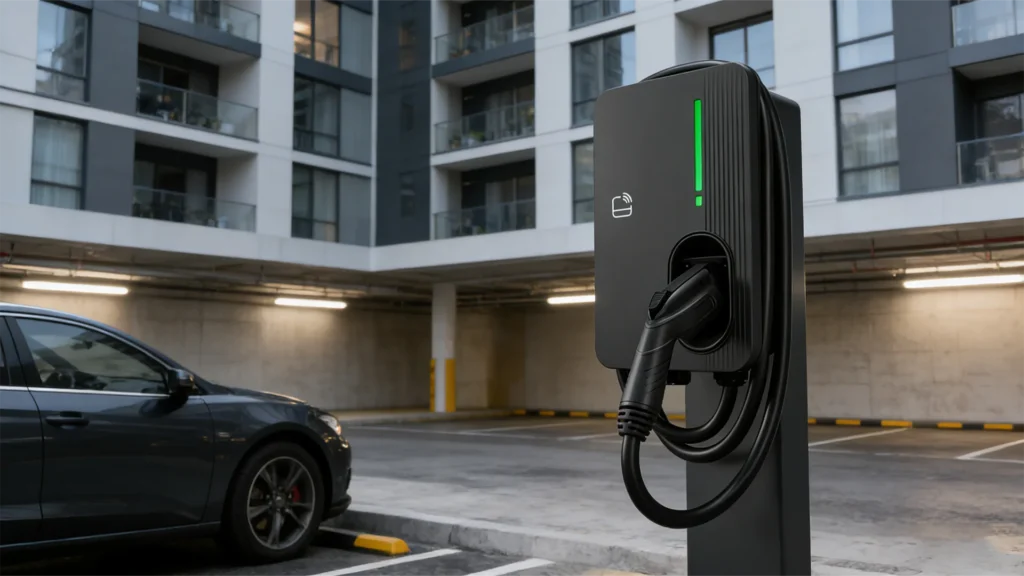
- Found in malls, offices, and parking garages
- Often networked and app-controlled
- Useful for top-up charging during the day
J1772 works seamlessly in both environments, which is why it remains the most widely deployed AC charging standard.
Is J1772 Future-Proof?
While DC fast charging standards continue to evolve, J1772 remains highly relevant for:
- Home charging
- Workplace charging
- Fleet and apartment installations
Even as NACS (Tesla connector) adoption grows, J1772 infrastructure is expected to remain in service for many years due to its massive installed base.
Common Questions About J1772 Plug (FAQ)
Can I charge my Tesla with a J1772 charger?
Yes, with a Tesla J1772 adapter. The charging rate depends on the model.
What is the difference between Level 1 and Level 2 charging?
Level 1 = 120V AC (~1.4 kW)
Level 2 = 240V AC (~7–19 kW)
Are all EVs in North America compatible with J1772?
Almost all non-Tesla EVs use J1772 for AC charging.
Can J1772 support fast charging?
Only AC fast charging. For DC fast charging, CCS or CHAdeMO is required.
Can J1772 support smart charging?
Yes. Many J1772 chargers support smart scheduling, load balancing, and energy monitoring.
Is J1772 suitable for commercial installations?
Absolutely. It is widely used in workplaces, hotels, retail parking, and fleet depots.
Tips for Choosing the Right J1772 EV Charger
- Power Output: 7.2 kW, 11 kW, or 19.2 kW depending on your EV
- Smart Features: App control, scheduling, energy monitoring
- Certifications: Look for UL, ETL, or ENERGY STAR certified chargers
- Installation: Ensure a licensed electrician installs Level 2 chargers
Conclusion
The J1772 plug remains the standard connector for AC charging in North America. By understanding compatibility, using adapters correctly, and choosing the right charger, EV owners can enjoy seamless charging experiences across multiple vehicle brands.
