
Last updated: July 15, 2026
California’s MyFirstEV programme is expected to lower the upfront cost of buying a first zero-emission vehicle. When it begins later in summer 2026, eligible Californians are expected to receive $3,500 off a qualifying new EV or $1,750 off a qualifying used EV directly at the dealership.
For vehicle buyers, the benefit is easy to understand: a lower purchase price.
For EV charging businesses, the faced question is more complex:
Where will these first-time EV owners charge, and which charging solutions will different sites need?
The answer will not be the same for every project. Some buyers will install an AC EV charger at home. Apartment residents may need shared residential or workplace charging. Dealerships may require a mix of AC and DC equipment, while public charging developers may need high-power DC chargers that meet California’s funding and compliance requirements.
For EPCs, CPOs, distributors, installers and site hosts, MyFirstEV is therefore not simply a signal to purchase more chargers. It is a reason to examine where demand may emerge, how customers will use each site and which charging architecture best matches the project.
What Is MyFirstEV?
MyFirstEV is California’s upcoming point-of-sale incentive for residents acquiring their first zero-emission vehicle.
According to the California Governor’s Office, the programme is expected to provide:
- $3,500 off an eligible new EV with an MSRP of up to $50,000;
- $1,750 off an eligible used EV sold for up to $25,000;
- an immediate discount applied at the dealership;
- support for Californians acquiring their first zero-emission vehicle.
California is investing $135.5 million in MyFirstEV. Participating automakers are expected to match that amount dollar for dollar, creating a projected $270 million in combined point-of-sale savings.
The exact launch date, participating automakers and complete verification process had not yet been published as of July 15, 2026.
For a detailed explanation of the rebate, vehicle price limits and current eligibility information, read:
What Is MyFirstEV? California’s New EV Rebate Explained
What Could MyFirstEV Change in California’s EV Market?
MyFirstEV is a demand-side policy. It is intended to make an EV more affordable, but it does not directly fund the charging equipment that a buyer may need afterwards.
That distinction matters because every additional EV creates a charging need, but not necessarily a need for the same type of charger.
A new EV owner may charge:
- overnight in a private garage;
- in an apartment or condominium car park;
- during the working day;
- at a dealership;
- while visiting a retail or leisure destination;
- at a public fast-charging station;
- through a combination of several locations.
The U.S. Department of Energy notes that most EV owners perform the majority of their charging at home, while workplace and public charging supplement residential charging. People living in multifamily housing may have limited access to private home charging and may depend more heavily on workplace or public infrastructure.
MyFirstEV could therefore support charging demand across several parts of the market rather than creating one single “next big charger category”.
More EV Buyers Do Not Automatically Mean More DC Fast Chargers
A common planning mistake is to assume that growing EV adoption should always be answered with more high-power DC fast charging.
DC fast charging is essential where drivers need rapid energy delivery, particularly along travel corridors or at sites serving vehicles with short turnaround times. However, it may not be the most economical or operationally suitable option for locations where vehicles remain parked for several hours.
The most important factor is usually dwell time: how long a vehicle stays at the site.
A car parked at home overnight may receive sufficient energy from an AC charger. An employee parked for eight hours may not benefit significantly from DC charging. A driver stopping for 20 minutes along a highway, by contrast, is much more likely to need DC fast charging.
The U.S. Department of Energy recommends that workplace and multifamily projects generally consider Level 1 and Level 2 charging, while public charging hosts may evaluate Level 2, DC fast charging or a combination based on the site’s purpose.
The right question is therefore not:
What is the most powerful charger available?
It is:
How much energy must each vehicle receive during the time it remains parked?
Which Charging Scenarios Could See New Demand?
Home Charging
A first-time EV buyer with a private garage or driveway is likely to consider home charging first.
Typical decisions include:
- plug-in or hardwired installation;
- J1772 or J3400/NACS connector;
- charging current;
- available electrical capacity;
- indoor or outdoor installation;
- scheduled charging;
- app connectivity;
- dynamic load management;
- future solar or energy-storage integration.
The U.S. Department of Energy’s home-charging guidance explains that homeowners can use Level 1 charging or install Level 2 equipment for faster charging.
Customer scenario
A homeowner purchases a first EV and requests the highest-power residential charger available. However, the home’s electrical service is already supporting air conditioning, electric cooking and other major loads.
Installing the charger at maximum output may require an expensive panel or service upgrade.
Dynamic load management could provide a more practical alternative. The system can adjust EV charging according to the electricity being used elsewhere in the home, helping the owner make better use of the available capacity.
For distributors and installers, the customer may therefore need more than the charger itself. They may also need:
- load-management accessories;
- installation guidance;
- app configuration;
- connector advice;
- clear commissioning instructions;
- after-sales support.
Multifamily projects can start with Joint Tech’s North American AC charging range, including networked residential and commercial Level 2 chargers for shared parking, user management and scalable deployment.
Multifamily Housing
Apartment and condominium residents may not have direct access to a private electrical circuit or assigned charging equipment.
The DOE multifamily charging resources identify several issues that property owners and managers need to consider, including electrical access, parking arrangements, equipment ownership, billing and resident access.
Customer scenario
A multifamily property wants to add chargers to 30 parking spaces, but the building cannot support all chargers operating at full power at the same time.
Providing a dedicated high-capacity circuit for every space may be expensive and difficult to scale.
A more practical design may use:
- networked commercial AC chargers;
- group load management;
- user authentication;
- energy metering;
- resident billing;
- scheduled charging;
- phased installation;
- capacity planning for future expansion.
In this case, the value of the project depends less on the power rating of each charger and more on how effectively the available capacity is shared across residents.
Workplace Charging
Employees commonly remain parked for several hours, making workplace charging a natural extension of home charging.
The DOE workplace-charging guidance recommends involving utilities, electrical contractors, charging providers and other project stakeholders early in the process.
Customer scenario
An employer wants to install 20 charging ports. The first proposal assumes that every port will operate at full output simultaneously, but the building’s electrical supply cannot support the proposed peak load.
Because employees remain parked for six to nine hours, full output may not be necessary throughout the working day.
The project could instead consider:
- dual-port commercial AC chargers;
- dynamic load balancing;
- scheduled power allocation;
- employee authentication;
- OCPP-based management;
- charging limits;
- future expansion planning.
This approach can align energy delivery with the length of the working day while reducing pressure on the site’s available electrical capacity.
Multifamily projects can start with Joint Tech’s North American AC charging range, including networked residential and coFor workplaces and shared commercial car parks, the EVM005 dual-port commercial EV charger provides a practical Level 2 starting point for serving multiple vehicles with networked charging and project-level management.mmercial Level 2 chargers for shared parking, user management and scalable deployment.
Dealership Charging
Dealerships have a direct connection to MyFirstEV because the incentive is expected to be applied at the point of sale.
A dealership may need charging for:
- vehicle preparation before collection;
- showroom and demonstration vehicles;
- test-drive fleets;
- customer vehicles during servicing;
- employee vehicles;
- customer-facing charging;
- first-time EV buyer education.
Customer scenario
A dealer group needs several vehicles ready for customer delivery every morning while also supporting test drives and service operations during the day.
The dealership should first calculate:
- how many vehicles must be ready each day;
- how much energy each vehicle requires;
- whether overnight AC charging can meet most delivery schedules;
- whether selected DC chargers are needed for urgent turnaround;
- whether customer charging will be free or paid;
- how equipment will be managed across multiple locations.
A combination of AC and DC equipment may be more practical than using the same charger type for every dealership activity.
Standardising hardware, software and operating procedures across sites can also simplify employee training, maintenance and data management.
Retail and Destination Charging
Retail centres, restaurants, offices, hotels and leisure destinations may use charging as an amenity, customer-retention tool or paid service.
The appropriate charging type depends on how long visitors remain at the site.
A customer staying for two hours may receive meaningful energy from an AC charger. A driver stopping for 15–30 minutes is more likely to expect DC fast charging.
Customer scenario
A retail property assumes that installing DC fast chargers will automatically attract more drivers. However, visitors typically remain on site for 60–120 minutes, and the utility upgrade required for high-power equipment would significantly increase the project cost.
The site should compare:
- customer dwell time;
- expected charger utilisation;
- AC and DC installation costs;
- utility capacity;
- electricity tariffs and demand charges;
- payment requirements;
- maintenance responsibilities;
- whether charging is intended to earn revenue or improve the customer experience.
An AC deployment, mixed AC/DC solution or phased installation may provide a better fit than an all-DC approach.
Public DC Fast Charging
Public fast charging remains important for highway travel, urban drivers without reliable home charging and users who require rapid turnaround.
California supports this infrastructure separately through CALeVIP. Two upcoming Fast Charge California Project windows will provide incentives for eligible ready-to-build public DC fast-charging projects.
The relationship between the programmes is straightforward:
| Programme | What it supports | Primary audience |
|---|---|---|
| MyFirstEV | Acquisition of an eligible first ZEV | California vehicle buyers |
| CALeVIP | Eligible public DC fast-charging projects | Site owners and authorised project applicants |
MyFirstEV may support vehicle demand, while CALeVIP helps fund part of the public infrastructure needed to serve those vehicles.
For the latest application dates, incentive amounts and equipment requirements, read:
CALeVIP 2026 Funding: Up to $100K per Charging Port
Customer scenario
An EPC or charging developer plans to apply for CALeVIP support and begins comparing DC fast chargers.
The equipment’s advertised power and purchase price are only two parts of the decision. The project may also need to confirm:
- guaranteed output per port;
- CCS and J3400 connector configuration;
- CALeVIP equipment eligibility;
- OCPP requirements;
- payment options;
- reliability and uptime requirements;
- API and data-reporting capabilities;
- ENERGY STAR and applicable safety certifications;
- utility service design;
- permitting;
- commissioning schedule.
Ordering equipment before these requirements are confirmed can lead to redesign, project delays or loss of incentive eligibility.
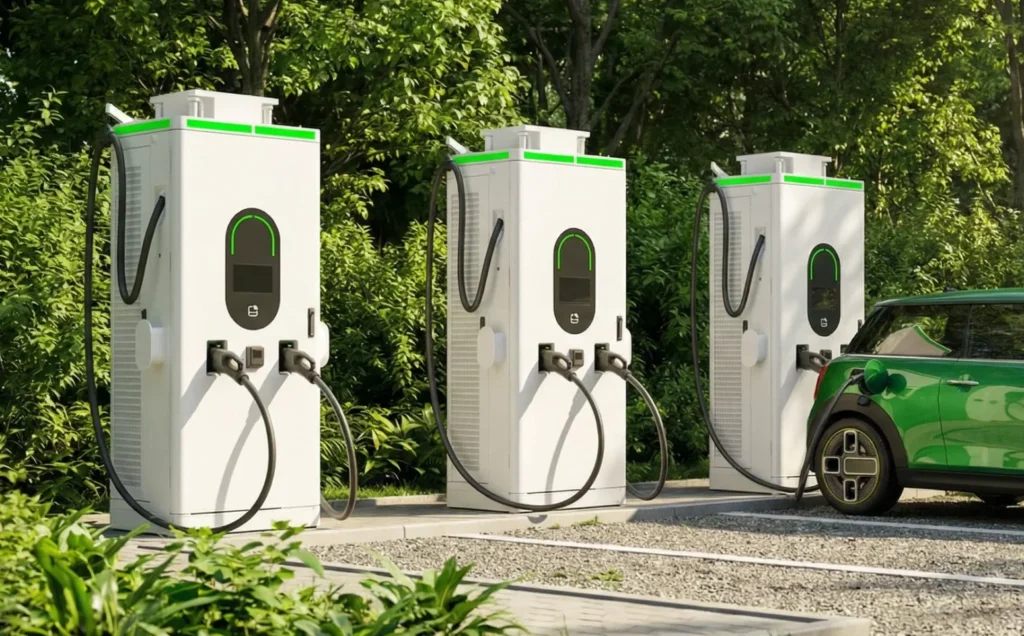
For North American public and commercial fast-charging projects, explore the JAVELIN 60–120 kW DC fast charger and Joint Tech’s broader CCS1 and J3400/NACS DC charging range.
For CALeVIP-funded projects, always confirm the required guaranteed output and verify that the selected equipment appears on the programme’s current eligible-equipment list before procurement.
Fleet and Commercial Charging
MyFirstEV is intended for consumer vehicle buyers and does not directly fund fleet vehicles. However, broader EV adoption may still affect employee charging, public infrastructure utilisation and the charging services available to commercial operators.
Fleet charging must be designed around operational schedules rather than general customer convenience.
Customer scenario
A fleet needs every vehicle ready by 6:00 a.m., but charging all vehicles simultaneously would create a large demand peak.
The project may require:
- vehicle duty-cycle analysis;
- departure schedules;
- managed charging;
- power allocation by vehicle priority;
- AC or DC charging based on dwell time;
- EMS integration;
- electricity tariff optimisation;
- optional solar and battery storage;
- remote monitoring;
- operational redundancy.
The measure of success is not simply charger utilisation. It is whether every required vehicle is ready for its assigned route.
Fleet operators can explore the EVH007 fleet charging solution or review Joint Tech’s wider fleet and logistics charging solutions for managed AC, DC fast charging and scalable depot planning.
When Should a Project Choose AC or DC Charging?
AC and DC chargers solve different operational problems. One is not universally better than the other.
| Project scenario | Typical dwell time | Practical starting point | Main consideration |
|---|---|---|---|
| Detached home | Overnight | Residential AC chargers | Household capacity |
| Multifamily property | Overnight | Networked AC chargers | Shared power and billing |
| Workplace | 4–9 hours | Dual-port commercial AC charging | Load distribution |
| Dealership | Mixed | AC chargers + DC fast chargers | Vehicle preparation |
| Retail destination | 30 minutes–3 hours | Commercial AC or DC fast charging | Visitor dwell time |
| Public travel site | 15–45 minutes | North American DC fast chargers | Rapid turnaround |
| Fleet depot | Scheduled | Fleet charging solutions | Routes and departure times |
Before selecting equipment, the project team should answer:
- Who will use the chargers?
- How long will vehicles remain parked?
- How much energy must each vehicle receive?
- How many vehicles may charge simultaneously?
- How much electrical capacity is available?
- Will users need payment or authentication?
- Must the charger connect to an existing CSMS?
- Which vehicle connectors are required?
- How will the equipment be maintained?
- Will the site expand later?
These questions help determine whether the project needs residential AC, commercial AC, DC fast charging or a combination.
What Should EPCs, CPOs and Site Hosts Prepare For?
EPCs
An EPC—Engineering, Procurement and Construction contractor—may manage the project from site design through equipment procurement, construction, commissioning and handover.
Before procurement, an EPC may need to confirm:
- utility and site capacity;
- project permits;
- charger output;
- connector configuration;
- safety certification;
- incentive eligibility;
- backend compatibility;
- payment requirements;
- network responsibility;
- lead time;
- commissioning support.
A manufacturer that only supplies a price list leaves many project interfaces unresolved.
EPCs generally benefit from suppliers that can provide:
- complete technical datasheets;
- submittal documentation;
- certification files;
- electrical and communication requirements;
- drawings and installation manuals;
- OCPP integration assistance;
- project-specific configuration;
- commissioning support;
- clear delivery coordination.
CPOs and EV service providers
CPOs need to evaluate the complete charging operation, including:
- charger hardware;
- CSMS compatibility;
- OCPP;
- payment;
- pricing;
- remote diagnostics;
- uptime;
- customer support;
- reporting;
- maintenance and spare-parts planning.
A technically capable charger may still be unsuitable if it cannot integrate reliably with the selected operating platform.
Site hosts and property owners
Site hosts should begin by defining the purpose of the charging service.
Questions include:
- Is charging an amenity or a revenue source?
- Who owns the equipment?
- Who pays for installation and electricity?
- How long will users park?
- Is payment required?
- Who is responsible for maintenance?
- How will the site expand?
Distributors and installers
Distributors and installers may receive enquiries from homeowners, landlords, employers, dealerships and small commercial sites.
They may need:
- a suitable residential and commercial product portfolio;
- J1772 and J3400/NACS options;
- clear installation documentation;
- load-management solutions;
- commissioning support;
- product training;
- stable supply;
- an effective after-sales process.
Dealership groups
Dealer groups may need to connect vehicle sales with charging education and installation support.
A first-time EV buyer may ask:
- Which home charger works with the vehicle?
- Do I need a panel upgrade?
- Can the charger be installed outdoors?
- How long will charging take?
- Is J1772 or NACS required?
- Can charging be scheduled?
- Is there an installer available?
A coordinated charger and installation programme can help dealerships provide a more complete EV ownership experience.
Why Charger Selection Should Not Start with a Product Model
Many projects begin with a request such as:
“Please quote ten 180 kW chargers.”
But without site and operating information, the requested specification may not match the actual project.
Common problems include:
Insufficient utility capacity
The site may require a utility upgrade, transformer work, managed charging or a different charger mix.
Charger power does not match dwell time
High-power DC equipment may add cost without producing enough operational value at a long-dwell site.
Backend incompatibility
The selected charger may not integrate with the customer’s existing CSMS, creating delays or unexpected development work.
Incorrect connector strategy
The project may need J1772, J3400/NACS, CCS1 or a combination depending on the target vehicles.
Payment considered too late
Public or shared charging may require payment hardware, user authentication or network support that was not included in the initial equipment specification.
Missing project documentation
The EPC, utility, authority having jurisdiction or incentive administrator may request technical documentation that cannot be produced quickly.
No expansion plan
Adding chargers later may require new trenching, switchgear and electrical upgrades that could have been anticipated during the initial design.
A project-requirement review should therefore come before the final quotation.
How Can a Manufacturer Support the Project?
An EV charger manufacturer cannot replace the EPC, installer, utility, CPO or site owner. It can, however, reduce uncertainty between these stakeholders.
A suitable manufacturing partner should help clarify:
- which charging type matches the use case;
- power available per port;
- load-sharing and dynamic-load-management options;
- connector configurations;
- market certifications;
- OCPP compatibility;
- payment options;
- network and data requirements;
- commissioning;
- maintenance;
- OEM or ODM requirements.
As EV adoption expands beyond early adopters, the customer experience becomes increasingly important. First-time EV owners expect charging to be straightforward, reliable and easy to understand.
The businesses serving them need equipment that can be integrated, operated and supported—not simply installed.
How Joint Tech Supports Different Charging Scenarios
Joint Tech works with North American charging brands, distributors, EPCs, CPOs and solution providers across residential, commercial and public charging projects.
Project discussions typically begin with:
- target vehicles;
- expected dwell time;
- available site power;
- network and payment requirements;
- certification requirements;
- ownership and operating model;
- future expansion.
Residential AC charging
Residential solutions can support requirements such as:
- J1772 and J3400/NACS configurations;
- plug-in or hardwired installation;
- scheduled charging;
- app connectivity;
- dynamic load management;
- outdoor installation;
- selected OCPP options.
These functions can help first-time EV buyers charge conveniently while managing available household electrical capacity.
Commercial AC charging
Networked commercial AC charging can support:
- multifamily properties;
- workplaces;
- dealerships;
- retail and destination sites;
- employee and tenant charging.
Project capabilities may include:
- single- and dual-port configurations;
- user authentication;
- OCPP integration;
- load balancing;
- payment integration on selected products;
- remote monitoring;
- OTA updates.
DC fast charging
North American DC fast-charging solutions can support:
- public charging;
- dealerships;
- fleet sites;
- commercial destinations;
- higher-turnover charging applications.
Project options may include:
- CCS1 and J3400/NACS configurations;
- different power levels;
- OCPP integration;
- network connectivity;
- payment options;
- remote diagnostics.
Eligibility for an incentive programme must always be verified against the programme’s current equipment list and technical requirements before procurement.
OEM and ODM support
Charging brands and solution providers may need equipment that matches an existing product identity, software platform or route to market.
Joint Tech supports OEM and ODM requirements involving:
- product configuration;
- branding;
- connector selection;
- backend integration;
- certification coordination;
- pilot production;
- manufacturing;
- technical support.
The objective is not only to supply charging hardware. It is to help partners translate a market requirement into a product and deployment plan that can be manufactured, integrated and supported.
What MyFirstEV Does—and Does Not—Tell the Market
MyFirstEV shows that California is continuing to use policy to reduce the upfront cost of EV adoption.
It does not yet tell businesses:
- how many additional EVs will be sold;
- where buyers will live;
- how many will have private parking;
- how frequently they will use public chargers;
- which sites will see the greatest utilisation increase;
- whether every planned charging site should expand immediately.
Businesses should therefore avoid treating the policy as a guaranteed demand forecast.
It is better used as one planning signal alongside:
- local EV registrations;
- housing type;
- traffic patterns;
- existing charger utilisation;
- customer surveys;
- utility capacity;
- nearby charging coverage;
- vehicle mix;
- project economics.
MyFirstEV may strengthen the case for charging investment, but site-level evidence should determine the final project design.
Key Takeaway
MyFirstEV could make it easier for more Californians to acquire their first zero-emission vehicle. That may support charging demand across homes, apartments, workplaces, dealerships, destinations and public charging sites.
However, the resulting demand will not be uniform.
A homeowner, apartment resident, employee, retail customer and highway traveller each need a different charging experience. Charger selection should reflect dwell time, energy demand, site capacity, payment, software, vehicle connectors and future expansion.
For EPCs, CPOs, distributors, installers and site hosts, the key question is not simply:
How many more chargers will California need?
It is:
Which charging experience will our users need, and how should the project be designed to deliver it reliably?
Frequently Asked Questions
Will MyFirstEV pay for a home charger?
The initial MyFirstEV announcement describes incentives for eligible new and used vehicles. It does not announce a separate MyFirstEV charger rebate.
Buyers should check utility, local and state charging programmes separately.
Will MyFirstEV increase EV charging demand?
It could support additional demand by reducing the upfront cost of a first EV. The scale and location of that demand will depend on vehicle sales, housing, parking access and driving behaviour.
Which charging scenario could see the greatest impact?
There is no single answer. Homeowners may need residential AC charging, apartment residents may need shared charging, workplaces may see employee demand, and drivers without home charging may rely more heavily on public stations.
Is AC or DC charging better?
AC charging is generally suitable when vehicles remain parked for several hours. DC fast charging is more appropriate when rapid energy delivery and vehicle turnover are important.
What should an EPC confirm before ordering chargers?
An EPC should confirm site capacity, utility requirements, permits, charger output, connectors, certifications, incentive eligibility, backend integration, networking, payment, lead time and commissioning requirements.
How could MyFirstEV affect dealerships?
Dealerships may need additional charging for vehicle preparation, test drives, servicing, customer delivery and first-time EV buyer education.
How is MyFirstEV different from CALeVIP?
MyFirstEV is a vehicle incentive for eligible first-time ZEV buyers. CALeVIP supports eligible EV charging infrastructure projects.
Should businesses install chargers based only on MyFirstEV?
No. The policy is a market signal, but investment decisions should still be based on local demand, vehicle dwell time, utility capacity, expected utilisation and project economics.
Official Sources
- California Governor’s Office: MyFirstEV announcement
- U.S. Department of Energy: EV Charging at Home
- U.S. Department of Energy: Multifamily Charging
- U.S. Department of Energy: Workplace Charging
- U.S. Department of Energy: Public Charging
- U.S. Department of Energy: Charging Infrastructure Procurement and Installation
- CALeVIP: Upcoming Rebates
MyFirstEV and CALeVIP requirements may change as California publishes additional implementation guidance. Buyers and project stakeholders should verify the latest official information before making purchasing or investment decisions.
