
Key Takeaways
- SAE J3400 is the open standard for NACS, published by SAE International as a TIR in December 2023, elevated to Recommended Practice in September 2024.
- The standard specifies a 5-pin connector capable of up to 1,000V DC / 500A — future-proofing it for 800V vehicle architectures.
- J3400 replaces both SAE J1772 (AC Level 2) and CCS1 (DC fast charging) on 2025+ model year vehicles from virtually every major OEM.
- NEVI federal funding requires a CCS connector alongside any J3400 connector — dual-standard deployment is currently the only compliant strategy for federally funded sites.
- The standard family now includes J3400 (system spec), J3400/1 (adapters, April 2025), and J3400/2 (connectors & inlets, May 2025).
- FHWA confirmed on December 11, 2024 that J3400 connectors and equipment are eligible for NEVI and Title 23 funding.
On This Page
What Is SAE J3400?
SAE J3400 is the formal industry standard for the North American Charging System (NACS) EV coupler — the compact, 5-pin connector that Tesla originally developed in 2012 for the Model S and opened to the industry in December 2022.
SAE International formed a task force in June 2023 to standardize the NACS design on an expedited timeline. The Technical Information Report (TIR) was published on December 18, 2023. Following a vote by the SAE EV Coupler Task Force on November 5, 2024, the document was elevated to an official Recommended Practice, published as J3400_202409 on September 30, 2024.
The standard covers the physical, electrical, functional, safety, and performance requirements for conductive power transfer using a hand-matable coupler capable of transferring either DC or single-phase AC power. With any manufacturer now free to produce J3400-compliant hardware independently of Tesla, NACS has transitioned from a proprietary Tesla system into an open, interoperable industry standard.
The J3400 Standard Family: J3400, J3400/1, J3400/2
SAE J3400 is not a single document — it is a family of three standards, each addressing a distinct layer of the connector ecosystem. Understanding all three is essential for engineers specifying hardware and CPOs evaluating compliance.
| Standard | Title | Published | Scope |
|---|---|---|---|
| SAE J3400 | North American Charging System (NACS) for Electric Vehicles | Dec 2023 (TIR) Sep 2024 (RP) | System-level specification: communication protocol, AC/DC power transfer, cybersecurity, V2X capability, safety and performance requirements |
| SAE J3400/1 | Electric Vehicle Charging Adapter Safety and OEM-Qualified Device Designation | April 2025 | Adapter requirements: physical, electrical, functional, and performance specs for adapters between SAE J3400 and SAE J1772. Defines OEM-qualified adapter designation process.[3] |
| SAE J3400/2 | Connectors and Inlets for the North American Charging System (NACS) | May 2025 | Physical and mechanical specifications for connectors and inlets: 2D mechanical drawings and 3D models for up to 1,000V operation. Enables OEMs and EVSE manufacturers to design interoperable hardware without direct Tesla involvement. |
Adapter Safety NoteJ3400/1 was created specifically because of safety concerns about non-standardized adapters flooding the market. The standard addresses latch/lock mechanisms, temperature-limiting safety features, and power delivery capability requirements. Vehicle manufacturers have liability concerns about unqualified adapters — J3400/1 creates a documented OEM-qualified designation process.[3]
Technical Specifications
Electrical Ratings
| Parameter | Value | Notes |
|---|---|---|
| Maximum DC Voltage | 1,000V DC | Upgraded from 500V in original Tesla NACS hardware; standardized in J3400/2 (May 2025)[4] |
| Maximum AC Voltage | 277V AC | Single-phase AC for Level 1 and Level 2 charging[5] |
| Maximum Current (AC Level 2) | 80A continuous | Supports up to ~19.2 kW at 240V |
| Maximum Current (DC) | 500A continuous | Supports up to 350 kW at 700V; 500 kW at 1,000V in high-power configurations[6] |
| Number of Pins | 5 pins | Shared-pin design: same pins carry both AC and DC power[5] |
| Communication (Basic) | PWM via Control Pilot (CP) | SAE J1772-compatible basic signaling for safety interlocks |
| Communication (High Level) | PLC via CP pin | DIN SPEC 70121 / ISO 15118 for Plug & Charge and V2G bidirectional communication |
| Bidirectional (V2G/V2H) | Supported | Native V2G capability via ISO 15118-20; defined in J3400/2[4] |
| Safety Certification | UL 2251 | Updated by UL to cover both NACS and J3400 connector geometries[1] |
| Adapter Safety Certification | UL 2252 | Published by UL specifically for EV charging adapters; manufacturers can certify against this standard[7] |
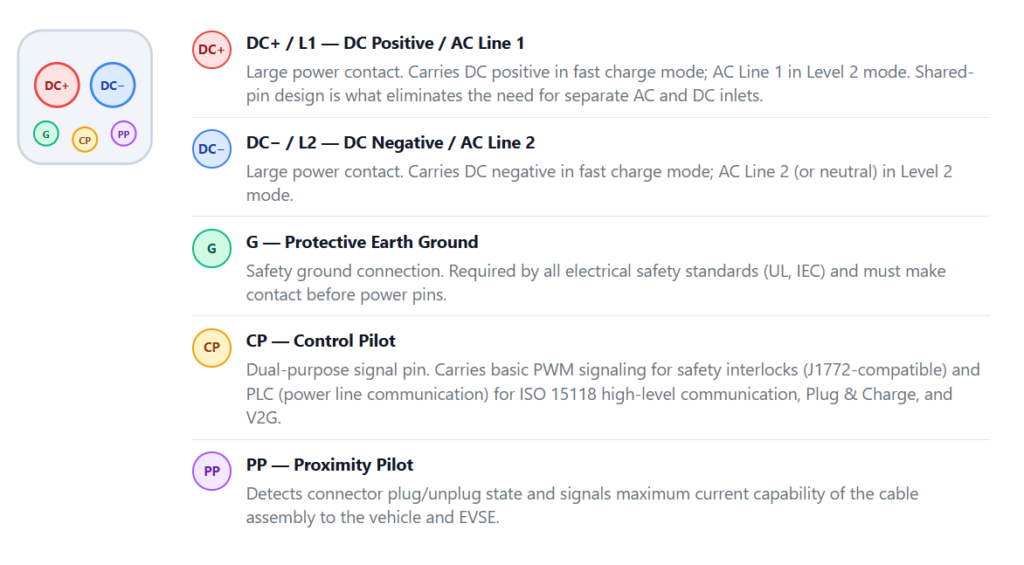
5-Pin Configuration (Pinout)
The J3400 connector uses a shared-pin architecture — the same two large power pins carry either AC or DC current depending on the charging mode. This is what allows a single compact connector to replace both the J1772 AC connector and the CCS1 DC combo connector.DC+DC−GCPPP
SAE J3400 vs. Tesla Proprietary NACS: What’s Different?
The terms “NACS” and “SAE J3400” are often used interchangeably — but there are important distinctions for procurement and compliance purposes.
| Dimension | Tesla Proprietary NACS (pre-2022) | SAE J3400 (2023–present) |
|---|---|---|
| Governing body | Tesla, Inc. | SAE International (independent standards body) |
| Open access | ✗ Proprietary, restricted | ✓ Fully open; any manufacturer can produce compliant hardware |
| Maximum DC voltage | 500V (original hardware) | 1,000V (standardized in J3400/2, May 2025)[4] |
| Formal compliance testing | ✗ No formal certification required | ✓ UL 2251 (connector), UL 2252 (adapters) |
| Adapter standard | ✗ None defined | ✓ J3400/1 (April 2025) with OEM-qualified designation process |
| Connector CAD/drawings | ~ Tesla specification only | ✓ J3400/2 provides official 2D drawings and 3D models |
| NEVI funding eligibility | ✗ Not recognized by FHWA before 2024 | ✓ FHWA confirmed eligible (Dec 11, 2024)[8] |
| Physical connector | Backward compatible — J3400 inlets accept both original NACS and new J3400 connectors[4] | |
Procurement ImplicationRequiring “NACS compatible” from a vendor is not enough. Demand documentation of formal SAE J3400 conformance and UL 2251 listing. A vendor can claim NACS compatibility based on the original Tesla spec without meeting the higher voltage (1,000V), cybersecurity, or testing requirements introduced in SAE J3400.
NEVI Compliance & Federal Recognition
The National Electric Vehicle Infrastructure (NEVI) Formula Program, funded at $5 billion under the 2021 Bipartisan Infrastructure Law, is the primary federal mechanism for deploying public EV charging across US interstate corridors.[9] Understanding its connector requirements is critical for any CPO or infrastructure developer seeking NEVI funding.
The Current Rule: CCS1 Is Still Required
Critical for CPOs Seeking NEVI Funds23 CFR 680 requires a permanently attached CCS1 connector on every DCFC port at federally funded stations. J3400 connectors and equipment are eligible for NEVI funds — but only when a CCS1 connector is also present. Installing J3400-only hardware will not satisfy NEVI requirements under current rules.[8]
What FHWA Actually Said (December 11, 2024)
On December 11, 2024, FHWA published updated Q&A guidance confirming that J3400 connectors and supporting equipment can be installed at NEVI sites using federal funds — as long as CCS compliance is maintained.[8] The same guidance confirmed that the J3400 standard became an industry Recommended Practice following the SAE Task Force vote on November 5, 2024.
NEVI Interoperability Requirements (as of February 2024)
| Requirement Layer | Standard Required | Notes |
|---|---|---|
| Charging Port Connector | CCS1 (required); J3400 (permitted alongside) | Minimum 4 network-connected DCFC ports per station, each capable of 150 kW[9] |
| EV-to-Charger Communication | ISO 15118-2 + Plug & Charge | Plug & Charge capability required for all federally funded chargers[10] |
| Charger-to-Network | OCPP 2.0.1 | Required for all NEVI-funded DCFC hardware[10] |
| Network-to-Network Roaming | OCPI 2.2.1 | Enables cross-network interoperability for EV drivers[10] |
| Uptime Requirement | 97% per port | Measured monthly; non-compliance can trigger funding recapture |
Joint ‘s EVD series DC fast chargers support both CCS2 (J1772 Combo / CCS1 in North America) and can be configured with dual-connector outputs. All EVD units support OCPP 2.0.1 and ISO 15118-2 (Plug & Charge) — satisfying the full interoperability stack required for NEVI compliance.
OEM Adoption Timeline
The pace of J3400 adoption has been, by standards-body norms, extraordinarily fast. From Tesla opening the design in December 2022 to a full SAE Recommended Practice in September 2024 — under two years.
- Dec 2022 : Tesla opens NACS. Tesla publishes the NACS connector specification and invites industry adoption.
- May 2023 : Ford first mover. Ford becomes the first non-Tesla OEM to announce J3400 adoption for North American vehicles, starting 2025 MY. GM follows within weeks.
- Jun 2023 : SAE task force formed. SAE International establishes the J3400 NACS task force on an expedited timeline, targeting year-end publication.
- Dec 18, 2023 : SAE J3400 TIR published. SAE International releases the Technical Information Report — the first official standardization of NACS.
- 2023–2024 : Broad OEM alignment. Rivian, Volvo, Polestar, Mercedes-Benz, Nissan, Honda, Toyota, Hyundai, Kia, BMW, Volkswagen Group — virtually all major light-duty OEMs selling in North America announce J3400 adoption.
- Aug 2024 : SAE Task Force votes for Recommended Practice. Formal elevation of J3400 status, enabling citation in regulations.
- Sep 30, 2024 : SAE J3400_202409 published. Full Recommended Practice document released — the standard is complete and citable in procurement specs and regulations.
- Dec 11, 2024 : FHWA Q&A update. FHWA confirms J3400 connectors and equipment are eligible for NEVI and Title 23 federal funding alongside required CCS connectors.
- MY 2025+ : Native J3400 ports in new EVs. Ford, GM, Rivian, Lexus, and others begin shipping vehicles with built-in J3400 inlets — no adapter needed for Supercharger and J3400-equipped public chargers.
- Apr 2025 : SAE J3400/1 published. Adapter safety and OEM-qualified device designation standard released, addressing proliferation of substandard adapters.
- May 2025 : SAE J3400/2 published. Connector and inlet physical/mechanical standard released with 2D drawings and 3D models for 1,000V operation.
Global Expansion: J3400 Beyond North America
Despite the word “North American” in the standard’s name, J3400/NACS adoption is expanding outside the continent. The dynamics are driven by OEM global platform consolidation — automakers want a single connector across all markets where possible.
| Market / OEM | Status | Notes |
|---|---|---|
| USA & Canada | ✓ Dominant — deploying now | All major OEMs committed; Supercharger network open; public DCFC adding J3400 ports |
| Japan & South Korea | Announced 2027+ | Currently use J1772 (AC) and CHAdeMO / CCS1 (DC). J3400 technically viable given J1772 compatibility |
| Europe | Type 2 / CCS2 dominant | AFIR mandates CCS2 for new EU public charging. J3400 not on a regulatory adoption path; CharIN (CCS body) has noted the parallel development |
| China | GB/T dominant; ChaoJi developing | Different regulatory environment; GB/T 20234 is mandated. J3400 not relevant for domestic China market |
| Southeast Asia | Mixed; watching OEM signals | Markets with high Japanese OEM penetration (Thailand, Malaysia) likely to follow Japan OEM decisions on J3400 |
The “North American” label is increasingly a misnomer. As Japanese and Korean OEM adoption announcements emerge, “J3400” or “NACS” will be more accurate market descriptions than “North American Charging Standard.” Infrastructure planners and equipment buyers in APAC should monitor OEM announcements closely through 2026–2027.
Frequently Asked Questions
-
Are SAE J3400 and NACS the same thing?
Effectively yes — but with important distinctions. NACS refers to the connector design and name; SAE J3400 is the formal open standard that governs it. The physical connector is the same, but SAE J3400 adds: formal compliance testing requirements (UL 2251), a higher voltage rating (1,000V vs the original 500V Tesla hardware), defined adapter standards (J3400/1), and mechanical drawings available to all manufacturers (J3400/2). When specifying hardware in a B2B or government procurement context, always reference SAE J3400, not “NACS compatible.”
-
Can a J3400 charging station charge a CCS1 vehicle?
Not directly — the connectors are physically incompatible. However, UL 2252-certified CCS1-to-J3400 adapters allow CCS vehicles to charge at J3400 ports. Major OEMs (Ford, GM, Rivian) shipped CCS-to-J3400 adapters to existing customers starting in 2024, specifically to enable access to Tesla Superchargers and J3400-equipped stations. The adapter supports both AC Level 2 and DC fast charging through the J3400 port.
-
What is the maximum power output of a J3400 charger?
The SAE J3400 standard supports up to 1,000V DC and 500A continuous current — theoretically enabling up to 500 kW. Current deployed hardware typically operates at 150–350 kW. Tesla V4 Superchargers deliver up to 250 kW for compatible vehicles. As 800V vehicle architectures (Porsche Taycan, Hyundai Ioniq 6, Lucid Air, and others) proliferate, J3400 infrastructure supporting 350–500 kW will become the recommended specification for new deployments through the 2020s.
-
When does J3400 harware need to support V2G bidirectional charging?
V2G (vehicle-to-grid) capability is defined in J3400/2 (May 2025) and communicated via ISO 15118-20. However, there is currently no regulatory requirement or federal mandate that J3400 EVSE must support V2G. V2G-capable J3400 infrastructure is emerging in commercial markets — particularly for fleet depot applications where grid services revenue is part of the business model — but it requires both a V2G-capable vehicle and V2G-capable EVSE. Buyers purchasing DCFC hardware today should confirm the firmware upgrade path to V2G rather than expecting immediate capability.
-
Is there a physical difference between the original NACS connector and SAE J3400?
The inlet (vehicle side) is geometrically identical — backward compatibility was a design requirement. The connector (cable side) has a hardware change in J3400 for 1,000V operation: increased isolation between the positive and negative terminals. This means new J3400 connectors fit all NACS inlets (old and new), but older NACS connectors rated for 500V should not be used at 1,000V DC applications.
-
How does a vendor prove SAE J3400 comliance?
Legitimate SAE J3400 compliance evidence should include: (1) a UL 2251 certificate of compliance explicitly listing J3400 connector geometry; (2) documentation referencing conformance with J3400_202409 (the Recommended Practice); and (3) for adapters, UL 2252 certification. Vendors who only provide the original Tesla NACS connector spec or informal testing data are not demonstrating SAE J3400 compliance. A procurement contract should specify J3400_202409 and UL 2251 as minimum requirements.
