

Sourcing EV Chargers 2026: A Complete Guide for Global Business Buyers
The global EV charging infrastructure market was valued at approximately $40–48 billion in 2025, depending on methodology — and every credible forecast puts the 2030 figure above $250 billion at a compound annual growth rate of 25–27%. The hardware demand driving that growth is real and accelerating: according to the International Energy Agency’s Global EV Outlook 2025, electric car sales exceeded 17 million globally in 2024 — more than one in five cars sold worldwide, up 25% year-over-year. Q1 2025 was up another 35% from Q1 2024. Public charging networks need to grow sixfold by 2035 to keep pace, per IEA projections.
For business buyers — distributors, CPOs, contractors, installers, and fleet operators — this growth creates both a significant opportunity and a sourcing challenge. The global EV charger supply chain is complex, inconsistently regulated, and full of suppliers whose quality claims are difficult to verify without a structured framework.
This guide covers everything you need to make an informed sourcing decision: OEM vs. ODM vs. private label, what’s actually inside a DC fast charger, certification requirements by market, how to verify OCPP compliance, a 10-point supplier audit, and how to structure a sourcing process that protects you from the most common failure modes.
Who this guide is for: Distributors building their own brand, CPOs deploying charging networks, electrical contractors bidding on EV infrastructure projects, fleet operators electrifying depots, and installers looking for reliable hardware. The sourcing decision is different for each — use the Quick Start below to go directly to what matters most for your situation.
Quick Start: Find Your Section
| You are… | Jump to | Your core questions |
|---|---|---|
| Distributor / Reseller | Part 2: OEM vs ODM vs Private Label | MOQ, branding, margin, what you own |
| CPO / Network Operator | Part 3: OCPP Compliance | OCPP version, CSMS compatibility, uptime, after-sales |
| Electrical Contractor | Part 2C: Certifications | UL/CE marking, installation docs, bid support |
| Fleet Operator | Part 4: Supplier Audit | Reliability, load management, warranty |
| Installer | Part 8: After-Sales | Technical support, spare parts, RMA process |
Part 1: Three Questions Every Buyer Must Answer Before Contacting Any Supplier
Most sourcing problems — wrong hardware, missed deadlines, certification gaps — start here. Eighty percent of buyers who have a difficult first sourcing experience skipped at least one of these questions.
Question 1: What Problem Am I Actually Solving for My Customer?
This sounds obvious. It isn’t. The answer determines the power level, the certification, the OCPP version, the connector type, and the after-sales structure — before you look at a single product listing.
1. Distributor:
What does your end customer need — power level, mounting, connector type? What certifications does your market require? What price point is competitive?
2.CPO:
What uptime SLA are you promising site hosts? What CSMS are you running? Do you need OCPI roaming?
3.Contractor:
What does the project spec say about certifications, power levels, and installation configurations? What’s the AHJ likely to require?
4.Fleet operator:
How many vehicles? What daily mileage? Overnight Level 2 AC or DC fast charging needed? (See our Fleet Depot Charging Guide for the full framework.)
Question 2: What Is My Real Timeline?
| Scenario | Realistic Timeline | Common Mistake |
|---|---|---|
| Sample / pilot units | 4–8 weeks | Expecting 2 weeks |
| Certification transfer (CE/UL to your entity) | 2–4 months | Assuming factory cert covers your sales |
| Private label / ODM batch | 8–14 weeks total | Treating it like a stock order |
| OEM full custom (hardware changes) | 16–24 weeks minimum | Comparing to ODM lead time |
Question 3: What Is My Risk Tolerance?
There is no objectively correct answer — but be explicit about it before you start:
Low-risk approach: Established manufacturer, multiple market certifications, verifiable reference customers, higher per-unit cost, longer qualification timeline. Right for regulated projects, large deployments, or CPOs with uptime SLAs.
Medium-risk approach: Certifications in place, newer manufacturer or limited references. Order 5–10 pilot units, run a 60-day soak test, review results before bulk commitment.
High-risk approach: Lowest-price supplier, unverifiable certifications, no reference customers. Not recommended for any application where charger failure creates safety or revenue risk.
Part 2: OEM, ODM, and Private Label — What You’re Actually Choosing
These three terms are used interchangeably and incorrectly in most supplier conversations. They describe fundamentally different commercial arrangements with different IP implications, timelines, and cost structures.
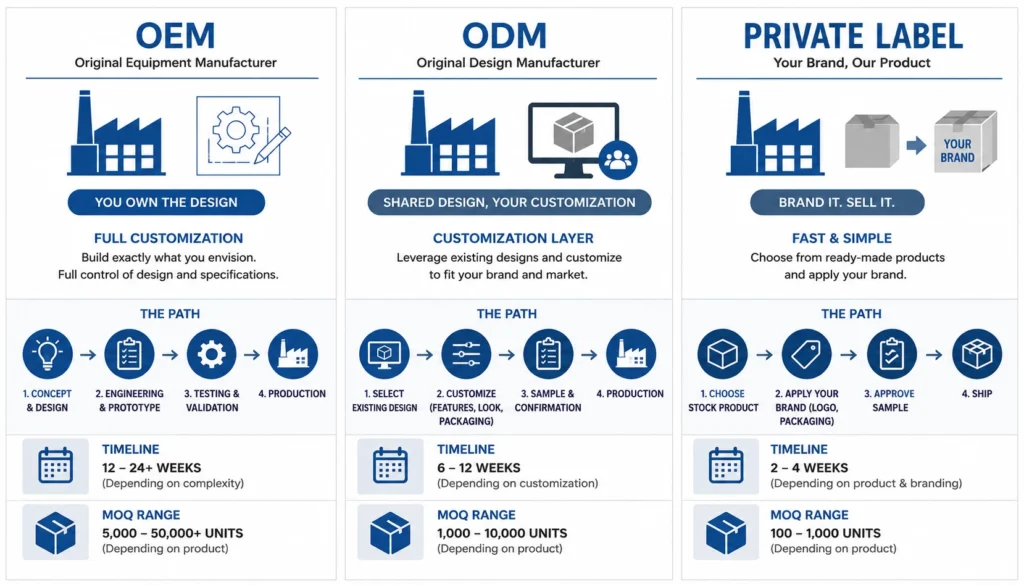
OEM (Original Equipment Manufacturing)
You provide the complete design: schematics, BOM, industrial design, firmware specifications. The manufacturer builds to your spec. You own all IP; the manufacturer cannot sell the same design to anyone else.
Right for: Companies with in-house hardware engineering teams, building a product that requires true differentiation, typically at 1,000+ units/year volume to justify NRE investment.
NRE (non-recurring engineering) cost: $20,000–$80,000+ depending on scope of changes.
Timeline to first production unit: 16–24 weeks minimum.
ODM (Original Design Manufacturing)
The manufacturer has an existing, proven hardware platform. You select a base model, then customize: enclosure color, branding, HMI skin, CSMS integration, connector type, sometimes firmware features. The manufacturer owns the base hardware IP; you own your customization layer.
Right for: Companies entering the market without hardware engineering capacity, wanting to bring a product to market in 3–4 months, building differentiation through software and brand rather than hardware.
Timeline: 8–14 weeks from spec sign-off to production delivery.
Private Label
The manufacturer’s existing product, relabeled with your brand. Zero development time. The manufacturer retains all IP. Your differentiation is price, service, and brand — not product.
Right for: First-time buyers testing market demand, distributors entering a new geography, installers wanting a curated hardware recommendation for customers.
| Dimension | OEM | ODM | Private Label |
|---|---|---|---|
| Who owns the design? | You | Factory (base) / You (customization) | Factory |
| Development timeline | 16–24 weeks | 8–14 weeks | 0–2 weeks |
| MOQ — AC EV Charger | 200+ | 200+ | 50–100 |
| MOQ — DC EV Charger | 2+ | 2+ | 2–5 |
| Unit cost | Lowest at scale | Mid-range | Highest per unit |
| Customization depth | Complete | Exterior + software | Branding only |
| Who holds the certification? | Shared / you (negotiated) | Manufacturer provides | Manufacturer provides |
| Time to market | Slowest | Fast | Fastest |
Certification note: When a manufacturer provides a CE or UL certificate, that certificate is issued to the certificate holder — typically the manufacturer. When you resell under your brand, you may be making a declaration of conformity on behalf of a product you did not certify. This is a legal distinction that matters in regulated markets. Clarify certificate ownership and your liability exposure before committing to any private label arrangement in the EU or US.
Part 2B: Inside a DC Fast Charger — What You’re Actually Buying
Suppliers will tell you their charger is “high quality.” That claim means nothing without specifics. Understanding the internal architecture of a DC fast charger — at the component level — is what allows you to ask the questions that distinguish real quality from marketing language.
1. The Power Module — The Heart of a DC Charger
The power module performs the core function: converting three-phase AC from the grid into regulated DC for the vehicle battery. It typically represents 40–60% of total BOM cost in a DC fast charger. Everything downstream depends on its efficiency, reliability, and thermal behavior.
Architecture: Per onsemi’s published DC fast charger reference design, the standard architecture is a two-stage converter: an AC-DC front end with Power Factor Correction (PFC), followed by an isolated DC-DC stage (typically a Dual Active Bridge or LLC resonant converter) that regulates output voltage and current to the vehicle battery.
Key switching devices:
| Technology | Typical Application | Efficiency | Cost | Key Vendors |
|---|---|---|---|---|
| IGBT (Silicon) | ≤ 60 kW, cost-sensitive | 94–96% | Lower | Infineon, Onsemi, ST, Mitsubishi |
| SiC MOSFET | ≥ 60 kW, premium | 97–98.5% | Higher (30–50% premium) | Wolfspeed, Infineon, Onsemi, ST |
As documented by Wolfspeed’s technical analysis, SiC MOSFETs offer improved operating temperature, better conduction losses, lower leakage currents, and higher surge capacity compared to silicon IGBT — at higher cost. For applications above 60 kW, or where cabinet size and cooling cost matter, SiC is increasingly the preferred choice.
Cooling architecture by power level:
| Method | Best For | Pros | Cons |
|---|---|---|---|
| Forced air cooling | ≤ 60 kW DC | Low cost, simple | Fan noise; dust accumulation reduces efficiency |
| Liquid cooling (cabinet) | ≥ 120 kW DC | Excellent heat dissipation, compact cabinet | Higher cost; leakage risk; requires maintenance |
| Liquid-cooled cable | ≥ 150 kW DC | Cable 30–40% lighter than air-cooled equivalent | More complex assembly; higher cost |
Questions to ask every DC charger supplier about the power module:
- What switching device does the power module use — IGBT or SiC? From which manufacturer?
- What is the rated efficiency at full load and at 50% load? (Request the efficiency curve, not just the peak number.)
- What is the maximum continuous operating time at full rated power in a 40°C ambient environment? Request the derating curve.
- Is the power module modular and field-replaceable? (Modular = lower repair cost and faster field service.)
- What is the MTBF specification for the cooling fan or liquid pump?
2. The SECC Unit — The Brain That Talks to EVs
The Supply Equipment Communication Controller (SECC) manages all communication between the charger and the vehicle’s Battery Management System (BMS). This is the unit that determines whether a charger successfully starts a session — and with which vehicles.
According to the US Department of Energy’s technical review of extreme fast charging architectures, the communication layer is a distinct design challenge from the power conversion layer, requiring specialized firmware for protocol handling and vehicle compatibility.
SECC communication protocols:
| Protocol | Function | Required For |
|---|---|---|
| IEC 61851-23 | Basic DC charging control | All DC chargers (mandatory) |
| DIN SPEC 70121 | Early CCS implementation | CCS1/CCS2 vehicle compatibility (legacy) |
| ISO 15118-2 | Plug & Charge, smart charging | NEVI-funded stations (mandated); premium deployments |
| ISO 15118-20 | V2G bidirectional, advanced scheduling | Next-gen V2G deployments (emerging) |
The most common failure mode in deployed DC chargers is not a hardware defect — it is SECC firmware incompatibility with specific vehicle models. A charger that works with 95% of vehicles and fails on 5% generates more customer complaints than one that works consistently at lower power. Ask suppliers for their tested vehicle compatibility list and their firmware update mechanism for new vehicle releases.
3. Communication Module — Staying Connected
The communication module handles all connectivity between the charger and your CSMS. Connection options and their tradeoffs:
| Technology | Reliability | Best For | Note |
|---|---|---|---|
| Ethernet (wired) | Highest | Indoor depots, controlled environments | Requires cabling infrastructure |
| 4G LTE cellular | High | All outdoor public locations | Requires local SIM / eSIM; ongoing data cost |
| 5G | High + low latency | High-density urban sites, V2G | Coverage dependent; hardware premium |
| Wi-Fi | Moderate | Indoor retail, workplace | Signal quality is site-dependent |
For public-facing sites, specify 4G LTE with dual-SIM or eSIM capability for carrier redundancy. A charger that goes offline because of a single carrier outage is an avoidable operational failure.
4. Thermal Management — Keeping It Cool Under Load
DC fast chargers generate significant heat at high power. Thermal management directly affects power module lifespan, charge reliability, and the charger’s ability to sustain rated output in hot ambient conditions (which is precisely when demand is highest).
The standard operating temperature range for commercial DC fast chargers is -30°C to +50°C. In practice, verify this with the supplier’s derating curve, not just the datasheet spec — many chargers reduce output power significantly above 35–40°C ambient.
Key thermal question for suppliers: At 40°C ambient temperature, what is the maximum continuous output power? Request the derating curve in writing, not just the rated spec at 25°C.
5. Key Electronic Components — What’s Inside Matters
Component sourcing directly determines reliability and long-term TCO. Asking suppliers for their Bill of Materials (BOM) at the brand level — not just the component category — is one of the highest-leverage quality verification steps available to a buyer.
| Component | Function | Tier-1 Suppliers | Why It Matters |
|---|---|---|---|
| Power switch (IGBT/SiC) | AC-DC conversion | Infineon, Onsemi, Wolfspeed, ST | Determines efficiency and thermal life |
| Gate driver IC | Controls power switches | Infineon, TI, Analog Devices | Wrong driver = switch failure |
| Isolated CAN transceiver | Vehicle BMS communication | TI, Analog Devices, NXP | Determines vehicle compatibility |
| Current / voltage sensor | Metering, protection | Allegro, LEM, TI | Accuracy required for billing; protection triggers |
| Contactor | Safety disconnection | TE Connectivity, Panasonic, Omron | Failure = safety event |
| Electrolytic capacitor | Filtering, bulk storage | Rubycon, Nichicon, TDK, KEMET | Capacitor failure is primary DC charger failure mode |
| MCU (main controller) | System control, OCPP stack | Infineon, NXP, STM32 | Determines OTA capability and firmware quality |
Warning: Suppliers who respond to BOM questions with “we use our own brand components” or “all Chinese domestic components” are signaling that either their parts sourcing is opaque or they are not using Tier-1 semiconductor suppliers. This is not automatically disqualifying — but it requires additional quality verification, specifically third-party reliability testing data.
Part 2: Certification Requirements by Target Market
Certification is not optional — it is a market access requirement. Shipping uncertified hardware into the US or EU creates liability for you, not the manufacturer. Verify certification status before placing any commercial order.
United States
| Equipment Type | Required Certification | Standard | Certifying Body Options |
|---|---|---|---|
| AC Level 2 Charger | UL 2594 (or ETL equivalent) | Standard for Electric Vehicle Supply Equipment | UL Solutions, CSA, Intertek |
| DC Fast Charger | UL 2202 (or ETL equivalent) | Standard for DC Charging Equipment for EVs | UL Solutions, CSA, Intertek |
| All equipment | FCC Part 15 | EMC / radio frequency emissions | Accredited FCC labs |
| NEVI-funded stations | OCPP 2.0.1 + ISO 15118-2 | 23 CFR Part 680 (2023 Final Rule) | OCA certification + FHWA compliance |
As documented by UL Solutions’ EV charging guide, DC fast charging equipment falls specifically under UL 2202 — not the more commonly cited UL 2594, which covers AC charging equipment. This distinction matters when reviewing supplier certification claims.
Realistic timeline for UL 2202: 6–9 months from submission to certificate issuance, for a product without prior UL history. Expect $50,000–$100,000+ in testing and engineering fees.
European Union
| Equipment Type | Required | Standard | Notes |
|---|---|---|---|
| AC Charger | CE marking + IEC 61851-1 | General EV charging safety requirements | Covers AC/DC systems up to 1,000V AC / 1,500V DC |
| DC Fast Charger | CE marking + IEC 61851-23 Ed. 2 | DC EVSE — updated 2023 edition | Updated to align with CCS, ISO 15118 |
| All equipment | RoHS, WEEE compliance | Hazardous substances and e-waste | Required for EU market access |
| AFIR-compliant stations | OCPP 2.0.1 + ISO 15118 | EU Alternative Fuels Infrastructure Regulation | Mandatory for publicly accessible stations |
The IEC 61851-23 Edition 2 (2023), as summarized by the American National Standards Institute, covers DC EV supply equipment specifications including safety requirements, EMC, and communication protocols. The 2023 edition updates align the standard with modern CCS2 connector requirements and ISO 15118 communication architecture.
Typical CE + IEC 61851-23 timeline: 2–4 months. Cost: $15,000–$30,000 through an accredited notified body (TÜV Rheinland, Bureau Veritas, SGS, Intertek).
China (GB/T Standards)
| Equipment Type | Required | Standard |
|---|---|---|
| AC Charger | CCC certification | GB/T 18487-1 (Conductive charging system, Part 1) |
| DC Fast Charger | CCC certification | GB/T 18487-1 + GB/T 20234-3 (DC connector) |
| Connectors | CCC certification (mandatory from 2025) | GB/T 20234-3 |
Note for buyers sourcing from Chinese manufacturers: A manufacturer holding GB/T certification does NOT automatically hold CE or UL certification. These are separate testing programs run by separate bodies. Verify each market’s certification independently.
Part 3: OCPP Compliance — The Most Overlooked Sourcing Requirement
OCPP (Open Charge Point Protocol) is the communication standard that governs how a charger talks to your CSMS (Charging Station Management System). Without it, you cannot remotely monitor, update, or manage your chargers. Without OCPP 2.0.1 specifically, you cannot support smart charging, Plug & Charge, OTA firmware updates, or comply with NEVI or EU AFIR requirements.
OCPP 1.6 vs. 2.0.1: The Key Differences
| Capability | OCPP 1.6J | OCPP 2.0.1 |
|---|---|---|
| Message types | ~25 core types | 100+ types across functional blocks |
| Security | TLS 1.2 optional | TLS 1.3 mandatory (Security Profile 3) |
| OTA firmware updates | Basic (no rollback) | Structured, with rollback and status reporting |
| ISO 15118 (Plug & Charge) | Via workaround wrapper | Native message support |
| Smart charging | Central control only | Central, Local, and External |
| V2G pathway | None | Via OCPP 2.1 upgrade (architecture compatible) |
| IEC standard status | Not standardized | IEC 63584 (approved 2024) |
| NEVI compliance | Listed as baseline option | Required for advanced features |
OCPP 2.0.1 was adopted as IEC international standard IEC 63584 in 2024, and published as a European standard by CENELEC in 2025. For any hardware being deployed in 2026 or later, specifying OCPP 1.6 is specifying obsolete hardware.
How to Verify OCPP Compliance (Not Just the Claim)
As of September 2025, Blink Charging noted that only 68 charger models worldwide held formal OCA OCPP 2.0 certification — in a market with thousands of commercially available models globally. “OCPP 2.0.1 ready” and “OCPP 2.0.1 certified” are not the same thing.
Method 1. Request the OCA certificate number.
Every genuinely certified product has one, issued by an OCA-approved independent testing lab (DEKRA, DNV, KSGA, Korean Testing Certification Institute, or Korea Testing Laboratory).
Method 2. Verify on the OCA Trusted Certificate tool.
This is a free public verification tool. Certificates issued from summer 2024 onward can be independently verified. Cross-check the product name, firmware version, and which profiles were tested.
Method 3. Check which profiles are certified.
Core-only certification does not confirm Smart Charging, Advanced Security (TLS 1.3), or ISO 15118 support. Require the specific profiles relevant to your deployment.
Method 4. Confirm production firmware version matches the certified version.
Pre-production units sometimes achieve certification; production hardware may run different firmware.
Method 5. Require a live CSMS connection demonstration.
Connect the sample unit to your actual CSMS. Test: smart charging profile enforcement, OTA update, and TLS 1.3 rejection of downgrade attempts.
Red flags in supplier OCPP claims: “OCPP 2.0.1 ready” (not certified) · “OCPP 2.0.1 compatible” (can connect, but what works?) · “Certification in progress” (no current certificate = no current compliance) · “We have our own certification process” (self-certification ≠ OCA independent lab testing)
For the complete OCPP implementation and verification framework — including the 5-test acceptance checklist — see our OCPP 2.0.1 & CSMS Implementation Guide.
Part 4: How to Evaluate an EV Charger Manufacturer — 10-Point Supplier Audit
This framework applies whether you are sourcing 10 units or 1,000. The questions are the same; the weight you give each factor scales with order volume and deployment risk.
| # | Audit Point | What to Check | Minimum Standard |
|---|---|---|---|
| 1 | Factory quality certifications | Request current ISO certificates with expiry dates; verify on issuing body website | ISO 9001 mandatory; ISO 14001 and 45001 recommended |
| 2 | Product certifications for your market | CE, UL 2202, GB/T — certificate must name the specific product model and firmware version | Certificate from accredited lab (TÜV, UL Solutions, Bureau Veritas, Intertek, CSA) |
| 3 | OCPP compliance | OCA certificate number; verify on OCA Trusted Certificate tool; test with your CSMS | OCA-certified for Core + Advanced Security at minimum; Smart Charging for CPO applications |
| 4 | Production capacity and on-time delivery | Annual capacity, number of production lines; request OTD% for last 6 months | OTD ≥ 90%; capacity headroom above your order volume |
| 5 | Quality control process | IQC (incoming), IPQC (in-process), FCT (functional test), burn-in duration | FCT 100% of units; 48-hour burn-in minimum for DC chargers |
| 6 | R&D capability | Engineering team size by discipline; hardware revision history; firmware roadmap | Dedicated hardware + software + structural engineering; active firmware update history |
| 7 | After-sales support structure | Warranty terms in writing; spare parts availability; RMA process; support hours | 3-year warranty including power module; 24/7 technical support for CPO applications |
| 8 | Reference customers | Request 2–3 customer contacts in similar application (CPO, fleet, distributor); actually call them | At least 2 references operating for 12+ months at meaningful scale |
| 9 | Supplier financial stability | Years in operation; export countries and volume; ownership structure | 5+ years in EV charger manufacturing; exporting to 10+ countries |
| 10 | Communication transparency | Response time to technical questions; willingness to open factory for audit; NDA availability | <24 hour response; open to factory visit; no resistance to NDA before technical sharing |
Part 5: Red Flags — What to Watch For Before You Sign Anything
These patterns are observable before a Purchase Order is signed. Encountering any of them does not automatically disqualify a supplier — but each one warrants specific follow-up before proceeding.
Certification Red Flags
- Cannot provide a certificate number traceable to a named accredited lab
- Certificate lists a different model number than the product being quoted
- Certificate issuing lab is not recognized (not TÜV, UL Solutions, Bureau Veritas, Intertek, SGS, DEKRA, or equivalent ILAC-accredited lab)
- “Our product meets CE requirements” without a Declaration of Conformity
- Certification covers only the AC version; DC version “will be certified soon”
Technical Red Flags
- Datasheet shows only peak power — no rated/continuous power or derating curve
- Efficiency specification is a single number at 100% load (real efficiency curves show 10%, 25%, 50%, 75%, 100% load)
- No third-party test report for efficiency or EMC claims
- Cannot demonstrate OCPP connection to a CSMS during evaluation
- “OCPP 2.0.1 ready” without OCA certificate number
Commercial Red Flags
- Price significantly below market (AC charger below $120, DC 60 kW below $1,400): unit economics don’t work at those prices for a compliant product
- Refuses to provide references; or references cannot speak to specific deployment experiences
- Requests 100% prepayment before sample delivery
- MOQ dramatically higher than discussed: “we said 2 DC units but now require 10”
Communication Red Flags
- Responses take more than 48 hours to technical questions
- Factory visit declined or repeatedly rescheduled
- Technical specifications change between first contact and formal quotation
- Resistance to signing NDA before sharing firmware architecture details
Part 6: Cost Breakdown and Total Cost of Ownership
Reference Price Ranges (May 2026)
Note: Pricing varies significantly by order volume, customization scope, certification status, and market conditions. The ranges below represent indicative market reference points for compliant, certified products. Pricing for non-certified or uncertified products may be 30–50% lower — and that gap represents your certification, compliance, and liability exposure.
| Product | Private Label | ODM | OEM (high volume) |
|---|---|---|---|
| AC Level 2 Charger (7–22 kW) | $180–$280/unit | $150–$220/unit | $120–$180/unit |
| DC Fast Charger 30 kW | $2,500–$4,000/unit | $1,800–$2,800/unit | $1,500–$2,200/unit |
| DC Fast Charger 60 kW | $4,500–$7,000/unit | $3,500–$5,500/unit | $2,800–$4,500/unit |
| DC Fast Charger 120 kW | $9,000–$14,000/unit | $7,000–$11,000/unit | $5,500–$9,000/unit |
| DC Fast Charger 240 kW | $18,000–$28,000/unit | $14,000–$22,000/unit | $11,000–$18,000/unit |
One-Time Cost Items Often Missed in RFQ Comparisons
| Cost Item | Typical Range | Who Pays? |
|---|---|---|
| ODM NRE (tooling, firmware customization) | $5,000–$25,000 | Buyer (one-time) |
| OEM NRE (hardware design, tooling) | $20,000–$80,000+ | Buyer (one-time) |
| CE certification (new product to your entity) | $15,000–$30,000 | Buyer or shared |
| UL 2202 certification | $50,000–$100,000+ | Buyer or shared |
| Ocean freight per 20′ container | $2,500–$6,000 | Buyer (varies with rate) |
| Import duties (US, standard HTS) | Varies; check current Section 301 tariff status | Buyer |
Tariff advisory: US import tariffs on EV charging equipment from China are subject to active policy review as of 2026. Verify current tariff classification and applicable rates with a licensed customs broker before finalizing cost models for US distribution. Section 301 tariffs have been subject to revisions and should not be assumed stable from prior-year quotes.
5-Year TCO: Why Unit Price Is the Wrong Metric
For a CPO deploying 50 DC fast chargers at a commercial site, a $500/unit price difference is $25,000. An additional 2% failure rate over 5 years (25 service events at $800 average cost including downtime) is $20,000 — plus the reputational cost of charger availability problems. A 1% efficiency difference at 50 kW average output and $0.12/kWh electricity for 5 years is approximately $13,000 per charger. Unit price is rarely the right optimization target.
Part 7: Lead Time and Logistics — Realistic Planning
| Order Type | Sampling | Production | Ocean Freight | Total (Realistic) |
|---|---|---|---|---|
| Private Label (AC 50 / DC 2–5) | 1–2 weeks | 2–4 weeks | 4–6 weeks | 7–12 weeks |
| ODM (AC 300 / DC 2+) | 3–5 weeks | 5–8 weeks | 4–6 weeks | 12–19 weeks |
| OEM custom (hardware changes) | 8–12 weeks | 5–8 weeks | 4–6 weeks | 17–26 weeks |
These timelines assume the factory has no production backlog and all materials are available. During high-demand periods (typically Q2 and Q3), add 2–4 weeks across all categories. For shipments into the US, allow additional time for customs clearance — currently averaging 3–7 business days for commercial EV charger shipments without documentation issues.
Ocean freight rates are variable. Air freight is available for urgent shipments at 8–12x the cost — viable for samples and critical replacement units, not economical for production quantities.
Part 8: After-Sales Support and Warranty — What to Require in Writing
After-sales terms negotiated in writing before the order are enforceable. After-sales terms discussed verbally before the order are marketing.
Warranty Minimums — What to Require
| Component | Minimum Warranty | Why |
|---|---|---|
| Overall product | 3 years | Industry standard for commercial deployments |
| Power module | Must be included in product warranty | Most expensive component; most likely to need service |
| Charging cable and connector | 1–2 years (high-wear item) | Physical wear from daily use |
| Firmware support | 5 years from product purchase | Security patches and vehicle compatibility updates |
Spare Parts Strategy
For any deployment of 20+ DC chargers, maintain a local spare parts buffer:
- 2–3 power modules (the most common service component)
- 2–3 main control boards
- 2–3 charging cables/connectors (highest physical wear item)
- 1 display/HMI unit
RMA Process — The Cross-Shipping Standard
The most operator-friendly warranty process follows this sequence: (1) remote diagnosis via CSMS/logs; (2) if hardware defect confirmed, manufacturer ships replacement unit or component proactively; (3) operator installs replacement and returns defective unit. This “cross-ship” model minimizes downtime. A manufacturer who requires you to return the defective unit before shipping the replacement is adding 4–8 weeks of downtime risk per incident.
Part 9: Why Joint?
You’ve now read the full sourcing framework. You know what questions to ask, what certifications to verify, what’s inside the hardware, and what red flags to watch for. That means you can evaluate any supplier — including us — against objective criteria.
Here is how JointCharging performs against the 10-point audit framework:
| Audit Point | JointCharging |
|---|---|
| Factory quality certifications | ISO 9001 certified manufacturing; 15,000 m² production facility |
| Product certifications | CE (IEC 61851-23), ETL (UL 2202 equivalent) on DC models; CE + IEC 61851-1 on AC models |
| OCPP compliance | OCPP 2.0.1 capable across DC product line; CSMS-agnostic open API |
| Production capacity | 5,000+ DC units/year rated capacity; 12+ years in EV charger manufacturing (est. 2014) |
| R&D capability | 25+ engineers (hardware, firmware, structural); active product roadmap through 2027 |
| After-sales | 3-year product warranty standard; 24/7 technical support for CPO customers; cross-ship RMA available |
| Reference customers | 30+ countries served; available under NDA |
| Financial stability | 12+ years operating; active in North America, Europe, and Asia-Pacific |
How Joint Supports Each Buyer Type
| Buyer Type | What We Provide |
|---|---|
| Distributor / Reseller | Private label from 50 AC / 2 DC units; ODM customization (branding, HMI, connector); regional exclusivity negotiable |
| CPO / Network Operator | OCPP 2.0.1 hardware, CSMS-agnostic open API, uptime SLA, 24/7 technical support, OCPI-ready units |
| Electrical Contractor | Complete installation documentation, CAD drawings, remote commissioning support, certified installer training |
| Fleet Operator | AC + DC full product range, dynamic load management, solar + storage integrated solutions (see our Fleet Depot Guide) |
| Installer | Certified installer program, 48-hour spare parts dispatch, simplified RMA, remote diagnostic access |
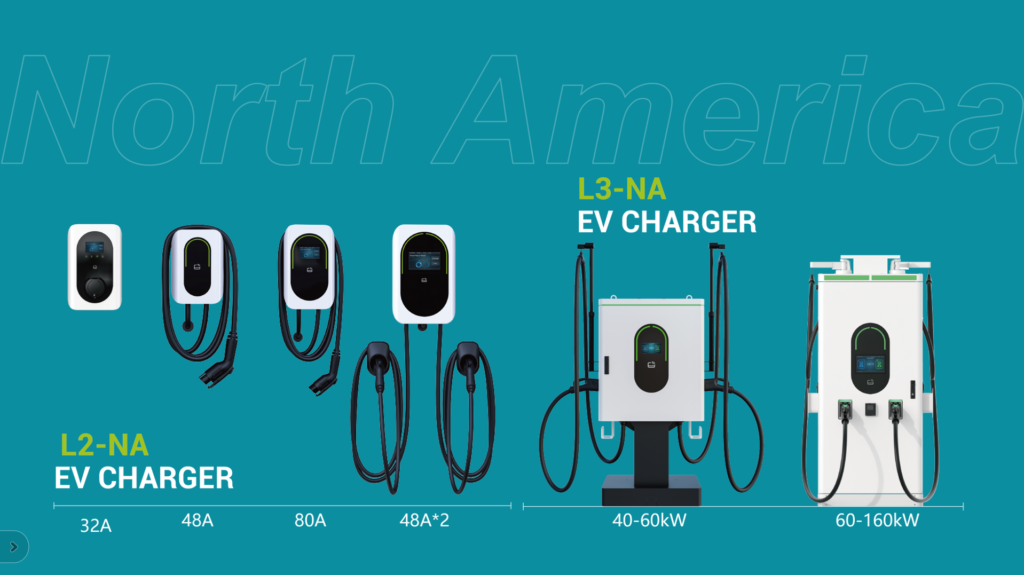
Browse our product range: AC EV chargers for North America (7–22 kW) and DC fast chargers for USA and Canada (60–240 kW, CCS1/NACS). For integrated energy storage systems, see energy storage systems for EV charging.
Part 10: How to Start — A 5-Step Sourcing Process
Step 1. Define Requirements (1–2 weeks)
Document: target market and required certifications, power level and connector type, OCPP version, quantity and timeline, ODM vs. private label vs. OEM based on your resources and IP needs.
Step 2.Shortlist 3–5 Suppliers (1–2 weeks)
Apply the 10-point audit checklist as a filter. Any supplier who cannot answer #1 (ISO cert), #2 (product cert), or #3 (OCPP cert) with verifiable documentation is removed from the list.
Step 3.Request Formal Proposals (2–4 weeks)
Issue an RFQ that specifies: product model, target market and certifications required, OCPP version, customization scope, MOQ and target pricing, lead time, warranty terms, reference customer contact information.
Step 4. Verify — Don’t Just Trust (4–8 weeks)
Factory visit (in person or video). Sample unit testing including OCPP CSMS connection, TLS verification, OTA test, smart charging profile test. Reference customer calls. Certificate verification via OCA Trusted Certificate tool and UL/CE issuing body databases.
Step 5.Pilot Order Before Bulk Commitment (2–3 months)
Order 5–20 units (or the minimum viable quantity for your application). Deploy in real conditions. Track: uptime rate, session success rate, CSMS communication stability, any SECC vehicle compatibility issues. Make the bulk decision with real operational data, not spec sheets.
Frequently Asked Questions
What is the difference between OEM, ODM, and private label for EV chargers?
OEM means you provide the complete design and own all IP — the manufacturer builds to your specification. ODM means you select from the manufacturer’s existing hardware platform and customize exterior, branding, and software — you own the customization, the manufacturer owns the base design. Private label means the manufacturer’s existing product ships under your brand with no hardware changes. OEM is the most differentiated and most time- and capital-intensive; private label is the fastest to market with the least IP control.
What is the minimum order quantity for EV chargers?
For private label: typically 50–100 units for AC Level 2 chargers, 2–5 units for DC fast chargers. For ODM: typically 300+ AC units, 2+ DC units. For OEM (full custom): similar to ODM for initial run, but with NRE cost added. DC fast chargers have lower MOQs than AC chargers because unit economics at the factory level work at smaller quantities.
How do I verify that a supplier’s OCPP 2.0.1 certification is real?
Request the OCA certificate number and verify it on the Open Charge Alliance’s Trusted Certificate tool at openchargealliance.org. Check which certification profiles are covered — Core-only does not confirm Smart Charging or Advanced Security compliance. Also confirm the certified firmware version matches what ships on production units.
What’s actually inside a DC fast charger that determines quality?
The power module (40–60% of BOM cost) is the most important component — specifically the switching device (IGBT or SiC MOSFET) and its manufacturer, the cooling architecture, and the thermal management design. The SECC unit determines vehicle communication compatibility. Ask suppliers for their BOM at the brand level for key components: switching devices, gate drivers, capacitors, and contactors. Tier-1 semiconductor suppliers (Infineon, Onsemi, Wolfspeed, ST, TI, NXP) are verifiable; “domestic brand” answers are not.
What certifications do I need to sell DC fast chargers in the US?
UL 2202 (from UL Solutions, CSA, Intertek, or equivalent NRTL) is the primary product safety certification for DC charging equipment in North America. FCC Part 15 is required for EMC compliance. NEVI-funded stations additionally require OCPP 2.0.1 and ISO 15118-2 capability. ETL listing (from Intertek) is an alternative to UL listing and is equally accepted by AHJs. Note that CE certification from a European notified body is not accepted as equivalent to UL in the US; these are separate certifications from separate bodies.
What is a realistic lead time for an ODM EV charger order from China?
From spec sign-off to delivery at your warehouse: 12–19 weeks for a standard ODM order at reasonable volume. This includes 3–5 weeks of pre-production (tooling, firmware customization, sample approval), 5–8 weeks of production, and 4–6 weeks of ocean freight. Air freight can reduce the shipping portion to 1–2 weeks at 8–12x the cost. Factory backlogs during peak periods (Q2 and Q3) can add 2–4 weeks to production time.
How should warranty and after-sales support be structured for international customers?
Require 3-year warranty on the complete product including power module, in writing in the purchase contract — not just a verbal commitment or a warranty card. The most operator-friendly RMA process is cross-shipping: manufacturer sends replacement hardware proactively when a defect is confirmed remotely, and you return the defective unit after installation of the replacement. This minimizes downtime. Maintain a local spare parts buffer of power modules, control boards, and charging cables to handle the inevitable service events without waiting for international shipping.
Product certifications, OCPP specification status, import tariff rates, and market incentive programs referenced in this article are subject to change. Verify current certification requirements with the relevant testing bodies and customs tariff schedules before finalizing procurement decisions. Last reviewed: May 2026.
Related Posts
Redefining AC Charging — Making Smart Chargers Truly Smart
The core truth: Most AC chargers on the market cannot read your EV’s actual battery…
MyFirstEV Is Coming: Which EV Chargers Will the Market Need?
Last updated: July 15, 2026 California’s MyFirstEV programme is expected to lower the upfront cost…

What Is MyFirstEV? California’s New EV Rebate Explained
Last updated: 15 July 2026 MyFirstEV is California’s new point-of-sale rebate programme for residents buying…
What Is CALeVIP? California’s 2026–2027 DC Fast Charging Incentives Explained
Last updated: July 15, 2026 California is providing $55.2 million in new funding for publicly…
Is There Still Room for a New Private Label EV Charger Brand?
The honest version of that question sounds like this: the EV charger market is obviously growing…

Private Label EV Charger Launch: Complete Checklist
Most private label EV charger brands spend months getting the product right — and maybe…
