
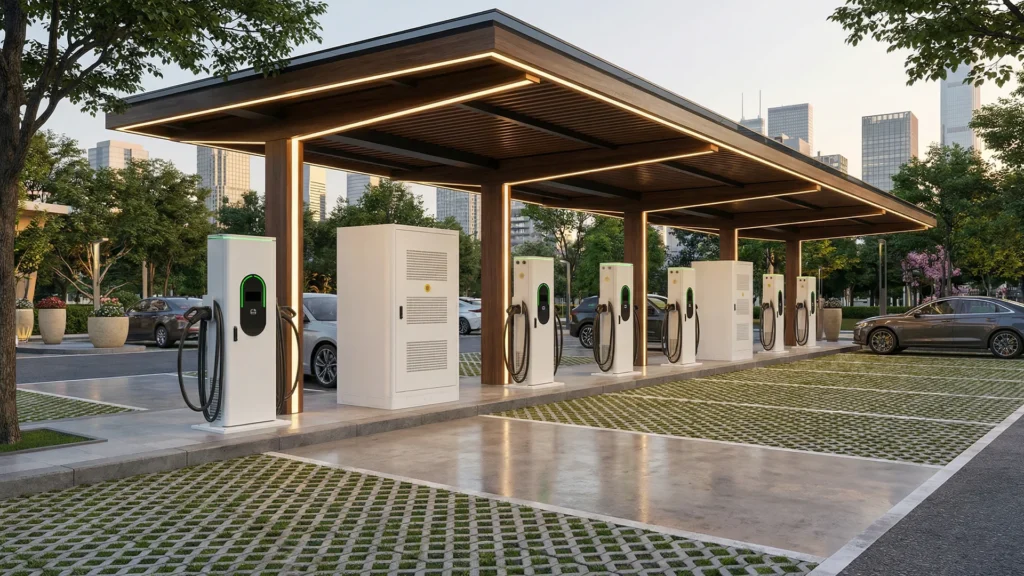
Light Commercial EV Fleet Charging: A Complete Guide for CPOs [2026]
The electrification of light commercial vehicle fleets is no longer a pilot program or a sustainability gesture. It is an accelerating economic reality. The global electric light commercial vehicle market reached $18.79 billion in 2025 and is growing at 14.8% annually — driven by e-commerce logistics expansion, urban low-emission zone mandates, and an operating cost structure that is decisively improving in favor of electric over diesel for urban and regional delivery routes. More than 62% of urban delivery operators had adopted at least one electric commercial vehicle for last-mile operations as of 2025.
For CPOs, this shift represents one of the clearest near-term revenue opportunities in the market: fleet operators deploying light commercial EVs (LCVs) need depot charging infrastructure designed for their specific duty cycles, and they need a partner who understands the difference between a last-mile delivery van and a regional box truck. A 42 kWh last-mile delivery van and a 120 kWh regional light truck have completely different infrastructure requirements — different charger types, different power levels, different grid impact, different management software needs.
This guide covers everything a CPO needs to design, deploy, and manage charging infrastructure for LCV fleets — from duty cycle analysis through charger selection, demand charge management, solar-plus-storage integration, and a worked financial model. Throughout, we reference the CHEVOO HongTu and HongYun series as representative LCV fleet vehicles, with specific charger compatibility notes for each model.
TL;DR: The right primary charger for most LCV last-mile depot fleets is Level 2 AC (7–22 kW). Demand charges from unmanaged simultaneous plug-ins are the primary operating cost risk. Smart charging management with departure-based scheduling consistently reduces peak demand by 35–55% and total electricity costs by up to 40%. The US DOE’s Alternative Fuels Data Center documents that light-duty all-electric vehicle O&M costs average 6.1 cents per mile — versus significantly higher diesel equivalents. For LCV fleets averaging 60–150 miles per day, depot charging pays back infrastructure investment in 2–3 years on fuel savings alone.
Table of Contents
The LCV Fleet Market Opportunity for CPOs in 2026
Light commercial vehicles — cargo vans, high-roof delivery vans, and light-duty trucks in the 3.5–7.5 tonne GVW class — are the workhorses of urban logistics. According to the European Environment Agency, nearly 70% of goods transported within EU cities move by van. In North America, the same segment dominates last-mile delivery for e-commerce, food distribution, municipal services, and field service operations. The electric LCV market is projected to reach $116.60 billion globally by 2032, from $24.49 billion in 2025 — a CAGR of 25.0%.
Why LCV Fleets Are Leading Commercial EV Adoption
LCVs are disproportionately well-suited to electrification compared to heavier vehicle classes, for three structural reasons:
- Route predictability: LCV fleets in last-mile delivery and field service operate on defined daily routes with predictable mileage — typically 60–200 miles per day. This predictability allows accurate battery sizing and reliable overnight depot charging without range anxiety.
- Fuel cost advantage: The US DOE’s Alternative Fuels Data Center documents that light-duty all-electric vehicle operation and maintenance costs average 6.1 cents per mile, while electricity prices are significantly more stable than diesel. At urban stop-and-go duty cycles — the primary LCV operating mode — regenerative braking further improves efficiency.
- Total cost of ownership convergence: The US DOE’s Federal Fleet Training materials document that EV fueling costs can be as low as 3 cents per mile versus 10+ cents per mile for gasoline equivalents. For fleet operators running high-mileage urban routes, TCO parity with diesel is already achieved in many markets.
Key LCV Fleet Segments for CPOs
The LCV electrification opportunity spans several distinct fleet operator categories, each with different charging requirements that a CPO must understand to deliver the right infrastructure design:
- Last-mile delivery: Amazon DSP networks, FedEx Ground ISPs, UPS private fleets, DHL, regional couriers. Predictable overnight return, 8–12 hour charging window, Level 2 AC primary. This is the highest-volume and fastest-growing segment.
- Food and beverage distribution: Predictable multi-stop routes, often 100–150 miles per day, return-to-depot. Temperature control may add battery load (refrigeration units).
- Municipal service fleets: Parks departments, utility crews, code enforcement, meter reading, inspection services. Daytime dwell at municipal depots during operational hours — natural solar charging opportunity.
- Rental and shared fleets: More variable duty cycles, higher daily mileage potential. May require faster DC charging for vehicles with short inter-rental turnaround.
- Field service operations: Telecom, utilities, HVAC. Typically depot-return, moderate daily mileage, good compatibility with overnight Level 2 AC.

Understanding LCV Duty Cycles: The Foundation of Depot Design
Depot charging infrastructure designed without a clear duty cycle analysis is infrastructure designed for the wrong vehicle, at the wrong power level, with the wrong grid impact. Before any hardware is specified or electrical engineering begins, document how the fleet actually operates.
Pattern A: Overnight Return-to-Depot (Last-Mile Delivery)
The most common and most economical LCV charging pattern. Vehicles depart between 6 and 8 AM, complete urban or suburban delivery routes, and return between 4 and 7 PM. The charging window is 10–12 hours — fully adequate for Level 2 AC charging to restore most or all battery capacity before the next morning departure.
For a van with a 42–54 kWh battery (such as the CHEVOO HongTu 6 or HongTu 7) consuming 25–40 kWh on a typical 80–120 km urban delivery route, an 11 kW Level 2 AC charger restores full capacity in 4–5 hours — well inside the overnight window. This is the duty cycle where Level 2 AC dominates and DC fast charging adds cost without operational benefit.
Primary charger: Level 2 AC 7–22 kW
Charger-to-vehicle ratio: 1:1
Key management need: Departure-based scheduling to prevent simultaneous plug-in demand spike
Pattern B: Multi-Shift / Opportunity Charging
Vehicles operate in two or three shifts with 30–90 minute gaps between route assignments. Level 2 AC cannot practically restore meaningful range in a 30-minute window — an 11 kW charger adds only 5.5 kWh in 30 minutes, covering approximately 25–30 km. This pattern requires selective DC fast charging (50–120 kW) at the depot for vehicles that need rapid partial recharge between shifts, supplemented by Level 2 AC for overnight top-up.
Primary charger: Level 2 AC overnight + DC 50–120 kW for inter-shift
DC charger-to-vehicle ratio: 1 DC port per 3–6 vehicles depending on shift overlap
Key management need: Priority queue management for DC ports; departure scheduling for overnight AC
Pattern C: Extended Range / Regional Delivery
Vehicles cover 150–300 km per day, sometimes not returning to depot daily. Larger battery packs are required (70–120 kWh), and overnight Level 2 AC may not restore full capacity in the available window for high-daily-mileage operations. DC fast charging (60–150 kW) at the depot provides faster recovery, and en-route public DC charging supplements for vehicles on longer routes. This pattern describes the CHEVOO HongYun 7 and HongYun 9 use cases.
Primary charger: DC 60–120 kW at depot; public DCFC for en-route
Key management need: State of charge monitoring, dispatch-integrated charging priority
Pattern D: Daytime Dwell (Municipal and Service Fleets)
Vehicles are dispatched in the morning and parked at the depot during business hours while staff are in the field, or vehicles park at municipal lots during operational shifts. The natural dwell window aligns with solar PV production hours — making this the pattern with the strongest solar self-consumption opportunity. Level 2 AC (7–22 kW) is fully adequate.
Primary charger: Level 2 AC 7–22 kW
Solar synergy: Highest of the four patterns — daytime charging coincides with PV peak production
Daily Energy Requirements by CHEVOO Vehicle Model
The CHEVOO HongTu and HongYun series — distributed in North America through JointCharging — cover the full range of LCV fleet applications from urban last-mile delivery vans to regional light-duty box trucks. The following table documents the daily energy requirements and charger recommendations for each model, based on typical fleet duty cycles.
| CHEVOO Model | Battery Capacity | CLTC Range | Typical Daily Energy Use | Recommended Charger | Charge Time (0–100%) |
|---|---|---|---|---|---|
| HongTu 6 (urban van) | 41.86 kWh CATL LFP | 305 km | 25–35 kWh | EVM005 Level 2 AC (7 kW) | ~6 hours |
| HongTu 7 (high-roof van) | 41.86 / 53.58 kWh CATL LFP | 251–316 km | 30–45 kWh | EVM005 Level 2 AC (11 kW) | ~5 hours (53.58 kWh) |
| HongTu 8 (maxi cargo van) | 70.19 kWh CATL LFP | 324 km | 45–60 kWh | EVM005 Level 2 AC (22 kW) | ~3.5 hours |
| HongYun 7 (light box truck) | 70.59 kWh CATL LFP | — | 50–65 kWh | EVD100 DC (60 kW) | ~1.2 hours |
| HongYun 9 (regional truck) | 100.07 / 120.27 kWh CATL LFP | 520–624 km | 80–110 kWh | EVD100 DC (120 kW) | ~1 hour |
Daily energy use based on typical urban and regional LCV duty cycles. Actual consumption varies with route density, climate, and auxiliary loads. CATL LFP chemistry is specified for all CHEVOO models, offering high cycle life and thermal stability suited to intensive depot charging schedules.
JointCharging’s AC EV chargers for North America (7–22 kW) and CCS1/NACS DC fast chargers for USA and Canada (60–240 kW) are fully compatible with the CHEVOO HongTu and HongYun series charging specifications. All models support OCPP 2.0.1 for dynamic load management and CSMS integration.
Depot Charging Infrastructure Design for LCV Fleets
Effective depot design for an LCV fleet is not primarily about charger selection — charger selection is straightforward once the duty cycle is understood. The engineering challenge is managing the aggregate grid impact of charging all vehicles in a predictable simultaneous window, and sizing the electrical infrastructure for the fleet’s 3–5 year growth target rather than just the initial deployment. For deeper context on the foundational design principles, see our complete EV fleet depot charging guide.
Charger-to-Vehicle Ratio Guidelines
| Operation Type | Primary Charger | Charger:Vehicle Ratio | For 50 Vehicles |
|---|---|---|---|
| Overnight return-to-depot | Level 2 AC (7–22 kW) | 1:1 | 50 Level 2 AC |
| Multi-shift operations | Level 2 AC + DC fast charging | 1.2:1 AC + selective DC | 50 AC + 8–12 DC |
| Regional delivery (large battery) | DC fast charging primary | 1 DC per 3–5 vehicles | 10–17 DC ports |
Power Management for LCV Depots
The electrical infrastructure required for an LCV depot is determined by the fleet size, the charger power level, and critically — the concurrency management approach. For a 50-van HongTu 7 depot with 11 kW Level 2 AC chargers:
- Unmanaged (all vehicles plug in at 6 PM): 50 × 11 kW = 550 kW peak demand
- Smart managed (staggered over 4 hours): ~150–175 kW peak demand
That 375 kW difference determines whether the depot needs a major utility service upgrade — costing $200,000–$500,000 and taking 12–18 months — or can operate within an upgraded existing commercial service. Smart charging management with OCPP 2.0.1-enabled departure scheduling is not optional at scale; it is the primary capital cost management tool.
For the technical framework of power management strategies — from basic load balancing through V1G and V2G — see the Power Management section of our Fleet Depot Charging Guide.
Depot Layout Best Practices for LCV Fleets
- Charger placement aligned with parking flow: Position chargers so cable reach does not require routing across adjacent stalls or traffic lanes. LCV cargo vans typically have charge ports on the driver-side front or driver-side B-pillar — verify port location for each vehicle model before planning charger column positions.
- Cable management for high-density parking: In tight depot layouts with 20+ vans in parallel, cable hangers or retractors prevent trip hazards and cable damage from vehicle movement.
- Oversize conduit from day one: Install conduit for the Phase 3 fleet target on the first construction mobilization. Pulling additional wire later costs a fraction of re-excavating. This is the single most impactful cost-avoidance decision in depot construction.
- Weather protection for outdoor depots: Commercial depot charging equipment in outdoor environments should meet NEMA 3R minimum for rain protection; NEMA 4 for wash-down or severe weather environments. Verify enclosure rating before specifying hardware for outdoor installation.
The Demand Charge Problem: The Primary Operating Cost Risk for LCV Depots
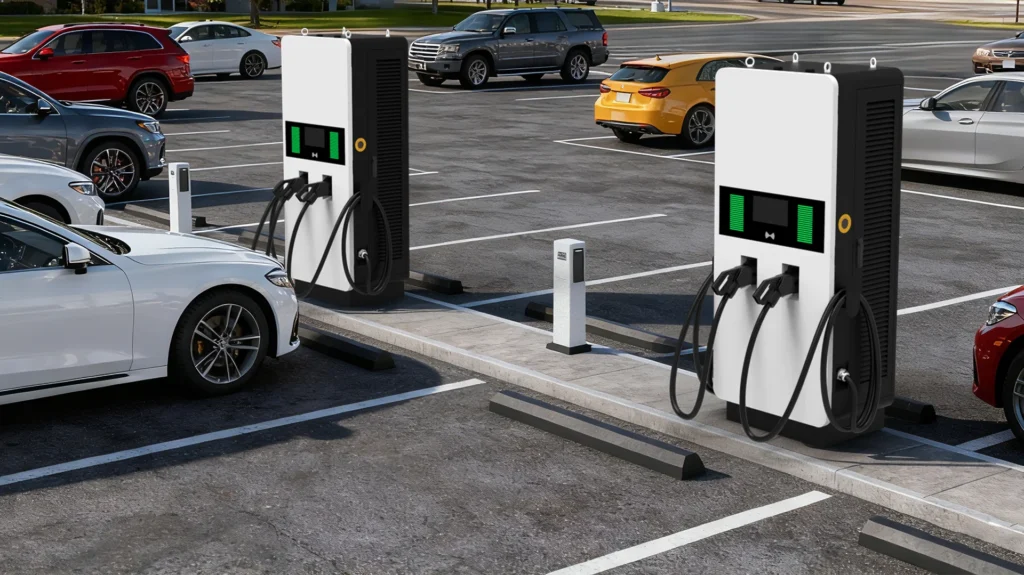
Fleet operators evaluating LCV electrification almost universally understand that they will pay for the electricity their vehicles consume. Significantly fewer understand that commercial utility tariffs impose a second charge — the demand charge — based on the peak power draw in any 15-minute window during the billing month. For LCV depots where all vehicles return and plug in simultaneously, this is not a theoretical risk. It is the most common source of unexpected cost overruns in the first year of LCV fleet electrification.
How Demand Charges Work at LCV Scale
Commercial utility demand charge rates vary by utility and rate class. Typical commercial rates in the US range from $8 to $22 per kW per month. One 15-minute peak event sets the demand charge for the entire month — regardless of how efficiently the fleet charges for the other 99.9% of billing hours.
Consider a 40-van HongTu 7 depot where all vehicles return between 5:30 and 6:00 PM and plug in immediately:
- Peak simultaneous draw: 40 × 11 kW = 440 kW
- Monthly demand charge at $14/kW: $6,160
- Monthly demand charge at $20/kW: $8,800
- Annual demand charge cost: $73,920 – $105,600
This recurring cost is avoidable with smart charging management that stages vehicle start times across a 3–4 hour window. The same 40 vehicles managed with departure-based scheduling create a peak of approximately 130–160 kW instead of 440 kW — reducing the monthly demand charge to $1,820–$3,200, a saving of $4,000–$5,000 per month.
Unmanaged vs. Managed: A Worked Comparison
| Scenario | Fleet | Peak Demand | Monthly Demand Charge ($14/kW) | Annual Cost |
|---|---|---|---|---|
| Unmanaged (all plug in at 6 PM) | 40 × HongTu 7 @ 11 kW | 440 kW | $6,160 | $73,920 |
| Smart managed (staggered 4 hours) | 40 × HongTu 7 @ 11 kW | ~150 kW | $2,100 | $25,200 |
| Managed + solar/storage buffer | 40 × HongTu 7 @ 11 kW | ~90 kW | $1,260 | $15,120 |
The managed scenario saves $48,720 per year in demand charges alone — before accounting for TOU energy rate optimization. This saving is purely a function of software configuration, not hardware. It requires OCPP 2.0.1-compatible chargers and a CSMS that supports departure-based scheduling — both of which should be baseline specifications for any LCV depot deployment. For the full discussion of smart charging strategies, see the Financial Modeling & ROI section of our CPO guide.
Smart Charging Strategies for LCV Depots
- Stagger start times: Configure the CSMS to queue vehicle charging starts across a 3–4 hour window after return, rather than starting all vehicles simultaneously at plug-in.
- Set a demand ceiling: Program a hard maximum site load that the CSMS will not exceed regardless of how many vehicles are simultaneously plugged in. Size the ceiling to match the utility service capacity and avoid demand charge thresholds.
- Departure-based prioritization: Vehicles scheduled for 5 AM dispatch charge first and at priority power; vehicles with 9 AM departures charge at lower power during the later overnight window. This ensures readiness without maximizing simultaneous draw.
- TOU rate optimization: Most commercial utility tariffs offer significantly lower energy rates during off-peak hours (typically 9 PM to 6 AM). Scheduling maximum charging load in these windows reduces per-kWh cost by 35–55% compared to on-peak charging, as documented by industry analysis.
Solar + Storage Integration for LCV Fleet Depots
LCV depot operators frequently ask whether rooftop solar can power their fleet charging. The answer is: yes, but only with battery storage as the intermediary. The timing mismatch between solar production (10 AM – 3 PM peak) and LCV charging demand (6 PM – 6 AM primary window) means that solar alone contributes very little to overnight depot charging. Battery energy storage is the bridge that makes the economics work. For a deeper analysis of the solar-plus-storage integration framework, see the solar and storage integration section of our CPO guide.
How Solar + Storage Works for LCV Depots
- During the day (10 AM – 3 PM): The solar PV array produces at peak output while the fleet is on route and the depot load is minimal. This surplus generation charges the battery storage system.
- At vehicle return (4–7 PM): The battery begins discharging to contribute to the initial charging wave as vehicles return and plug in, reducing peak grid draw.
- Overnight (7 PM – 6 AM): The battery continues discharging into the managed charging window, further reducing demand charges and supplementing grid supply with stored solar energy.
- Net result: Lower demand charges, lower per-kWh energy costs (solar energy at near-zero marginal cost versus grid rates), and a documented renewable energy contribution for fleet operators’ sustainability reporting.
Sizing Solar + Storage for CHEVOO Fleets
| Fleet Size | Vehicle Model | Daily Energy Need | Recommended Solar PV | Recommended BESS |
|---|---|---|---|---|
| 20 vans | HongTu 7 (53.58 kWh) | 600–900 kWh/day | 150–200 kWp | 300–500 kWh |
| 50 vans | HongTu 7 (53.58 kWh) | 1,500–2,250 kWh/day | 400–500 kWp | 750–1,000 kWh |
| 50 trucks | HongYun 9 (120 kWh) | 4,000–5,500 kWh/day | 800 kWp – 1 MWp | 1,500–2,500 kWh |
| 100 vans | HongTu 8 (70.19 kWh) | 4,500–6,000 kWh/day | 1–1.5 MWp | 1,500–2,500 kWh |
JointCharging’s energy storage systems for EV charging are designed for behind-the-meter depot applications, with integrated DC coupling to the charging infrastructure for maximum round-trip efficiency. Our PV+ESS+EVSE integrated solutions support dynamic power allocation across the full CHEVOO model range.
Financial Case for Solar + Storage at LCV Depots
- Demand charge reduction: $2,000–$5,000/month for mid-size depots (50–100 vans), depending on local utility demand charge rates
- Energy cost savings: Solar energy delivered at near-zero marginal cost versus grid rates of $0.10–$0.20/kWh during peak windows
- Federal Investment Tax Credit (ITC): Qualifying commercial solar and storage systems meeting prevailing wage and apprenticeship requirements are eligible for a 30% ITC under Section 48. Verify current availability with a qualified tax advisor — the legislative landscape for clean energy credits has been active in 2025–2026.
- 30C EV Infrastructure Tax Credit: Up to 30% of EV charging equipment cost (capped at $100,000 per item of property) in qualifying census tracts under the IRA’s Alternative Fuel Vehicle Refueling Property Credit. Verify current status — the 30C credit has been subject to legislative discussion.
- Payback period: 5–8 years for solar + storage at LCV depot scale, depending on local electricity rates and demand charge structure. Demand charge reduction alone often drives the majority of the financial return.
LCV Fleet Charging Costs and ROI Analysis
The financial case for LCV fleet electrification is now demonstrably stronger than for heavier vehicle classes, because the ratio of operating cost savings to vehicle premium is more favorable. The primary driver is energy cost: electric vans and light trucks operate at dramatically lower per-mile fuel costs than diesel equivalents.
Cost Per Mile: Electric LCV vs. Diesel
The US DOE’s Alternative Fuels Data Center documents light-duty all-electric vehicle O&M costs averaging 6.1 cents per mile — encompassing both fuel and maintenance. The DOE’s Federal Fleet Training documents EV fueling costs as low as 3 cents per mile for light-duty vehicles at $0.10/kWh electricity rates. Diesel equivalents — with fuel at $3.50–$4.00/gallon and van fuel economy of 18–22 MPG — cost $0.16–$0.22/mile in fuel alone.
| Cost Component | Diesel Delivery Van | EV Van (Managed Depot Charging) |
|---|---|---|
| Fuel / Energy cost per mile | $0.16 – $0.22 | $0.03 – $0.08 |
| Maintenance per mile | $0.08 – $0.12 | $0.03 – $0.05 |
| Total operating cost per mile | $0.24 – $0.34 | $0.06 – $0.13 |
| Annual savings (20,000 miles) | $2,200 – $5,600 per vehicle per year | |
Sources: US DOE AFDC (EV O&M costs), DOE Federal Fleet Training (fueling cost calculation methodology), EIA diesel price data. Maintenance savings reflect elimination of oil changes, transmission service, exhaust aftertreatment, and reduced brake wear from regenerative braking. As documented by the California Air Resources Board (CARB), EV maintenance costs are substantially lower than diesel equivalents per mile.
Depot Charging Infrastructure ROI Model
| Parameter | 20-Van HongTu 7 Depot | 50-Van HongTu 7 Depot | 100-Van HongTu 7 Depot |
|---|---|---|---|
| Chargers (Level 2 AC, 11 kW) | 20 | 50 | 100 |
| Hardware + installation cost | $40,000 – $60,000 | $100,000 – $150,000 | $200,000 – $300,000 |
| Annual energy cost (off-peak managed) | $12,000 – $18,000 | $30,000 – $45,000 | $60,000 – $90,000 |
| Annual diesel fuel savings vs. fleet | $44,000 – $88,000 | $110,000 – $220,000 | $220,000 – $440,000 |
| Annual maintenance savings | $16,000 – $48,000 | $40,000 – $120,000 | $80,000 – $240,000 |
| Simple payback (fuel + maintenance savings) | 5 – 18 months | 5 – 18 months | 5 – 18 months |
Fuel savings calculated based on 20,000 annual miles per vehicle, $3.75/gallon diesel average, 20 MPG baseline diesel van versus $0.12/kWh off-peak electricity rate. Maintenance savings based on DOE documentation of EV O&M cost advantage. Infrastructure CAPEX does not include electrical service upgrades, which vary by site.
Available Incentives for LCV Depot Charging
- NEVI Formula Program: 80% federal cost share for EVSE at designated Alternative Fuel Corridors. Requires OCPP 2.0.1 compliance and minimum 150 kW per port for DCFC. The NEVI program has experienced administrative changes since early 2025 — verify current program status and requirements with FHWA’s August 2025 Interim Final Guidance before relying on NEVI funding in project financials.
- CALeVIP (California): The Fast Charge California Project, launched August 2025 by the California Energy Commission, covers up to 100% of project costs, capped at $100,000 per charging port for publicly accessible DCFC installations. For Level 2 AC at fleet depots in Southern California, the CALeVIP Level 2 program has offered up to $6,000 per connector in eligible counties.
- IRA 30C EV Infrastructure Tax Credit: Up to 30% of EV charging equipment cost, capped at $100,000 per item of property for businesses in qualifying census tracts. Check current legislative status with a qualified tax advisor.
- Utility make-ready programs: Over 180 US utilities offer commercial EV fleet programs that can cover grid upgrade costs and provide TOU rate structures favorable to off-peak charging. PG&E, SCE, Xcel Energy, and Duke Energy are among the utilities with active programs. Contact your local utility’s commercial EV team before finalizing infrastructure specifications.
- State fleet electrification programs: California HVIP (up to $60,000 per heavy truck for vehicle purchase), NYSERDA, Colorado RAQC, Oregon DEQ, and Washington State DOC all maintain active fleet electrification incentive programs. The DSIRE database (dsireusa.org) is the authoritative source for state-level incentives by technology and geography.
For a complete treatment of available federal and state incentives for CPOs and fleet operators, including eligibility criteria and application processes, see our dedicated EV Charging Grants & Incentives Guide.
CHEVOO Fleet Compatibility: HongTu and HongYun Series
The CHEVOO HongTu and HongYun series, distributed in North America by JointCharging, covers the complete LCV fleet application range — from compact urban delivery vans to long-range regional light trucks. All models use CATL lithium iron phosphate (LFP) battery chemistry, which offers excellent cycle life, thermal stability suited to intensive daily charging schedules, and lower fire risk compared to NMC chemistry — important considerations for high-density depot environments.
HongTu 6 — Urban Last-Mile Van
The entry point of the CHEVOO commercial van range, designed for high-density urban delivery in congested city centers. With a 41.86 kWh CATL LFP battery and 305 km CLTC range, it is optimized for routes of 80–150 km per day — covering the vast majority of last-mile urban delivery applications without range anxiety. DC fast charging from 0 to 80% in approximately 45 minutes means exception cases (unexpected extended routes) can be handled at public DCFC without disrupting the next day’s dispatch.
Recommended charger: EVM005 Level 2 AC at 7 kW — full charge from typical daily depletion in 5–6 hours overnight
Best deployment: High-density urban delivery, e-commerce last-mile, food delivery
HongTu 7 — High-Roof Cargo Van
Available in two battery configurations (41.86 kWh and 53.58 kWh) with 7.1 m³ cargo volume — suited for appliance delivery, furniture logistics, and high-volume parcel operations where cargo space matters as much as range. The 53.58 kWh variant charges to full capacity overnight at 11 kW in approximately 5 hours, making it the ideal candidate for the standard overnight return-to-depot model at the 11 kW AC charging level.
Recommended charger: EVM005 Level 2 AC at 11 kW
Best deployment: Furniture and appliance delivery, high-volume courier, regional last-mile
HongTu 8 — Maxi Cargo Van
The extended-wheelbase, high-payload variant with a 70.19 kWh CATL LFP battery and 324 km range. Designed for heavier payload applications where the HongTu 7’s cargo volume is insufficient. The 70 kWh battery typically sees 45–60 kWh daily consumption on regional routes; an 11 kW Level 2 AC charger restores this in 4–6 hours overnight. For operators with multi-shift requirements or shorter overnight windows, the 22 kW Level 2 option reduces charge time to approximately 3.5 hours for a full-depletion recovery.
Recommended charger: EVM005 Level 2 AC at 22 kW (primary); DC 60 kW for multi-shift exception
Best deployment: Regional courier, B2B distribution, multi-stop suburban delivery
HongYun 7 — Light-Duty Box Truck
A step up from the van configuration into the light-duty truck segment, with a 70.59 kWh CATL LFP battery and a 4.25-meter cargo box suited for palletized goods and food distribution. The HongYun 7 bridges the gap between high-roof cargo van and full box truck, serving food and beverage distribution, building materials delivery, and retail replenishment. DC fast charging (60 kW) is recommended as the primary option given the vehicle’s heavier daily energy demand and potential for extended routes.
Recommended charger: EVD100 DC fast charging at 60 kW
Best deployment: Food and beverage distribution, retail replenishment, B2B pallet delivery
HongYun 9 — Regional Light Truck
The highest-capacity model in the CHEVOO range, available with 100.07 kWh and 120.27 kWh CATL LFP battery options offering 520–624 km CLTC range. The HongYun 9 targets regional delivery operations covering 200–400 km per day — cross-city logistics, regional distribution center replenishment, and inter-city courier operations. With daily energy demand of 80–110 kWh, overnight Level 2 AC charging is insufficient for full recovery; DC fast charging at 120 kW restores typical daily consumption in under 1 hour.
Recommended charger: EVD100 DC fast charging at 120 kW
Best deployment: Regional logistics, inter-city delivery, cross-city distribution
JointCharging Charging Solutions for CHEVOO Fleets
| CHEVOO Model | JointCharging Charger | Charge Time (typical daily depletion) | Primary Duty Cycle Fit |
|---|---|---|---|
| HongTu 6 | EVM005 Level 2 AC (7 kW) | 4–5 hours | Overnight return-to-depot |
| HongTu 7 (53.58 kWh) | EVM005 Level 2 AC (11 kW) | 3–5 hours | Overnight return-to-depot |
| HongTu 8 | EVM005 Level 2 AC (22 kW) | 2.5–3.5 hours | Overnight / limited multi-shift |
| HongYun 7 | EVD100 DC (60 kW) | ~1.2 hours | Overnight DC / multi-shift capable |
| HongYun 9 | EVD100 DC (120 kW) | ~1 hour | Regional delivery, multi-shift |
JointCharging offers pre-configured charging packages for CHEVOO fleet deployments, including depot design consultation, load management software configuration, and integrated ESS options. Contact our fleet charging team for fleet pricing and site assessment.
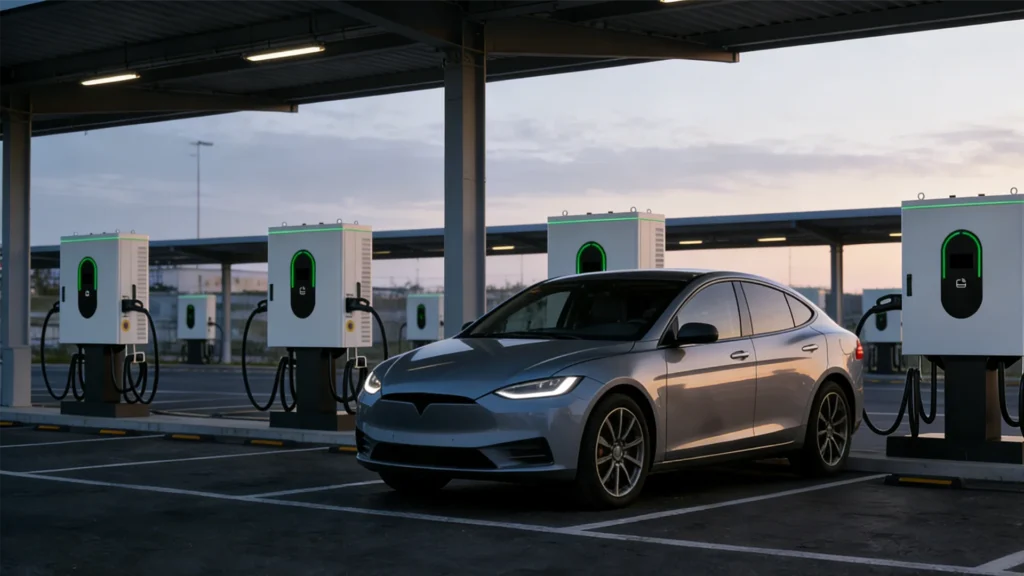
Case Study Scenario: 50-Van HongTu 7 Depot
To make the economics concrete, consider the following representative LCV depot scenario based on typical last-mile delivery operations with a 50-van HongTu 7 fleet.
Scenario Overview
- Fleet: 50 × CHEVOO HongTu 7 vans (53.58 kWh CATL LFP battery, 316 km CLTC range)
- Daily route: 120–160 km per van (urban and suburban delivery)
- Operations: Depart 7 AM, return 5:30–6:30 PM, single shift return-to-depot
- Daily energy draw: 40–50 kWh per van × 50 vans = 2,000–2,500 kWh per night
Charging Infrastructure
- 50 × Level 2 AC chargers at 11 kW (one per vehicle position) with OCPP 2.0.1 smart charging
- 1 × EVD100 DC 60 kW fast charger for exception cases (vehicles returning below 15% SoC)
- CSMS configured with departure-based scheduling: vehicles dispatching at 7 AM begin charging at 6 PM; vehicles with 9 AM departure start at 9 PM
- Demand ceiling set at 160 kW (versus 550 kW unmanaged theoretical maximum)
Solar + Storage Integration
- 400 kWp rooftop PV (on available depot roof and optional canopy over part of the parking area)
- 500 kWh battery ESS — absorbs daytime solar surplus, discharges into overnight charging window
- Expected solar contribution: 30–40% of total annual fleet energy demand (varies by location and season)
Key Financial Metrics
| Metric | Value |
|---|---|
| Total annual energy delivered to fleet | 730,000 – 912,500 kWh |
| Average charging cost (off-peak, managed) | $0.09 – $0.12/kWh all-in |
| Annual energy cost (electricity + demand charges) | $65,700 – $109,500 |
| Equivalent diesel cost (50 vans, 130 km/day, $3.75/gallon, 20 MPG) | $290,000 – $360,000 |
| Annual fuel savings | $180,000 – $295,000 |
| Annual maintenance savings (estimated) | $80,000 – $120,000 |
| Charging infrastructure CAPEX (chargers + installation, ex. ESS) | $120,000 – $165,000 |
| Simple payback on infrastructure (fuel savings only) | 5 – 11 months |
This scenario is illustrative, based on typical fleet parameters and publicly available data from the US DOE AFDC, EIA fuel price data, and industry benchmarking. Actual results depend on local utility rates, specific route profiles, vehicle procurement costs, and available incentives. Engage a qualified energy consultant for project-specific financial modeling.
Key Lessons from This Scenario
- Departure-based scheduling is the highest-ROI infrastructure decision: The shift from 550 kW unmanaged peak to 160 kW managed peak saves approximately $54,000 per year in demand charges — more than the cost of the Level 2 hardware alone.
- The exception DC charger earns its keep: One 60 kW DC port serving as an exception charger for vehicles returning below 15% SoC prevents dispatch failures without requiring DC hardware at every stall.
- Solar + storage payback is driven by demand charge savings, not just energy: In markets with $14–$20/kW demand charges, the BESS system pays back primarily through peak shaving rather than energy arbitrage.
For the phased deployment framework — how to start with Phase 1 infrastructure and expand with operational data — see our phased depot deployment section.
LCV Fleet Depot Charging Checklist
Phase 1: Fleet Operations Assessment
- ☐ Document duty cycle for each vehicle model: departure time, return time, daily km, route type
- ☐ Calculate daily kWh per vehicle model (cross-reference CHEVOO battery capacity and route energy consumption)
- ☐ Identify vehicles that require DC fast charging vs. those that can use Level 2 AC overnight
- ☐ Confirm vehicle readiness requirement (minimum SoC and departure time for each shift)
- ☐ Project fleet growth for years 1, 3, and 5
Phase 2: Site Electrical Assessment
- ☐ Document existing service: voltage, amperage, phase, current load
- ☐ Calculate managed peak demand (fleet × charger kW × 0.25–0.35 managed concurrency factor)
- ☐ Identify gap between available capacity and managed fleet demand
- ☐ Engage utility: pre-application meeting, capacity inquiry, TOU rate options, make-ready program
- ☐ Evaluate solar canopy feasibility: available roof / covered parking area vs. estimated generation
Phase 3: Infrastructure Design
- ☐ Select charger mix: Level 2 AC (7/11/22 kW) primary + DC for exceptions or multi-shift
- ☐ Specify OCPP 2.0.1 compatibility on all hardware
- ☐ Size conduit and feeder for 5-year fleet target (deploy chargers for Phase 1 only)
- ☐ Size BESS if solar + storage is in scope (see sizing table above)
- ☐ Configure CSMS with departure-based scheduling and demand ceiling
Phase 4: Installation and Commissioning
- ☐ Install oversized conduit infrastructure before charger deployment
- ☐ Commission OCPP 2.0.1 CSMS connectivity and test with all deployed chargers
- ☐ Test departure scheduling with simulated fleet departure times
- ☐ Verify demand ceiling does not exceed configured maximum under full-fleet plug-in conditions
- ☐ Document baseline utility bill before first vehicle charging event
Phase 5: Operations and Optimization
- ☐ Monitor vehicle readiness rate weekly (flag if below 95%)
- ☐ Review utility bills monthly: verify demand ceiling is holding, identify any breach events
- ☐ Track kWh per vehicle per day — flag consumption outliers for vehicle maintenance review
- ☐ Assess Phase 2 expansion triggers quarterly (fleet growth, readiness failures)
- ☐ Apply for utility demand response program once Phase 1 operational data is available
Frequently Asked Questions About LCV Fleet Charging
What is the best charger for HongTu 7 fleet vans?
For overnight return-to-depot operations — the standard last-mile delivery pattern — the EVM005 Level 2 AC charger at 11 kW is the recommended primary solution for the HongTu 7. At 11 kW, the 53.58 kWh battery charges from typical daily depletion (30–45 kWh used) in 3–5 hours overnight, well within the 10–12 hour charging window. This configuration is significantly more cost-effective than DC fast charging for a fleet with an adequate overnight window.
How much does depot charging cost per mile versus diesel for LCV fleets?
Based on US DOE data, light-duty all-electric vehicle O&M costs average 6.1 cents per mile, while diesel vans typically cost $0.24–$0.34 per mile in combined fuel and maintenance. The gap is primarily driven by two factors: electricity costs significantly less than diesel per unit of energy delivered to the wheels (EVs convert over 77% of electrical energy to motion, versus 12–30% for diesel), and EV maintenance costs are substantially lower due to fewer moving parts, no oil changes, and reduced brake wear from regenerative braking.
Do I need DC fast charging for my LCV fleet?
For most return-to-depot LCV fleets — last-mile delivery, municipal services, field service — with overnight dwell times of 8+ hours, Level 2 AC charging is sufficient and significantly more cost-effective. DC fast charging becomes necessary for: multi-shift operations with 2–4 hour inter-shift dwell; vehicles with large batteries (70+ kWh) that require faster recovery due to unusually long routes; or the HongYun 7 and HongYun 9 regional trucks where daily energy demand exceeds what Level 2 AC can practically restore in the available overnight window.
What is the payback period for LCV depot charging infrastructure?
For a well-designed LCV depot with managed charging, fuel and maintenance savings typically recover the infrastructure investment in 5–18 months, depending on fleet size, local diesel prices, electricity rates, and available incentives. This assumes the vehicles themselves are already purchased or leased. Infrastructure payback is driven primarily by the avoided diesel cost — for a 50-van fleet averaging 120 km/day, annual diesel savings of $110,000–$220,000 against infrastructure CAPEX of $100,000–$150,000 makes the payback arithmetic straightforward.
Can solar power overnight depot charging for LCV fleets?
Not without battery storage. Solar PV production peaks between 10 AM and 3 PM, while most LCV fleets charge overnight (6 PM – 6 AM). Battery energy storage captures daytime solar surplus and discharges it during the overnight charging window, enabling effective solar contribution to the fleet’s energy budget. Without storage, solar panels at a return-to-depot LCV depot contribute very little to the fleet’s actual charging energy.
What charger-to-vehicle ratio do I need for overnight LCV charging?
For overnight return-to-depot fleets, the standard ratio is 1:1 — one charging position per vehicle. This doesn’t mean all positions draw full power simultaneously; smart charging management staggers active draws. But each vehicle needs a dedicated plug-in position available when it returns, or drivers face queuing delays and missed readiness targets. For DC fast charging serving multi-shift top-up needs, one DC port can serve 3–6 vehicles per day depending on dwell time and power level.
Key Takeaways
- The electric light commercial vehicle market is growing at 14.8% annually — faster than any other commercial vehicle segment. More than 62% of urban delivery operators had adopted at least one electric LCV for last-mile operations as of 2025. CPOs who build LCV fleet charging expertise now are positioned for the largest near-term volume opportunity in commercial charging.
- Most LCV last-mile depot fleets need Level 2 AC (7–22 kW) as the primary charger — not DC fast charging. The overnight charging window (10–12 hours) comfortably accommodates full recharge from daily depletion for all CHEVOO HongTu models. DC fast charging is the right tool for the HongYun series, multi-shift operations, and exception handling.
- Demand charges from unmanaged simultaneous plug-ins are the primary operating cost risk. Smart charging management with departure-based scheduling reduces peak demand by 60–70% in the worked examples above — saving more annually than the hardware cost in many scenarios.
- The US DOE documents LCV O&M costs averaging 6.1 cents per mile for all-electric vehicles versus $0.24–$0.34 per mile for diesel equivalents. Infrastructure payback on fuel savings alone typically runs 5–18 months for well-designed LCV depots.
- Solar + storage integration requires battery energy storage to bridge the timing gap between daytime PV production and overnight depot charging. The financial case is primarily driven by demand charge reduction, not energy arbitrage.
- Specify OCPP 2.0.1-compatible hardware for all LCV depot deployments. This is the prerequisite for departure-based scheduling, demand response program participation, and future V2G capability.
JointCharging is the North American charging partner for CHEVOO commercial EV fleets, offering a complete PV+ESS+EVSE solution for HongTu and HongYun series depot deployments. Explore our AC EV chargers for North America, CCS1/NACS DC fast chargers, and energy storage systems for EV charging to configure the right solution for your fleet’s duty cycle.
Fleet energy consumption figures, incentive program details, and utility rates referenced in this article are subject to change. Vehicle specifications are based on manufacturer-provided data for the CHEVOO HongTu and HongYun series. Actual performance varies with route, climate, load, and driving patterns. Verify current incentive availability with the relevant program administrators before finalizing project financials. Last reviewed: May 2026.
Related Posts
- Redefining AC Charging — Making Smart Chargers Truly Smart
- MyFirstEV Is Coming: Which EV Chargers Will the Market Need?
- What Is MyFirstEV? California’s New EV Rebate Explained
- What Is CALeVIP? California’s 2026–2027 DC Fast Charging Incentives Explained
- Is There Still Room for a New Private Label EV Charger Brand?
