
EV Charging Site Selection & Permitting: A Complete Guide for CPOs [2026]
A Charge Point Operator (CPO) installs, owns, and manages EV charging stations. This guide covers procurement strategy, supplier evaluation, OCPP compliance, CSMS selection, and financial modeling — everything you need to build a profitable charging network.
- EV Charging Site Selection & Permitting: A Complete Guide for CPOs [2026]
- Why Site Selection Determines 80% of Your CPO Profitability
- Site Typology: Matching Charger Mix to Location Type
- Grid Capacity and Interconnection: The #1 Barrier to Deployment in 2026
- Permitting and Regulatory Compliance: A Step-by-Step Walkthrough
- Solar + Storage Integration: Why It Has to Be a Day-One Decision
- What Does a Data-Driven Site Selection Process Actually Look Like?
- Site Selection and Permitting Checklist for CPOs
- Frequently Asked Questions About EV Charging Site Selection and Permitting
- Key Takeaways
Site selection is the decision that determines whether a charging project thrives or barely breaks even — and most CPOs underestimate it. You can source CCS1/NACS DC fast chargers for USA & Canada at a competitive price point, negotiate a solid lease, and deploy the latest OCPP 2.0-compatible hardware — and still watch the project stall if the grid interconnection takes 18 months, the zoning classification is wrong, or the traffic pattern never materializes. According to the 2025 State of EV Charging Network Operators Report, energy constraints are the single biggest challenge for CPOs, with 46% citing this as their top issue and more than 90% expecting grid capacity to hinder growth over the next 12 months. Site selection and permitting are where that constraint is won or lost — before a single charger is installed.
This guide walks through every stage of the site evaluation and permitting process: from screening criteria and grid feasibility through permit applications, solar-plus-storage integration, and the data-driven methodologies that separate high-performing networks from underutilized assets. Whether you are siting your first corridor hub or scaling a multi-state network, this is the framework that keeps projects on schedule and on budget.
TL;DR: The three variables that determine CPO project success before construction begins are (1) grid capacity and interconnection timeline, (2) site traffic volume and EV adoption in the catchment area, and (3) zoning compatibility. Get these right first — everything else is optimization. Demand charges can add 30–50% to monthly operating costs at DC fast charging sites; battery storage and dynamic load management are the primary mitigation strategies. California’s AB 1236 and AB 970 mandate streamlined permitting with binding timelines, but enforcement is uneven — knowing the rules gives you leverage.
Why Site Selection Determines 80% of Your CPO Profitability
The economics of a charging station are highly nonlinear. A site with 15% port utilization may lose money even with premium per-kWh pricing; the same hardware at 35% utilization can be profitable within three years. The difference is almost always location — specifically, the combination of traffic volume, EV density in the catchment area, dwell time alignment, and grid economics. Hardware and software optimization happen at the margin. Site selection sets the ceiling.
The 3 Non-Negotiable Site Criteria
Before any financial modeling, every candidate site must clear three filters. Skipping any one of them generates projects that look viable on paper and fail in operation.
1. Traffic volume and EV adoption in the catchment area.
Annual Average Daily Traffic (AADT) is the baseline proxy for demand at corridor and highway sites. For destination sites — retail, hospitality, workplace — the relevant metric is visitor or employee count and their EV ownership rate. The Driivz site selection framework identifies EV density, road accessibility, and proximity to complementary amenities as the primary demand drivers. California, which accounted for 25.1% of all vehicle sales being EVs as of January 2025, offers very different demand fundamentals than lower-adoption states — and that delta should be reflected in your financial model from day one.
2. Grid capacity and interconnection feasibility.
This is consistently the hardest constraint and the most common source of project delays. A site that requires a distribution transformer upgrade (>200 kW peak load), a feeder upgrade (>3 MW), or a substation upgrade (>7 MW) carries materially different capital requirements than one with existing capacity. NREL analysis shows that battery-buffered 150-kW ports require at least 120 kWh of storage per port to deliver rated power through the first hour of operation at a grid-constrained site. Grid feasibility assessment is not an afterthought — it belongs in phase one of desktop screening.
3. Zoning and land use compatibility.
EV charging stations are not universally permitted as-of-right. Commercial and mixed-use zoning typically allows EVCS without discretionary review; industrial, residential, and agricultural zones often require conditional use permits or variances that add 3–12 months to a project timeline. Legal and permitting considerations should be evaluated at the desktop screening stage, not after a lease has been signed.
How Site Location Impacts Your Financial Model
The relationship between location quality and financial performance is direct and well-documented. Research published in Energy and AI (December 2025) on corridor DCFC economics found that stations in the bottom utilization quartile cost approximately six times more per kWh delivered than average-utilization sites — not because of hardware differences, but because fixed costs (grid connection, equipment depreciation, software subscriptions) are spread over far fewer charging events. The same study found that sites subject to utility demand charges average a levelized cost of charging of $0.43/kWh versus $0.31/kWh for stations without demand charge exposure — a 39% premium that directly compresses margins.
| Site Type | Typical Dwell Time | Optimal Charger Mix | Key Revenue Driver | Primary Risk |
|---|---|---|---|---|
| Highway Corridor | 20–45 min | 150–350 kW DCFC | Session throughput | Demand charges, low early utilization |
| Urban Hub / Retail | 1–3 hours | DCFC + Level 2 mix | High turn rate + amenity draw | Parking conflict, grid capacity |
| Workplace / Destination | 4–10 hours | Level 2 AC (7.4–22 kW) | Amenity value, employee retention | Low per-session revenue, capex recovery |
| Fleet Depot | 6–12 hours (overnight) | Level 2 AC + managed DCFC | Guaranteed utilization, ToU optimization | Load spike management, OCPP integration |
Site Typology: Matching Charger Mix to Location Type
One of the most common — and most expensive — mistakes CPOs make is applying a uniform hardware strategy across fundamentally different site types. A four-stall 150-kW DCFC installation at a workplace with eight-hour average dwell times wastes both capital and grid capacity. Conversely, a Level-2-only installation at a highway rest stop fails EV drivers entirely. The charger mix must follow the dwell time.
Destination AC Sites: Workplace, Hotels, and Retail
Sites where drivers typically stay four to ten hours — workplaces, hotels, shopping centers with grocery anchors — are ideally served by Level 2 AC charging in the 7.4–22 kW range. The slow power delivery matches the dwell time: a vehicle arriving at 8 AM with 40% charge is full by noon at 11 kW. AC EV chargers for North America are significantly lower in both hardware cost and grid impact than DC fast chargers, which makes the economics more forgiving at sites where peak utilization is naturally capped by parking turnover rather than charging speed. The revenue model at these sites is often indirect — amenity value, employee satisfaction, tenant attraction — rather than direct per-kWh revenue. For CPOs operating under a host-revenue split model, managing host expectations about direct revenue is critical.
DC Fast Charging Hubs: Highway Corridors
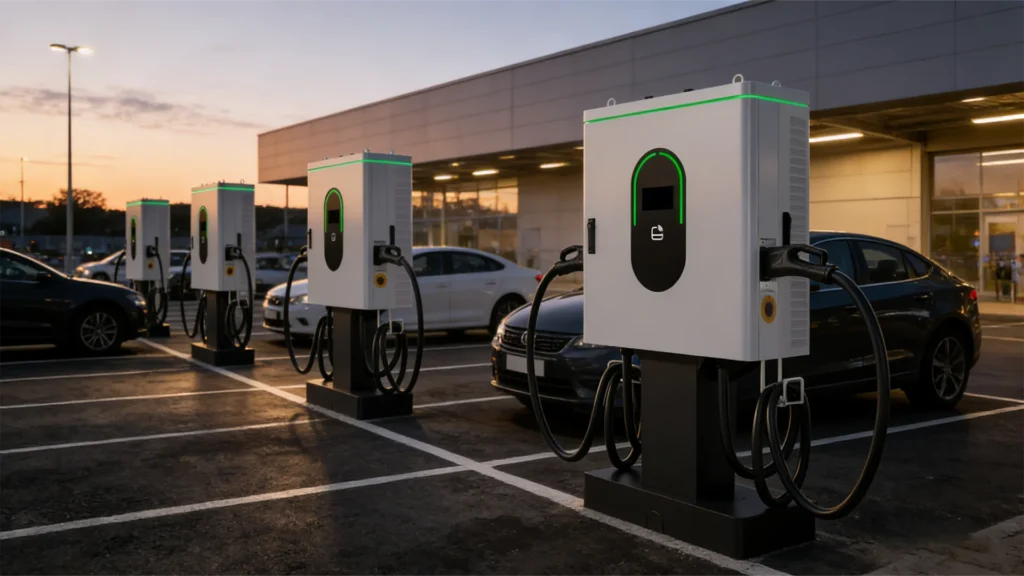
Corridor sites demand high power and fast throughput. The minimum viable configuration under NEVI federal standards is four 150-kW continuous-power ports per station. As the EV fleet matures toward higher-capacity batteries, port power requirements are trending upward: the NREL corridor economics study projects that 350-kW ports will represent 56% of corridor capacity by 2040, up from essentially zero today.
The critical design variable at multi-stall DCFC sites is the coincidence factor — the probability that all ports are in simultaneous peak use. Engineering for 100% coincidence (i.e., provisioning full grid capacity for every port at rated power simultaneously) dramatically overstates the required grid connection and inflates demand charges. Real-world coincidence factors for DC fast charging sites are significantly below 1.0, particularly at 4–8 stall configurations. Building in dynamic load management from the outset allows CPOs to share power across ports intelligently, reducing peak grid draw without degrading the user experience during normal traffic patterns. Smart energy management that dynamically caps site load and prioritizes connectors based on real-time demand is now table stakes for any multi-stall DC fast charging installation.
Fleet Depots: Scheduled and Controlled Charging
Fleet depot charging has fundamentally different economics than public charging. Utilization is predictable, access is controlled, and charging windows are defined by operational schedules rather than organic traffic. The primary engineering challenge is load management: a depot bringing back 30 vehicles after the evening shift, all plugging in simultaneously, creates a demand spike that can double or triple the site’s grid draw within minutes. Dynamic power allocation — distributing available capacity across all connected vehicles based on departure priority and state of charge — is the solution, and it requires OCPP 2.0 smart charging profiles or equivalent managed charging software.
The depot charging model supports aggressive load shifting to off-peak rate windows, which can substantially reduce electricity costs. For fleet operators on time-of-use tariffs, shifting charging from on-peak (often $0.20–$0.36/kWh) to overnight off-peak (often $0.08–$0.13/kWh) can cut energy costs by 40–60% per session. This requires both smart charging software and a utility rate that offers meaningful TOU differentiation.
Mixed-Use Sites: AC and DC Combination
The most resilient site configuration from a revenue-per-square-foot perspective is a mixed AC/DC installation that serves both short-dwell and long-dwell use cases. A retail center with a grocery anchor, for example, can support 4–8 Level 2 AC ports for shoppers doing their weekly shop (60–90 minute dwell) alongside 2–4 DCFC ports for quick-stop customers. This configuration maximizes parking lot utilization, reduces grid peak by keeping some load on lower-power AC circuits, and creates a site that works across the full EV adoption curve as the mix of vehicle types and driver behaviors evolves.
Grid Capacity and Interconnection: The #1 Barrier to Deployment in 2026
Grid capacity is the constraint that most frequently converts a financially viable project into a delayed or abandoned one. The data is unambiguous: according to the Driivz 2025 State of EV Charging Network Operators Survey, all EV charging professionals surveyed expect grid capacity to impact expansion, with 82% anticipating moderate constraints and 10% expecting significant limitations. Understanding this constraint — and designing around it — is now a core CPO competency.
Understanding Utility Interconnection Timelines
The US grid interconnection system is under severe pressure. Lawrence Berkeley National Laboratory’s “Queued Up” analysis documents that the median time from interconnection request to commercial operation has grown to approximately five years for large generation projects — up from under two years a decade ago. While EV charging station interconnections typically move faster than utility-scale generation projects (they are distribution-level connections, not transmission-level), the underlying grid infrastructure is the same system under the same stress.
For CPOs, the practical implication is that utility engagement must happen at the beginning of site evaluation, not after a lease is signed. A site that requires a new transformer or feeder upgrade can add 12–24 months and $100,000–$3,000,000 in infrastructure costs to a project. A site with existing spare capacity may interconnect in 60–90 days. That difference is invisible in a desktop analysis and decisive in the project economics.
FERC Order 2023, enacted in 2024, introduced reforms intended to speed interconnection processes — PJM, for example, has targeted 1–2 year timelines under the new framework. However, as the Solar and Storage Industries Institute notes, the structural challenges are not resolved by procedural reform alone, and CPOs should plan conservatively.
How to Assess Grid Capacity at a Candidate Site
A basic grid feasibility assessment has four components:
- Transformer capacity: What is the rated capacity of the transformer serving the parcel, and what is the current loading? A transformer at 60% utilization with 400 kVA spare capacity can support a 4-stall 150-kW DCFC site (at realistic coincidence factors) without upgrade. One at 90% utilization cannot.
- Secondary voltage and service entrance: 480V three-phase is standard for commercial DC fast charging. Sites with only single-phase or 208V three-phase service require service upgrades before DCFC installation.
- Feeder capacity: Distribution feeder capacity limits the aggregate load the utility can deliver to a given area. High-density commercial corridors may have feeder congestion that limits new load additions regardless of individual transformer availability.
- Interconnection study requirement threshold: Many utilities require a formal interconnection study for loads above a specific threshold (commonly 50–200 kW depending on the utility). Knowing this threshold before application avoids surprises.
The first step in any site evaluation should be a call or written inquiry to the local distribution utility’s new service department with the proposed load profile. This takes days, not weeks, and filters out sites that look attractive on traffic and zoning grounds but face prohibitive grid upgrade costs.
Strategies to Work Within Grid Constraints
Grid constraints are not necessarily project killers — they are engineering problems with engineering solutions. The three primary strategies:
- Dynamic load management (DLM): Software-based power sharing across ports reduces peak grid draw without reducing session throughput at normal utilization levels. DLM is effective when the site’s average load is well below its theoretical peak — which is true at most public charging sites except during brief daily peaks.
- Battery energy storage: A behind-the-meter battery system can buffer peak demand, reducing the grid connection size required and eliminating or reducing demand charges. NREL analysis establishes that battery-buffered 150-kW ports need at least 120 kWh of storage per port for full power delivery in the first hour. Battery storage is increasingly the preferred solution for corridor sites where grid capacity is limited and demand charges are material.
- Phased deployment: Installing fewer ports initially, with conduit and electrical infrastructure sized for full buildout, allows a CPO to begin operations within existing grid capacity and add ports as interconnection capacity expands — without repeating expensive civil and electrical work.
Permitting and Regulatory Compliance: A Step-by-Step Walkthrough
Permitting is the phase that most frequently introduces unpredictable delays into a CPO project timeline. The good news: it is also the phase most amenable to preparation. A complete, accurate permit application package submitted to a jurisdiction with a clear streamlining ordinance can result in approval in 20 business days. An incomplete application at a jurisdiction without a streamlining process can take 6–12 months. The difference is almost entirely in preparation.
The Standard Permit Application Package
Regardless of jurisdiction, a complete commercial EVCS permit application typically requires the following:
- Electrical plan: Single-line diagram showing service entrance, distribution panel, branch circuits to each EVCS, conductor sizing, overcurrent protection, and grounding. In California, installations must comply with California Electrical Code Article 625 (based on NEC 625), which governs EV charging equipment. Continuous load calculations must be sized at 125% of the maximum equipment load (NEC 625.41).
- Site plan: Dimensioned plan showing EVCS locations, ADA accessibility path of travel, signage, parking stall dimensions, and proximity to structures. Plans must show compliance with applicable accessibility standards (see below).
- Load calculations: Formal documentation showing that the existing service can support the added EVCS load, or documentation of the service upgrade required.
- Equipment specifications: UL listing or equivalent certification documentation for all installed equipment. In North America, ETL or UL listing is the standard acceptance criteria for AHJs.
- Utility interconnection application (separate track): Filed directly with the local distribution utility, not through the building department. This is a parallel process — start it simultaneously with the building permit application.
Accessibility Requirements for EV Charging Stations
ADA accessibility requirements for EV charging are frequently misunderstood and inconsistently applied. In California, CBC Chapter 11B-228.3 establishes the minimum number of accessible EV charging stations required based on total station count. Key requirements include:
- At least one accessible EVCS for every 25 total charging spaces (or fraction thereof)
- Van-accessible spaces require a minimum 8-foot-wide access aisle adjacent to a 9-foot-wide parking space (17 feet total minimum width)
- The accessible charging equipment, payment interface, and cable management system must be within reach range (15″–48″ above finished grade for forward reach; 9″–54″ for side reach)
- An accessible route must connect the accessible EVCS to the site’s accessible entrance without crossing vehicle traffic lanes where possible
Accessibility deficiencies are among the most common reasons permit applications are returned as incomplete. Engage an accessibility consultant or plan checker familiar with CBC Chapter 11B for any project with more than four total charging spaces.
Expedited Permitting Programs: California AB 1236 and AB 970
California’s AB 1236 (2015), codified at Government Code Section 65850.7, requires all California cities and counties to adopt an expedited, streamlined permitting process for electric vehicle charging stations. In March 2025, California Attorney General Rob Bonta issued a legal alert reminding local jurisdictions of their obligations — indicating that enforcement of the statute is an active priority.
- Application completeness determination: 5 business days for 1–25 stations at a single site; 10 business days for 26 or more stations
- Application approval: 20 business days for 1–25 stations; 40 business days for 26 or more stations
Qualifying applications — those that meet all health and safety requirements and use a jurisdiction’s published checklist — must receive administrative (ministerial) approval. No discretionary review, no planning commission hearings, no environmental impact review for standard EVCS installations. Some jurisdictions with AB 1236-compliant processes, such as the City of Pleasant Hill, have achieved permit processing in 1–5 business days.
The practical upside for CPOs: if a jurisdiction has a compliant streamlining ordinance, you can predict your permitting timeline with high confidence. If it does not, you have legal leverage — and the March 2025 AG alert strengthens that leverage considerably. Check the GO-Biz EVCS Permit Streamlining Map to verify compliance status before finalizing a California site.
Regulatory Trends to Monitor in 2026
- NEC 2026 / CEC 2025 cycle updates: The 2026 National Electrical Code includes updates affecting EVSE installation requirements, particularly around raceway fill, cable management, and outdoor weatherproofing standards. California adopts updated electrical codes on a rolling basis — confirm the currently adopted cycle with your AHJ before final engineering.
- NEVI compliance requirements: Federally funded NEVI stations must meet 23 CFR Part 680 standards — at least four networked DCFC ports, 150 kW minimum continuous power, CCS Type 1 connectors (with NACS adapters now required), and specific uptime reporting requirements. If your site qualifies for NEVI funding, design to these standards from the outset.
- Cybersecurity compliance: NEVI-funded stations are subject to cybersecurity requirements aligned with IEC 62443 and NIST frameworks. OCPP 2.0.1’s built-in security profiles support compliance. Hardware selected for NEVI-funded sites should be confirmed as OCPP 2.0.1-capable.
- Curbside charging legislation: Several US cities are piloting or adopting curbside charging ordinances that allow EVCS installation in the public right-of-way. San Francisco has an active pilot program. These projects involve additional permitting tracks through public works or transportation departments rather than standard building departments.
Solar + Storage Integration: Why It Has to Be a Day-One Decision
The single most predictable source of CPO operating cost overruns at DC fast charging sites is demand charges. According to US DOE data, demand charges can represent 30–50% of total monthly energy costs at commercial EV charging sites — not because the energy consumption is high, but because a single 15-minute peak during the measurement period sets the billing demand for the entire month. A 150-kW charger used at full power for one session per day can generate a demand charge that rivals the cost of all the energy delivered that month.
Solar alone does not solve this problem. Photovoltaic output is inherently variable — cloud transients can drop a 100-kW array from full output to near zero in seconds — and the peak demand from a DCFC charging event lasts 20–40 minutes regardless of weather. Battery energy storage is the solution that makes solar contribution meaningful and directly addresses the demand charge problem.
Why EV Charging Sites Need Battery Storage in 2026
The economic case for behind-the-meter battery storage at DC fast charging sites is now compelling. The core mechanism: a battery system charges from the grid during off-peak hours (low electricity rate, zero demand contribution) and discharges to serve charging events during peak hours. This flattens the site’s demand profile, reducing or eliminating the peak that triggers demand charges.
A real-world illustration: a site with a single 150-kW DCFC and a commercial demand charge rate of $15–$20/kW faces a potential demand charge of $2,250–$3,000/month from that single charger, even if utilization is modest. A 200-kWh battery system sized to offset that peak — charging overnight at off-peak rates and discharging during the demand window — can eliminate most of that charge. At $15/kW demand rates, that represents $1,800–$2,500/month in savings.
Battery Sizing Rules of Thumb for CPO Sites
| Site Configuration | Total Rated DCFC Power | Recommended Battery Power | Recommended Battery Energy | Primary Purpose |
|---|---|---|---|---|
| 2-stall corridor site | 300 kW | ≥150 kW | 200–300 kWh | Demand charge reduction |
| 4-stall corridor site | 600 kW | ≥200 kW | 300–450 kWh | Grid buffer + demand charge |
| 4-stall grid-constrained site | 600 kW (derated to grid limit) | ≥150 kW | 450–650 kWh | Grid offset + full power delivery |
| Fleet depot (30 vehicles) | Variable (managed charging) | ≥100 kW | 200–400 kWh | Peak shaving + ToU shifting |
The NREL benchmark of 120 kWh per 150-kW port applies specifically to grid-constrained sites where the battery must deliver rated port power even when grid supply is limited. For sites with adequate grid capacity, the battery is sized primarily around demand charge economics, which produces a smaller system with faster payback.
DC Coupling vs. AC Coupling
When solar is added to a charging site, the coupling architecture determines efficiency and cost:
- DC coupling connects the PV array and battery to a shared DC bus before the inverter. This is more efficient (one conversion stage less) and better suited to new-build installations where all components are specified together. Preferred for greenfield sites.
- AC coupling connects the PV inverter and battery inverter to the AC bus independently. This is more flexible and retrofit-friendly — the solar and battery systems can be installed separately with standard equipment. Preferred for brownfield sites adding storage to existing solar, or sites where the PV and EVCS systems are served by different contractors.
Financial Case for Solar + Storage at EV Charging Sites
The Investment Tax Credit (ITC) under Section 48 of the tax code currently provides a 30% credit on qualifying solar and battery storage systems for commercial projects that meet prevailing wage and apprenticeship requirements. This is a dollar-for-dollar reduction in federal tax liability — not a deduction. Additionally, the 30C Alternative Fuel Vehicle Refueling Property Tax Credit, expanded under the Inflation Reduction Act, provides up to 30% credit (up to $100,000 per item of property) on qualifying EV charging infrastructure in low-income or rural census tracts.
Important note: the ITC legislative landscape is actively changing as of 2026. Congress has been considering modifications to clean energy tax credits; CPOs should verify current credit availability and eligibility with a qualified tax advisor before finalizing project pro formas. The credits described above were in effect as of the date of this article but are subject to change.
A simplified payback illustration for a 4-stall 150-kW corridor site with a 400-kWh battery system:
- Battery system installed cost: approximately $400,000–$600,000 at current market rates
- 30% ITC: $120,000–$180,000 credit
- Monthly demand charge savings: $2,000–$4,000 (at $10–$20/kW rates)
- Net payback period: approximately 24–48 months post-ITC, depending on local demand charge rates
CE-certified energy storage systems with EV charging integration are available as integrated solutions that simplify both the engineering and procurement process compared to sourcing battery and charging hardware separately.
What Does a Data-Driven Site Selection Process Actually Look Like?
For many CPOs, site selection has historically been a combination of network operator intuition, real estate broker relationships, and opportunistic site host outreach. That approach produces inconsistent results — some sites outperform, many underperform, and the reasons are rarely analyzed systematically. The shift to data-driven site selection is now a competitive differentiator.
The GIS and Multi-Criteria Decision-Making Framework
Academic research on optimal EVCS placement — including a comprehensive review by researchers at Aalto University — consistently converges on a multi-criteria decision-making (MCDM) framework applied to geographic information system (GIS) data. The criteria fall into five categories:
- Demand indicators: EV registration density by ZIP code, traffic volume (AADT), proximity to high-traffic generators (grocery, hospitality, highway interchange)
- Grid indicators: Transformer spare capacity, substation proximity, feeder loading, historical interconnection approval rates
- Land use indicators: Zoning classification, parcel size, existing impervious surface (reduces civil cost), site host alignment
- Competitive network indicators: Proximity to existing public charging, coverage gaps in current network, NEVI corridor eligibility
- Economic indicators: Real estate cost, construction cost index by market, local incentive availability
Each criterion is weighted based on the CPO’s strategic priorities and the specific market context. A network focused on highway corridor coverage weights traffic and NEVI eligibility heavily. A network serving urban EV-dense markets weights EV density and grid capacity. The MCDM approach makes these trade-offs explicit and auditable rather than implicit and inconsistent.
Why Transportation-Based Siting Outperforms Electrical-Node-Based Siting
A common mistake in early network planning is siting chargers based on proximity to electrical substations or distribution infrastructure — the locations where grid connection is easiest — rather than where drivers actually travel. Research on transportation-power system integration consistently shows that electrical-node-based selection produces significant misalignment with actual travel demand patterns. Traffic flow matrices — origin-destination data from GPS and household travel surveys — are a more reliable predictor of charging demand than any grid-side indicator. The nodes of the transportation network and the nodes of the electrical network often do not coincide, and optimizing for one while ignoring the other produces suboptimal sites on both dimensions.
Multi-Stage Network Planning
The IEA Global EV Outlook 2025 emphasizes that data-driven decision-making is essential in a rapidly expanding and competitive market. Best practice for network planning now includes using initial site selection data — traffic, dwell patterns, EV density, proximity to amenities — to continuously guide network optimization, not just initial deployment. Sites that underperform against demand projections should trigger a structured root-cause analysis (which criteria were wrong?) rather than simply being written off.
A three-stage 15-year planning horizon, with re-evaluation at each 5-year stage, allows a CPO to balance near-term economic efficiency with longer-term network coverage and user experience goals. Early-stage sites should be chosen for economic robustness (high-confidence demand, manageable grid costs); later stages can address coverage gaps that are strategically important but carry higher commercial risk.
Site Selection and Permitting Checklist for CPOs
Use this checklist to structure the evaluation of any candidate site through the full pre-construction process.
Phase 1: Desktop Screening (complete before any site visit)
- ☐ AADT data from state DOT for nearest highway or arterial
- ☐ EV registration density from state DMV or third-party data (ZIP code level)
- ☐ Zoning verification — confirm EVCS is a permitted use, not conditional
- ☐ Utility territory identification and initial grid capacity inquiry
- ☐ Competitive network audit — existing public chargers within 2-mile radius
- ☐ NEVI corridor eligibility check (FHWA Alternative Fuel Corridor map)
- ☐ Local incentive programs — state, utility, municipal
- ☐ AB 1236 / streamlining ordinance status if in California (GO-Biz map)
Phase 2: Site Visit and Physical Assessment
- ☐ Confirm service entrance location, voltage, and phase configuration
- ☐ Estimate trench length from service entrance to EVCS pad
- ☐ Assess ADA path of travel from EVCS to site accessible entrance
- ☐ Document physical constraints: trees, drainage, grade changes, existing structures
- ☐ Verify parking stall dimensions and lane widths for accessibility compliance
- ☐ Photograph all utility markings, transformer location, and service panel
Phase 3: Permit Application Package Assembly
- ☐ Electrical plan (single-line diagram, load calculations, NEC/CEC Article 625 compliance)
- ☐ Site plan (dimensioned, showing EVCS locations, ADA compliance, signage)
- ☐ Equipment cut sheets with UL/ETL listing confirmation
- ☐ Demand charge analysis and DLM / storage design (if applicable)
- ☐ Jurisdiction checklist review — match application to AHJ’s published requirements
Phase 4: Utility Interconnection Application
- ☐ Submit interconnection application to distribution utility (run in parallel with building permit)
- ☐ Request formal load study if site load exceeds utility threshold
- ☐ Document transformer capacity and any required upgrade scope
- ☐ Confirm service entrance construction schedule with utility
Phase 5: Pre-Construction Final Checks
- ☐ All permits issued and on file
- ☐ Utility construction work order confirmed and scheduled
- ☐ Site host agreement executed with utility access provisions
- ☐ OCPP backend platform connected and tested with hardware
- ☐ Inspection scheduling confirmed with AHJ
Frequently Asked Questions About EV Charging Site Selection and Permitting
Do I need a building permit to install a Level 2 EV charger at a commercial site?
Yes, in virtually all US jurisdictions, commercial Level 2 EV charger installations require a building permit — specifically an electrical permit. The work must be performed by a licensed electrical contractor and inspected by the authority having jurisdiction (AHJ). In California, AB 1236-compliant jurisdictions must process these applications within 20 business days. Residential Level 2 chargers also typically require permits, though some jurisdictions offer simplified self-certification processes for low-amperage residential installations.
How do I assess grid capacity at a potential charging site?
The fastest approach is a direct inquiry to the local distribution utility’s new service department. Provide the site address and your proposed load profile (total kW, number of ports, anticipated peak draw). The utility can typically tell you whether a new service is needed, whether a transformer upgrade is required, and what the expected timeline and cost are. For more detailed analysis, a licensed electrical engineer can perform a site survey to document existing infrastructure capacity before you commit to the location.
What is the typical interconnection timeline for a DC fast charging site?
It varies significantly by utility, site complexity, and whether grid upgrades are required. For a site with existing adequate capacity and no infrastructure upgrades, utility service connections typically take 60–120 days after application. Sites requiring transformer upgrades add 6–12 months. Sites requiring new feeder or substation infrastructure can add 18–36 months. This variability makes early utility engagement — before signing a lease — one of the highest-leverage actions a CPO can take.
What does the 30% Investment Tax Credit cover for EV charging and battery storage?
Under Section 48 of the tax code, qualifying commercial solar energy systems — including paired battery storage — are eligible for a 30% ITC if prevailing wage and apprenticeship requirements are met (otherwise the base rate is 6%). The 30C Alternative Fuel Vehicle Refueling Property Tax Credit provides up to 30% credit (capped at $100,000 per item of property) on EV charging equipment located in qualifying census tracts. The legislative status of both credits is subject to ongoing Congressional action; consult a qualified tax advisor for current eligibility. Note that to qualify for the 30C credit, equipment must be operational by June 30, 2026, under current law.
Can I install EV chargers on curbside public streets?
In some cities, yes — but it requires a separate permitting track through the public works or transportation department rather than a standard building permit. San Francisco and several other California cities have active curbside charging programs. These projects typically involve a license agreement with the municipality, compliance with encroachment permit requirements, and design standards for pedestrian safety and accessibility. The regulatory framework for curbside charging is evolving rapidly; check with your target city’s transportation department for current program status.
Key Takeaways
- Grid capacity is the #1 bottleneck for CPO network expansion in 2026 — start utility conversations before signing any lease.
- Charger mix must match site dwell time: Level 2 AC for 4–10 hour destinations; DCFC for highway corridors and quick-stop urban sites; managed Level 2 for fleet depots.
- Demand charges add 30–50% to monthly energy costs at DC fast charging sites. Battery storage is the primary mitigation, and it should be designed into the site from day one.
- In California, AB 1236 and AB 970 mandate streamlined permitting with binding timelines (20 business days for 1–25 stations). Use the GO-Biz map to verify jurisdiction compliance status before committing to a site.
- Data-driven site selection — combining AADT, EV density, grid capacity scoring, and competitive network analysis — consistently outperforms intuition-based approaches on financial performance.
- Solar + battery integration planned at greenfield stage costs far less than retrofitting later. The 30% ITC makes the financial case at most sites with meaningful demand charge exposure.
Ready to evaluate hardware for your next site? Browse CCS1/NACS DC fast chargers for the US and Canada market — including ETL-certified models compatible with NEVI funding requirements — or explore energy storage systems for EV charging sites designed for behind-the-meter demand charge management.
Regulations, tax credits, and utility policies referenced in this article are subject to change. Verify current requirements with your local authority having jurisdiction, utility, and qualified tax advisor before finalizing project design or financial models. Last reviewed: May 2026.
Related Posts
Redefining AC Charging — Making Smart Chargers Truly Smart
The core truth: Most AC chargers on the market cannot read your EV’s actual battery…
MyFirstEV Is Coming: Which EV Chargers Will the Market Need?
Last updated: July 15, 2026 California’s MyFirstEV programme is expected to lower the upfront cost…
What Is MyFirstEV? California’s New EV Rebate Explained
Last updated: 15 July 2026 MyFirstEV is California’s new point-of-sale rebate programme for residents buying…
What Is CALeVIP? California’s 2026–2027 DC Fast Charging Incentives Explained
Last updated: July 15, 2026 California is providing $55.2 million in new funding for publicly…
Is There Still Room for a New Private Label EV Charger Brand?
The honest version of that question sounds like this: the EV charger market is obviously growing…
Private Label EV Charger Launch: Complete Checklist
Most private label EV charger brands spend months getting the product right — and maybe…
