

If you manage a commercial EV fleet, you already know the pitch: lower fuel costs, reduced maintenance, cleaner operations. What nobody tells you before you sign the purchase order is that the charging side of the equation is where fleets actually get into trouble.
Table of Contents
Recently, I saw a fleet operator on Reddit sharing his current situation: his Level 2 chargers are too slow for mid-day turnarounds, his utility bill is brutal, and his charger fans are clogging with depot dust.
That post drew a thread full of operators who recognized the same problems. I searched Reddit to see if other fleet managers were facing similar confusion—yes, quite a few were. So we decided to write this post to help them solve the problem and give direct, technical answers.
6 Real EV Fleet Charging Problems & Solutions
1. “I Don’t Know Which Commercial EV Charger Is Actually Worth Buying“
This is the starting point for nearly every fleet operator entering the space. The charger hardware market is crowded, pricing is opaque, and brand-name recognition from consumer EV charging does not reliably translate to commercial-grade performance. Fleet managers ask: Do I need AC or DC? What power level? What happens if the software locks me in?
The honest answer depends on your duty cycle.
First, determine whether you need a DC or AC EV Charger.
For overnight depot charging where vehicles dwell for 8–12 hours, AC chargers (7.4 kW to 22 kW) deliver full charges at a significantly lower hardware and installation cost than DC fast chargers. For depots with shorter vehicle dwell times, high-utilization applications, or heavy-duty trucks with large battery packs, DC fast chargers (30 kW to 400 kW) are required to ensure vehicles are charged before next departure.
| Charger Type | Power Range | Best For | Typical Dwell Time Needed | Key Consideration |
|---|---|---|---|---|
| AC (Level 2) | 7.4 kW – 22 kW | Light commercial vehicles, overnight depot charging, vans | 6–12 hours | Lower hardware cost, lower grid impact |
| DC Fast Charger | 30 kW – 150 kW | Medium-duty trucks, buses, short dwell depots | 1–4 hours | Higher throughput, higher demand charge risk |
| DC Ultra-Fast | 150 kW – 400 kW | Heavy-duty trucks, transit buses, rapid turnaround | 20–90 minutes | Requires significant grid capacity planning |
Next, confirm whether you need ocpp 1.6j or 2.0.1
The non-negotiable specification for any commercial fleet charger is OCPP compliance (Open Charge Point Protocol). OCPP 1.6J is the minimum; OCPP 2.0.1 is preferred for new deployments. Without it, your charger hardware is locked to its manufacturer’s software ecosystem — meaning if the vendor changes pricing, gets acquired, or shuts down support, you have no exit. Always verify OCPP compliance before purchasing.
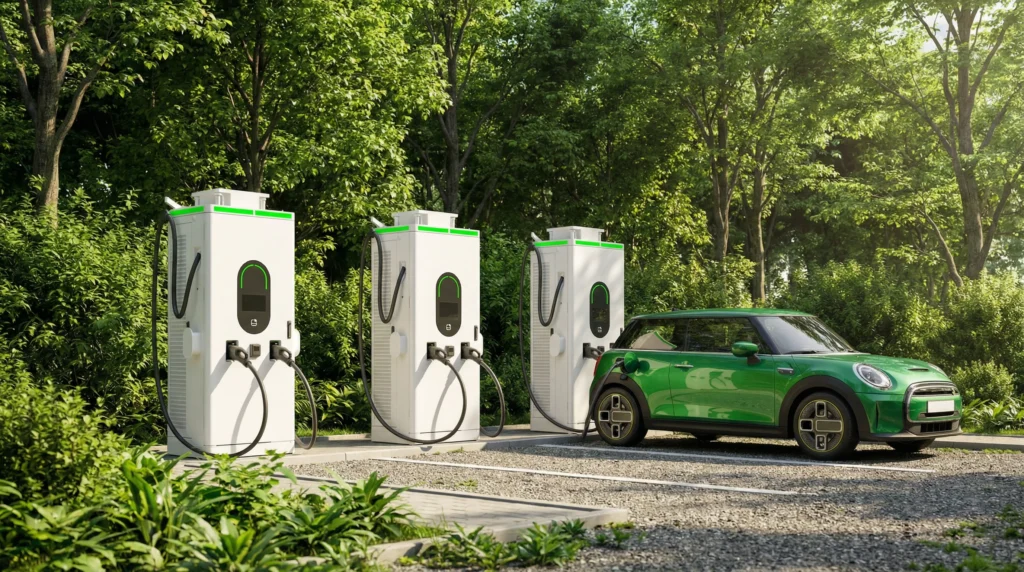
Finally, determine the type of connector required for the vehicle
For fleet operators in North America, ensure any charger you purchase supports CCS1 or NACS (J3400) connectors depending on your vehicle makes — the industry is converging on both. For European and global markets, CCS2 and Type 2 are the relevant standards. Purchasing the wrong connector standard is a costly mistake that cannot be easily corrected.
2. “How Do I Set Up a Charging Depot for 20+ Vehicles Without Destroying My Electricity Budget?“
This is where most fleet operators hit their first serious operational shock. The infrastructure cost is predictable and one-time. The electricity cost is ongoing, and if unmanaged, it can eliminate the fuel savings that justified the EV transition in the first place.
The core issue is demand charges. Utility providers in most markets bill commercial customers not just for the total energy consumed (kWh), but for the peak power demand (kW) within any billing interval — often a 15-minute window. When multiple vehicles plug in simultaneously at the end of a shift, that single event can set a demand charge that applies to the entire monthly bill. One fleet manager described their experience bluntly in an online forum: “We had a $43,000 surprise on our first utility bill after the EVs arrived.” This outcome is preventable — but only with deliberate infrastructure design.
The solution framework for a 20-vehicle depot charging setup has three pillars:
- Dynamic Load Balancing (DLB): A system-level function that monitors total site power consumption in real time and distributes available capacity across active chargers. When total draw approaches the utility threshold, DLB reduces individual charger output automatically — keeping all vehicles charging, but preventing demand charge spikes. This is not optional for multi-vehicle depots.
- Smart charging schedules: Configure chargers to delay charging start until off-peak tariff windows (typically 11 PM – 6 AM in most markets). Most fleet vehicles have sufficient dwell time for this approach. Fleets using smart charging management report up to 40% reduction in electricity costs compared to unmanaged charging.
- Phased infrastructure build-out: Do not install all chargers at full power on day one. A staged approach — starting with fewer, lower-power chargers and adding capacity as your fleet grows — prevents overbuilding grid connections and avoids unnecessary capital expenditure on infrastructure you won’t need for 12–18 months.
For large depots where grid capacity is a genuine constraint, battery energy storage systems (BESS) co-located with charging infrastructure can absorb off-peak energy and dispatch it during high-demand charging windows — effectively decoupling your peak charging demand from the grid peak. This is particularly relevant for heavy-duty truck depots where a single MHDV battery can draw as much electricity as dozens of light-duty vehicles. Learn more about CE-certified energy storage with EV charging for depot-scale applications.
3. “The Business Case Is Getting Hard to Justify — Incentives Are Gone and Costs Are Higher Than Expected“
This concern is legitimate and has intensified in 2025. Federal EV incentive programs in the United States changed materially: the 45W commercial clean vehicle tax credit was terminated in September 2025, removing a significant subsidy that many TCO models had relied upon. This has forced fleet operators to rebuild their financial cases from the ground up.
However, the business case for fleet electrification remains structurally sound — it simply requires more rigorous modeling. Key factors that still hold:
- Fuel cost differential: Electricity costs $0.03–$0.06 per mile at depot charging rates versus $0.15–$0.25 per mile for diesel. This 60–80% reduction in per-mile energy cost compounds significantly across high-mileage commercial fleets.
- Maintenance savings: EVs eliminate oil changes, transmission service, exhaust system repairs, and reduce brake wear through regenerative braking. Fleet operators report 40–50% lower maintenance costs per vehicle compared to equivalent ICE vehicles.
- State-level incentives remain active: California’s HVIP program offers up to $60,000 per heavy-duty vehicle. New York, Colorado, Oregon, and Washington maintain active fleet electrification programs. Utility make-ready rebates for charging infrastructure are widely available. The 30C infrastructure tax credit (30% up to $100,000 per site) — check current 2026 eligibility.
- Regulatory compliance timeline: EPA Phase 3 GHG standards beginning with model year 2027 create compliance pressure regardless of ROI calculations. Fleets that electrify proactively avoid the cost premium of last-minute procurement.
The critical discipline is building a complete TCO model — not just comparing sticker prices. A proper fleet EV TCO model must include: vehicle purchase price, financing cost, charging infrastructure CapEx, ongoing electricity cost (modeled with demand charges at your specific utility rate), maintenance savings, residual/resale value, and any remaining incentives. Fleets that model this correctly consistently find that the economics favor electrification for return-to-base routes under 200 miles daily where overnight dwell time is available.
4. “What Key Factors Should Fleet Operators Consider When Planning EV Charging Infrastructure?“
Beyond hardware selection and electricity costs, fleet operators consistently raise a set of infrastructure planning questions that don’t have obvious answers from vendor datasheets. Here is the operational checklist that experienced fleet charging consultants use:
- Grid connection capacity: Request a utility load study before finalizing your charger count and power levels. Many depots — particularly older industrial sites — have available grid capacity well below what a full EV fleet requires. Grid upgrade lead times from utilities can range from 6 months to 3+ years in constrained markets. Start this conversation before purchasing vehicles.
- Network connectivity at charger locations: Smart chargers require continuous network connectivity to execute load balancing, scheduling, and remote monitoring. Many depot back lots have poor cellular signal. Plan for wired Ethernet runs to DC fast charger units — cellular backup alone is insufficient for mission-critical fleet operations.
- Duty cycle mapping: Document every vehicle’s daily mileage, departure time, return time, and average dwell time before selecting charger types. A delivery van returning at 6 PM with 12 hours of overnight dwell is a completely different infrastructure problem from a shuttle vehicle cycling multiple times per day.
- Connector compatibility: Verify connector standards for every vehicle make in your fleet before purchasing charger hardware. Mixed fleets (e.g., a combination of vehicles using CCS1 and NACS) require either multi-standard chargers or separate charger types for each vehicle segment.
- Scalability provisions: Install conduit runs and panel capacity for future charger expansion during initial construction — even if charger units are not installed immediately. The incremental cost of conduit during initial build is a fraction of the cost of trenching and re-running electrical later.
5. “Commercial Electric Truck Drivers: How Are You Dealing With Long-Haul Range and Charging Reliability?“
This pain point reflects the genuine frontier of fleet electrification: heavy-duty Class 6–8 trucks on routes that exceed overnight depot charging windows. Forum discussions from commercial truck operators reveal that the challenge is not just technical — it’s operational confidence. Drivers report anxiety about charging reliability at en-route stops, with public DCFC uptime issues affecting schedule adherence.
The current state of the industry is this: return-to-base routes under 200 miles daily have a well-established charging solution via depot charging. Long-haul routes over 300+ miles remain genuinely difficult with current technology and infrastructure density.
For operators in the transitional middle ground (150–300 mile routes), the practical approaches are:
- En-route charging partnerships: Negotiate dedicated charging access at distribution centers, customer sites, or partner depots along regular routes. Exclusive or priority access eliminates the public network reliability problem.
- Battery capacity selection: Where vehicle specification allows, choose the largest available battery pack for routes that approach range limits — the incremental cost is almost always lower than the operational disruption of mid-route charging.
- Hybrid fleet transition: For fleets with mixed route profiles, electrify the high-utilization return-to-base routes first (capturing maximum fuel savings) while retaining ICE or hybrid vehicles for unpredictable long-haul assignments. This hybrid approach produces the best near-term TCO while the charging network matures.
- On-route DC fast chargers at anchor sites: For dedicated routes, installing a DC fast charger at a midpoint anchor location (customer warehouse, company-owned facility) removes dependency on public networks entirely.
6. “Charger Reliability and Uptime — Is This a Real Problem for Commercial Fleet Operations?“
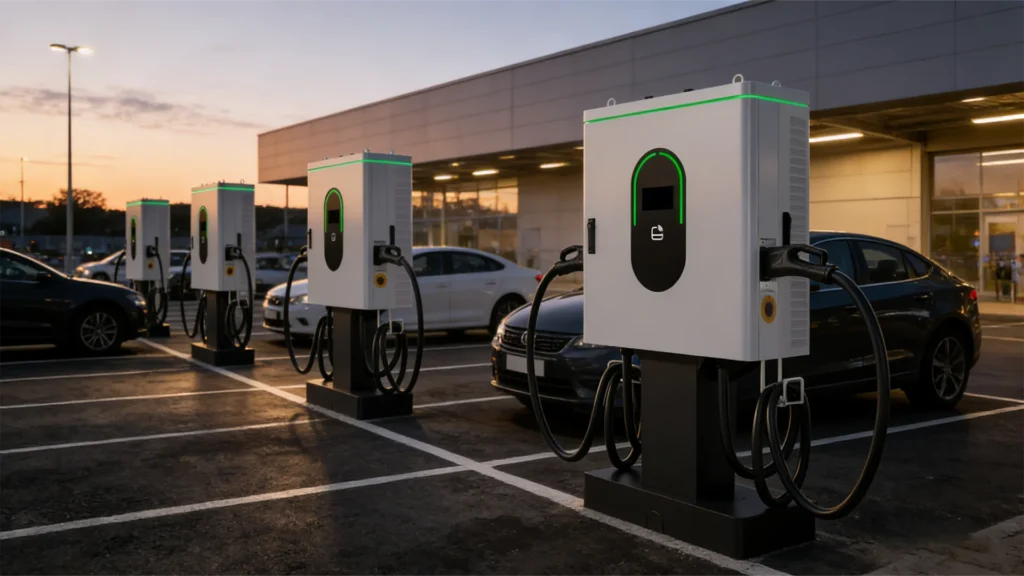
Yes — and it is the most operationally consequential issue for fleet operators who have already electrified. A charger that fails overnight is not merely inconvenient: it means vehicles are not ready for their morning departure window, which cascades into missed service commitments and driver scheduling disruption.
Industry data on public EV charging uptime is sobering: in 2023, EV drivers in the United States reported that something went wrong approximately 21% of the time when attempting to charge at public stations. For commercial fleets, where operational schedules are tight, this failure rate is unacceptable.
The solution set for depot charging reliability:
- Hardware certification standards: Specify chargers with ETL, CE, or TÜV certification depending on your market. These certifications require testing against defined performance and safety standards that uncertified hardware is not required to meet. For North American fleets, ETL listing is the relevant benchmark. For European operations, CE and TÜV certification apply.
- OCPP-based remote monitoring: OCPP-compliant chargers expose fault codes, session data, and connectivity status to your chosen charge management system. This means you can identify a failing charger remotely — before drivers arrive — rather than discovering it at 5 AM when the first shift begins.
- N+1 charger redundancy: For mission-critical fleets, install one spare charger port beyond your calculated requirement. The cost of one additional charger is always less than the operational cost of a vehicle that cannot depart on schedule.
- Vendor after-sales support: Assess charger manufacturer support responsiveness before purchase — not after. Request response time SLAs and verify parts availability. Manufacturers with accredited service labs (such as Intertek or SGS-accredited facilities) can generally provide faster diagnostic support for hardware faults.
What Does a Complete Fleet Charging Solution Actually Look Like?
Pulling these pain points together, a well-designed fleet charging solution has five integrated components:
- Right-sized hardware — AC chargers for overnight depot applications; DC fast chargers for short-dwell or heavy-duty applications; matched connector standards for your vehicle mix
- Dynamic load balancing — system-level power management that prevents demand charge spikes and maximizes charger utilization across all depot assets
- OCPP-compliant charge management software — open protocol connectivity that gives you control over scheduling, monitoring, reporting, and cost allocation without vendor lock-in
- Energy storage integration (where applicable) — battery systems that decouple peak charging demand from grid peaks, particularly relevant for heavy-duty depot applications with constrained utility capacity
- Certified, supported hardware — chargers with the market-appropriate safety certifications and a manufacturer with documented after-sales support capabilities
JointCharging has deployed over 200,000 units across 70+ countries since 2015. Our AC EV chargers for North America and CCS1/NACS DC fast chargers for USA & Canada are ETL-listed and OCPP 1.6/2.0 compatible. Our energy storage systems for EV charging are designed for depot-scale integration. All products are manufactured under ISO 9001 and TS 16949 certified processes.
Key Takeaways for Fleet Managers Planning EV Charging Infrastructure
- Specify OCPP-compliant chargers to avoid software vendor lock-in — this is non-negotiable for commercial deployments
- Model demand charges at your specific utility rate before finalizing charger power levels — this is where most TCO calculations fail
- Request a utility load study before purchasing vehicles — grid upgrade lead times can be longer than vehicle delivery lead times
- Start your utility and grid connection conversation at least 12 months before your target fleet electrification date
- Build conduit and panel capacity for future expansion during initial installation — the cost premium is minimal compared to retrofit expenses
- For heavy-duty applications, evaluate battery energy storage co-location to manage peak demand and reduce grid upgrade requirements
- Verify connector standards (CCS1, NACS/J3400, CCS2, Type 2) for every vehicle in your fleet before specifying charger hardware
If you’re working through any of these challenges for a specific fleet project, contact our fleet charging team with your vehicle count, duty cycle profile, and site location — we’ll scope a solution that addresses your actual constraints, not a generic one.
Frequently Asked Questions: Fleet EV Charging
What type of EV charger is best for a commercial fleet depot?
For most overnight depot applications with light commercial vehicles and vans, AC Level 2 chargers (7.4 kW–22 kW) provide the best combination of cost, grid impact, and charging speed. DC fast chargers (30 kW–400 kW) are required for short dwell times, heavy-duty trucks, or high-utilization applications where vehicles need to be charged in under 4 hours. The most important specification regardless of type is OCPP compliance, which ensures your hardware can be managed by any compatible charge management software without vendor lock-in.
How do I prevent high electricity bills when charging a fleet of 20+ EVs?
The primary risk is demand charges — utility fees based on your peak 15-minute power draw. These can represent the majority of your monthly electricity bill if multiple vehicles charge simultaneously. The solution is dynamic load balancing (DLB), which distributes available site capacity across active chargers to prevent demand spikes, combined with off-peak charging schedules. Fleets implementing smart charging management report up to 40% reduction in electricity costs compared to unmanaged charging.
How long does it take to set up a fleet charging depot, and what is the biggest lead-time risk?
Hardware procurement and installation typically takes 3–6 months. The longest lead-time item is almost always the utility grid connection upgrade, which can range from 6 months to over 2 years in constrained markets. This is why fleet operators should initiate the utility load study and grid connection application before — or simultaneously with — vehicle procurement, not after vehicles arrive.
Is the business case for EV fleet electrification still valid after federal incentive changes in 2025?
Yes, for return-to-base fleets with daily routes under 200 miles. The 60–80% reduction in per-mile energy cost versus diesel, combined with 40–50% lower maintenance costs, produces a strong long-term TCO advantage. State-level incentives (California HVIP, NY, CO, OR, WA programs) and utility make-ready rebates remain active as of 2026. The key discipline is building a complete TCO model that includes demand charges, infrastructure costs, and actual available incentives — not relying on simplified comparisons.
What does OCPP mean and why does it matter for fleet charging?
OCPP (Open Charge Point Protocol) is an open communication standard that defines how EV charger hardware communicates with charge management software. OCPP compliance means you can connect your chargers to any compatible software platform — enabling features like scheduled charging, load balancing, remote monitoring, cost allocation by vehicle, and fault reporting. Chargers without OCPP support are locked to a single vendor’s software ecosystem, creating long-term operational and commercial risk. OCPP 1.6J is the current baseline minimum; OCPP 2.0.1 is recommended for new installations.
How should I handle EV charging for heavy-duty trucks with large battery packs?
Heavy-duty trucks with 200–600+ kWh battery packs require DC fast chargers, often in the 100–400 kW range, and create substantial grid demand challenges at depot scale. For depots electrifying heavy-duty fleets, a utility load study is essential before hardware selection. Battery energy storage systems co-located at the depot can absorb off-peak grid energy and deliver it during peak charging windows, significantly reducing both demand charges and the required grid connection capacity. Smart charging scheduling — staggering charge start times by vehicle departure priority — is the minimum operational practice required.
