
Fleet electrification has crossed from pilot project to procurement policy. In 2026, the question most fleet managers are asking is no longer whether to electrify — it is how to structure the transition to generate measurable returns before the regulatory and incentive landscape shifts again.
The EY–Eurelectric Fleet Forward report, published 04 March 2026, quantifies the opportunity at up to €246 billion in cumulative operating cost savings across European corporate fleets by 2030. That number does not materialize automatically — it depends on getting infrastructure, energy contracts, and vehicle selection right from day one.
This guide covers what fleet electrification actually costs in 2026, which compliance deadlines demand immediate attention, how early movers are converting the transition into a competitive advantage, and what a practical depot charging strategy looks like in practice.
What Does Fleet Electrification Cost in 2026?
Fuel and Operating Cost Comparison
The operating cost gap between electric and combustion vehicles has widened to the point where it drives fleet decisions independently of sustainability commitments. According to Qmerit’s total cost of ownership (TCO) analysis, electric fleet vehicles operate at $0.04–$0.05 per mile in energy costs, compared to $0.175 per mile for gasoline-powered equivalents. For a vehicle logging 20,000 miles (32,187 km) annually, that translates to fuel savings of $2,500–$2,700 per vehicle per year.
Maintenance savings compound the advantage. Electric vehicles have fewer moving parts, no oil changes, and reduced brake wear due to regenerative braking. Qmerit estimates maintenance costs 40–50% lower for EVs versus combustion equivalents — meaning a fleet of 50 vehicles can save $30,000–$55,000 annually on servicing alone.
For heavier duty cycles, the data is equally persuasive. Zenobe’s electric fleet TCO model shows electric buses achieving a total cost of ownership (TCO) 7% lower per mile than diesel on a net present value (NPV) basis over a 15-year operating life, with electric driving costs 30–40% cheaper per mile on fuel alone.
Infrastructure Investment: What to Budget
Charging infrastructure is the capital line that surprises most fleet operators. AmpUp’s 2026 Commercial EV Charging Buyer’s Guide puts total installed costs for a Level 2 charging port at $3,000–$7,000, inclusive of hardware, electrical work, and permitting. Direct-current (DC) fast charger installations run $40,000–$150,000+ per unit, driven primarily by electrical service upgrades, trenching, and site preparation rather than hardware.
Additional variables include panel upgrades ($5,000–$25,000), conduit runs ($50–$150 per linear foot), and permits ($500–$2,500). A depot charging deployment for 20 vehicles with Level 2 chargers at each bay could realistically total $100,000–$200,000 in infrastructure, before any incentive offsets. Phased deployment — starting with the vehicles and routes where electrification is already cost-justified — is the standard approach for managing this capital requirement.
Incentive Deadlines: Time-Sensitive Savings
Several federal incentive programs have either expired or are approaching their end dates, making prompt action essential.
- The Section 45W Commercial Clean Vehicle Credit — up to $7,500 for light-duty commercial EVs (under 14,000 lb / 6,350 kg gross vehicle weight rating) and up to $40,000 for heavy-duty vehicles — expired on 30 September 2025.
- The Section 30C Alternative Fuel Vehicle Refueling Property Credit remains available for property placed in service before 30 June 2026. Businesses and fleets can claim 6% of per-port infrastructure costs (up to $100,000 per port), or 30% if prevailing wage and apprenticeship requirements are satisfied. This credit applies per individual charging port, not per site, making it particularly valuable for multi-port depot installations.
- State-level programs vary considerably. Many states — including New York and Oregon — have introduced their own zero-emission vehicle (ZEV) fleet incentive programs, as ForeFront Power documents. Fleet operators should audit available state programs as part of the financial planning process.
The Hidden Variable: Energy Contract Structure
VEV’s April 2026 analysis makes an important point that standard TCO spreadsheets miss: the cost of electricity is dynamic. Tariff structure, time-of-use pricing, standing charges, peak demand, and whether charging occurs on private or public infrastructure all materially affect what a fleet actually pays per mile. Poorly structured energy contracts can erode the operating cost advantage that makes the business case work. Electricity should be treated as a strategic procurement category, not a background utility cost.
The Compliance Landscape: What Fleet Operators Must Know
California: CARB ACF Changes and What Remains
The regulatory picture in California is more nuanced than headline summaries suggest. In October 2025, the California Air Resources Board (CARB) voted to repeal Advanced Clean Fleets (ACF) requirements for private and federal fleets, after failing to secure the necessary federal Clean Air Act waiver. According to the Heavy Vehicle Inspection compliance guide, drayage fleet ZEV mandates were also repealed at the same time.
What has not changed: state and local government fleets are still required to achieve 50% ZEV purchases (deadline extended three years), rising to 100% by 2030. The separate Advanced Clean Trucks (ACT) manufacturer sales mandate also remains in full force, requiring OEMs to reach 100% ZEV sales by 2036.
As combustion vehicle production declines under this mandate, all fleet operators will face progressively constrained ICE procurement options and pricing pressure — regardless of whether they are directly subject to ACF requirements.
United Kingdom: ZEV Mandate Escalating
In the United Kingdom, the Zero Emission Vehicle (ZEV) mandate requires that 33% of new car registrations and 24% of new van registrations be zero-emission in 2026 — up from 28% and 16% respectively in 2025, as FleetPoint reports. Fleet purchases account for 61.2% of the UK’s new EV market, meaning fleet procurement decisions directly shape whether manufacturers meet their ZEV quotas.
This is creating a structural shift in model availability. OEMs are prioritizing electric model production and, in some cases, strategically limiting ICE output to hit ZEV ratios — resulting in longer lead times for diesel vans and reduced combustion model choice.
European Union: AFIR and Grid Compliance
The EU Alternative Fuels Infrastructure Regulation (AFIR) mandates public charging coverage along Trans-European Network for Transport (TEN-T) corridors, with specific power thresholds for light and heavy vehicles. For fleet operators running cross-border routes in Europe, AFIR compliance at depot and en-route charging locations is now a practical logistics consideration, not merely a regulatory formality.
Combined with the EU CO₂-based tolling frameworks that the EY–Eurelectric report identifies as key to making heavy electric truck economics work, the regulatory direction is clear even where specific mandates are still maturing.
State-Level Regulations: A Patchwork Worth Mapping
Beyond California, several US states have independently enacted or proposed fleet ZEV requirements. New York and Oregon are among those with active state-level fleet electrification regulations, as ForeFront Power documents. Fleet operators managing vehicles across multiple states face a genuinely complex compliance matrix and should maintain a jurisdiction-by-jurisdiction regulation map as part of their fleet planning process.
How Does Electrification Create Competitive Advantage?
The Economics Are Now the Strategy
CleanTechnica’s December 2025 commercial electrification outlook states it directly: in 2026, TCO calculators — not sustainability commitments — will drive the majority of fleet electrification decisions. Companies that develop genuine cost advantages will capture market share from competitors still waiting for regulatory certainty that may not arrive on any predictable timeline. The business case needs to work with or without subsidies, and for many standard fleet use cases, it already does.
Motor Finance Online’s January 2026 analysis identifies early planning and dedicated internal resources as the distinguishing factors for businesses turning electrification into a genuine competitive advantage rather than a reactive compliance exercise.
Data-Led Operations as a Differentiator
FleetPoint identifies fleets that treat electrification as a data challenge — rather than purely a procurement decision — as those most likely to pull ahead. Practically, this means investing in telematics, AI-driven route optimization, predictive maintenance systems, and data-led charging management that shifts demand to off-peak tariff windows.
Each of these capabilities independently reduces operating costs. Combined with OCPP 1.6 or OCPP 2.0 (Open Charge Point Protocol)-enabled charging infrastructure, they form an integrated operations platform rather than a collection of disconnected tools.
Real-World Results: A Case Study
The numbers from early adopters are credible. The Zimi Charge case study published by P4G Partnerships documents an 83% reduction in energy costs and a 32% reduction in CO₂ emissions within the first year of fleet electrification. Results of that magnitude are not universal, but they illustrate what structured, data-informed transitions can achieve.
Customer and Shipper Expectations
Beyond operating economics, fleet electrification increasingly intersects with commercial relationships. Large shippers, logistics customers, and corporate procurement functions are applying Scope 3 emissions criteria to carrier and supplier selection. A fleet with documented electrification progress and measurable emissions data is a stronger commercial counterparty than one that cannot report on either. This dynamic is already visible in logistics and last-mile delivery contracting and is expected to extend across more freight categories through 2026 and beyond.
How to Build a Fleet Charging Infrastructure
Depot Charging Design Principles
Effective depot charging starts with the duty cycle, not the charger catalog. The key inputs are: daily mileage per vehicle, dwell time at depot, vehicle battery capacity, and the proportion of the fleet returning to base each night.
Most back-to-base commercial fleets — last-mile delivery vans, utility vehicles, municipal fleets — can fully recharge during overnight dwell time on AC Level 2 (7–22 kW) infrastructure at each bay. This is almost always the lowest-cost installation option and the simplest to operate.
Dynamic load balancing (DLB) is a non-negotiable feature for any multi-port depot deployment. DLB distributes available electrical capacity across active charging sessions in real time, preventing simultaneous peak draws that would trigger demand charges or require expensive grid upgrades. For a depot with 20 charging bays drawing from a shared electrical service, DLB effectively increases the usable capacity of that service without additional infrastructure spend.
AC vs. DC: When to Deploy Each
| Charger Type | Power Range | Typical Use Case | Installed Cost (per port) | Key Features |
|---|---|---|---|---|
| AC Level 2 — Fleet (e.g., EVH007) | 7.4–22 kW | Overnight depot charging, back-to-base fleets | $3,000–$7,000 | DLB, ISO 15118, J1772/NACS, OCPP 1.6/2.0 |
| AC Commercial (e.g., EVM002) | 19.2 kW | Commercial sites, workplace charging, mixed fleets | $3,500–$8,000 | OCPP 1.6/2.0, network management |
| DC Fast — Mid Power (e.g., EVD002) | 40–60 kW | Opportunity charging, short dwell time vehicles | $40,000–$80,000 | CCS1/CCS2/NACS, OCPP 2.0 |
| DC Fast — High Power (e.g., EVD100) | 30–150 kW | Heavy-duty vehicles, mixed depot, rapid top-up | $60,000–$150,000+ | Multi-standard connectors, modular power, OCPP 2.0 |
| ESS (Energy Storage System) + EV Charging | Varies (with storage) | Grid-constrained sites, peak demand management, solar integration | Site-specific | Solar + storage + charging hub, demand charge reduction |
OCPP Integration: Why Protocol Choice Matters
OCPP (Open Charge Point Protocol) 1.6 and OCPP 2.0 compatibility determines which charge management systems, energy management platforms, and fleet telematics tools your infrastructure can connect to. Proprietary protocols lock fleet operators into a single vendor’s software stack, which limits flexibility as management requirements evolve. OCPP 2.0 specifically adds enhanced security, smart charging capabilities, and ISO 15118 Plug and Charge (PnC) support — features that become increasingly relevant as fleets scale and integrate with grid flexibility programs.
Solar and Energy Storage Integration
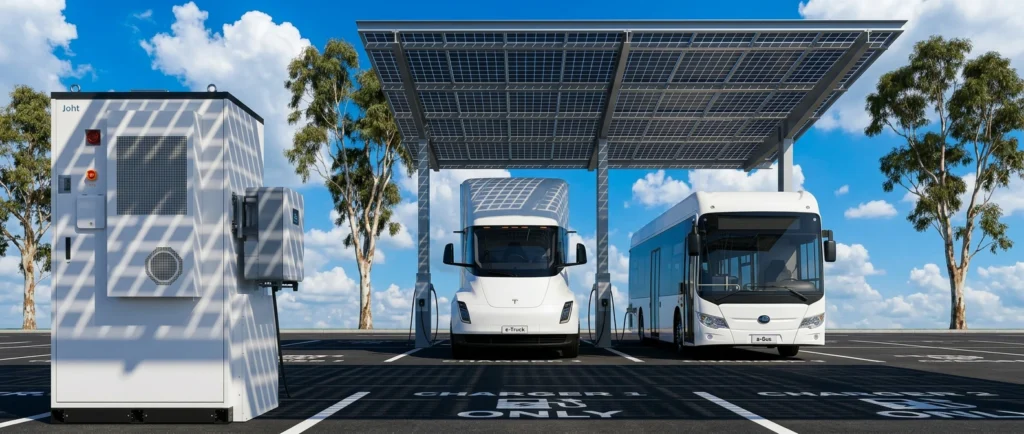
For depots with grid connection constraints or high peak demand charges, pairing EV charging infrastructure with on-site solar generation and battery energy storage systems (ESS) reduces both capital and operating costs. Solar generation offsets daytime electricity costs; the ESS buffer smooths peak charging demand and enables overnight delivery of stored solar energy to vehicles.
JointCharging operates a dedicated Solar + Storage + EV Charging Hub lab in Xiamen, China, validating integrated system performance under real operating conditions. This type of integrated solution is increasingly relevant for fleet operators in regions where grid upgrade timelines are measured in years, not months.
Product Spotlight: EVH007 Fleet Charger
The EVH007 is a purpose-built fleet charging unit delivering 11.5 kW at 48A, with native support for ISO 15118 (Plug and Charge), DLB for multi-bay deployments, and dual connector compatibility across J1772 and NACS standards — covering the entire North American commercial vehicle market. OCPP 1.6 and OCPP 2.0 compatibility ensures integration with existing fleet management systems.
ETL certification confirms compliance with US and Canadian electrical safety requirements. For fleets building out depot infrastructure before the 30C credit deadline, it is a well-specified fit for overnight bay-by-bay charging installations.
Explore AC EV chargers for the US and Canada or review CCS1 and NACS DC fast chargers for North America for applications requiring faster turnaround or heavier duty cycles.
What Should Fleet Operators Do Now?
The tactical sequence for 2026 is fairly consistent across fleet types and geographies. Priority actions, in order of urgency:
- Audit your duty cycles before selecting vehicles or chargers. The operating economics of electrification depend heavily on route length, daily mileage, overnight dwell time, and payload. Start with the vehicles and routes where the numbers already work — typically back-to-base operations, urban last-mile, and predictable shorter routes — rather than trying to electrify the hardest use cases first.
- Commission depot charging infrastructure before 30 June 2026. The Section 30C tax credit — up to 30% of per-port installation costs under prevailing wage conditions — expires for property placed in service after that date, according to the Alternative Fuels Data Center. Infrastructure projects with lead times for electrical work and permitting need to start immediately to hit this deadline.
- Treat energy procurement as a strategic input. Work with your energy supplier to structure electricity tariffs around off-peak charging windows. As VEV notes, smart charging and flexible procurement can materially reduce the effective per-mile energy cost. This step alone can determine whether your TCO model supports or undermines the business case.
- Map your compliance obligations by jurisdiction. The regulatory landscape differs significantly between California government fleets, UK-registered fleets under the ZEV mandate, and fleets in states with their own programs. Build a jurisdiction map and assign clear ownership of compliance monitoring.
- Invest in data infrastructure alongside vehicle infrastructure. Telematics, OCPP-connected charge management, and route optimization tools turn electrification from a cost center into an operational intelligence asset, as FleetPoint emphasizes. The fleets building these capabilities in 2026 will have a measurable operational advantage over those that treat chargers as dumb hardware.
- Model residual value and financing alongside TCO. As VEV’s analysis highlights, traditional three-year replacement cycles can make EV economics look unfavorable. The same asset financed differently, held longer, and operated with charging intelligence can produce substantially different results. Engage fleet finance and leasing partners who understand EV-specific asset life modeling.
Build Your Fleet Charging Strategy with JointCharging
With over 200,000 units deployed across 60+ countries, ETL, CE, TÜV, and Energy Star certifications, and a product portfolio spanning AC EV chargers for the US and Canada, DC fast chargers 30–400 kW, and energy storage systems with EV charging, JointCharging supplies fleet-grade charging infrastructure to operators in North America, Europe, and across Southeast Asia and the Middle East.
Manufacturing from a Malaysia facility provides favorable tariff positioning for US-market procurement. OCPP 1.6 and OCPP 2.0 compatibility across the product line ensures that infrastructure commissioned today integrates with the charge management and telematics platforms fleet operators will rely on through the decade.
Ready to specify your depot charging solution? Explore CCS1 and NACS DC fast chargers for North America or the full fleet AC charger range — or contact the team at JointCharging to discuss a depot design for your specific vehicle mix and site constraints.
Frequently Asked Questions: Fleet Electrification 2026
Is fleet electrification cost-effective in 2026?
For most commercial fleets operating predictable routes with depot-based charging, yes. Electric vehicles cost $0.04–$0.05 per mile in energy versus $0.175 per mile for gasoline vehicles, per Qmerit’s TCO analysis. A fleet of 50 vehicles can save $30,000–$55,000 annually on maintenance alone. Electric bus TCO is already 7% lower per mile than diesel on an NPV basis, according to Zenobe. The key variable is energy contract structure — poorly managed electricity procurement can erode those savings.
What is the CARB Advanced Clean Fleets (ACF) regulation status in 2026?
In October 2025, CARB repealed ACF requirements for private and federal fleets after failing to secure a federal Clean Air Act waiver, as documented by the Heavy Vehicle Inspection compliance guide. State and local government fleets still face a 50% ZEV purchase requirement, rising to 100% by 2030. The separate ACT manufacturer sales mandate remains in effect, requiring 100% ZEV sales by 2036 — which will progressively limit ICE vehicle availability for all fleet operators.
When does the 30C charging infrastructure tax credit expire?
The Section 30C Alternative Fuel Vehicle Refueling Property Credit expires for property placed in service after 30 June 2026, per the Alternative Fuels Data Center. Businesses and fleets can claim 6% of the cost of each charging port (up to $100,000 per port), or 30% if prevailing wage and apprenticeship requirements are met. Fleet operators should commission infrastructure projects immediately to capture this credit before the deadline.
What is dynamic load balancing (DLB) and why does it matter for fleet charging?
Dynamic load balancing (DLB) distributes available electrical capacity across multiple charging points in real time, preventing simultaneous peak draws that would require expensive grid upgrades. For a depot charging 20 or more vehicles overnight, DLB can reduce peak demand charges substantially and may eliminate the need for costly site electrical upgrades. It is a standard feature in commercial-grade EV chargers designed for fleet applications, including the JointCharging EVH007.
What charger type is best for fleet depot charging — AC Level 2 or DC fast charging?
Most depot charging scenarios are well-served by AC Level 2 chargers (7–22 kW) installed at each parking bay. Vehicles charge overnight during dwell time, which is typically sufficient for daily route mileage. DC fast chargers (30–400 kW) are appropriate for mid-route opportunity charging, high-utilization vehicles with short dwell times, or mixed fleets where some vehicles cannot charge overnight. A hybrid depot design often combines AC for base overnight charging with one or two DC fast chargers for operational flexibility.
Does ISO 15118 matter for commercial fleet chargers?
ISO 15118 enables Plug and Charge (PnC) functionality, where vehicles authenticate and initiate charging automatically without a card or app. For fleet operators, this simplifies driver workflows, enables automated billing per vehicle, and supports Vehicle-to-Grid (V2G) capability where the vehicle standard supports it. It also future-proofs infrastructure investment as more commercial vehicle OEMs adopt ISO 15118 compatibility.
