
Table of Contents
Electric trucks are no longer a pilot program — they are a procurement decision. According to the IEA’s Global EV Outlook 2025, global electric medium- and heavy-duty truck sales exceeded 90,000 units in 2024, growing nearly 80% year-on-year. Brazil sold almost 500 electric trucks in 2024, Canada nearly 2,000, and the United States deployed more electric trucks in 2024 alone than in the entire period from 2015 to 2022 combined. For fleet operators, logistics companies, and charge point operators (CPOs) in these markets, the question is no longer “should we electrify?” — it is “how do we build a charging infrastructure that actually keeps trucks moving?” This guide covers the full solution stack: DC fast charger hardware, operations management software, grid and energy storage integration, and how to calculate a realistic return on investment, illustrated with real-world context from Brazil and North America.
| Topic | Key Takeaway |
|---|---|
| Hardware | Electric trucks require 60–400 kW DC fast chargers; overnight AC is viable only for light-duty cycles |
| Software | OCPP-based fleet management platforms reduce energy costs by up to 40% through smart scheduling |
| Grid + Storage | Behind-the-meter ESS buffers peak load and reduces utility demand charges by 30–50% |
| ROI | Electricity costs $0.03–0.05/mile vs $0.17 for diesel; payback typically 3–5 years at fleet scale |
| Markets | Brazil and North America both have active incentive programs and fast-growing electric truck fleets |
Why Electric Trucks Demand a Different Charging Approach
A Class 8 electric truck carries a battery pack of 300–600 kWh — roughly 10 to 40 times larger than a passenger EV. This scale changes every variable in charging system design. A depot charging ten such trucks simultaneously may draw 1–3.5 MW of power, equivalent to a small industrial facility. That means the infrastructure decisions made before the first truck arrives — transformer capacity, panel sizing, conduit routing, utility engagement timelines — determine whether electrification delivers on its promise or becomes a costly operational constraint.
Heavy-duty vehicles charging at a shared depot also expose the limits of unmanaged charging. When every truck begins drawing power the moment it plugs in, the result is simultaneous peak demand that triggers utility demand charges, risks breaker trips, and may leave some vehicles undercharged by dispatch time. Fleet operators using smart charging management have reported up to 40% reduction in electricity costs and a 38% improvement in charger utilisation. The hardware alone is not enough — software and grid strategy are equally critical layers of the solution.
Hardware Layer: DC EV Chargers for Electric Truck Fleets
For electric trucks, the only viable charging technologies are Level 2 AC and DC fast charging (DCFC). Level 1 (standard 120 V) is entirely unsuitable for commercial operations. The choice between AC and DC depends on two variables: battery pack size and dwell time.
When to Use AC Chargers (Level 2, 7–22 kW)
AC chargers are appropriate for light-duty and medium-duty electric trucks with batteries under 150 kWh, where vehicles return to the depot for 8 or more hours overnight. A 22 kW AC charger can replenish approximately 150–180 km of range per hour for a medium-duty truck. The lower capital cost and simpler grid connection make AC a cost-effective choice for overnight depot charging, provided the vehicle fleet has predictable return-to-base schedules. A one-to-one ratio of chargers to vehicles is typical for overnight AC configurations.
Explore AC EV chargers for global markets or AC EV chargers for North America for depot fleet applications.
When to Use DC Fast Chargers (30–400 kW)
For Class 6–8 heavy-duty trucks with 300–600 kWh batteries, DC fast charging is the operational standard. A 150 kW DC charger can deliver approximately 100 km of range in 30–40 minutes. At 240–400 kW, mid-shift opportunity charging becomes viable during driver rest periods or loading windows, eliminating the constraint of overnight-only charging windows.
- 30–60 kW DC chargers: Medium-duty urban delivery trucks, last-mile vehicles, overnight depot supplement
- 60–120 kW DC chargers: Regional distribution trucks, Class 6–7, hub-and-spoke depot operations
- 150–240 kW DC chargers: Class 8 day-cab trucks, port drayage, fleet depot primary charging
- 300–400 kW DC chargers: Long-haul Class 8, high-utilisation 24-hour fleets, en-route corridor charging
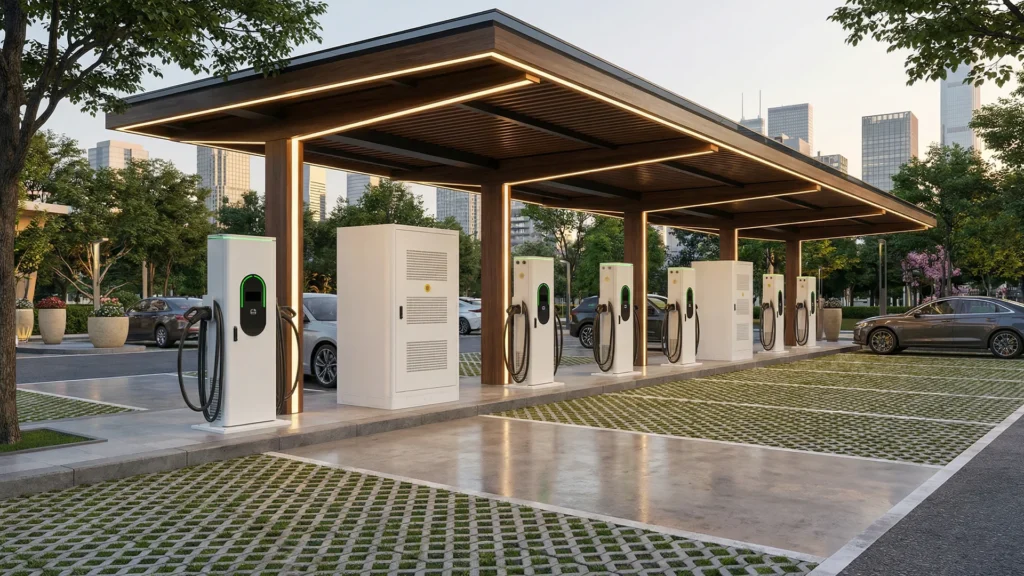
Joint Tech manufactures DC fast chargers from 30 to 400 kW for global markets (CCS2), as well as CCS1/NACS DC fast chargers for USA & Canada. Products carry CE, ETL, CB, and TUV certifications, and support OCPP 1.6 and OCPP 2.0 protocols for backend integration.
DC Charger Comparison: Truck Fleet Applications
| Power Level | Vehicle Class | Charge Time (300 kWh battery) | Typical Use Case | Connector (North America / Global) |
|---|---|---|---|---|
| 60 kW | Class 4–6 | ~5 hours | Overnight urban delivery depot | CCS1 / CCS2 |
| 120 kW | Class 6–7 | ~2.5 hours | Regional hub-and-spoke depot | CCS1 / CCS2 |
| 180 kW | Class 8 | ~1.7 hours | Drayage, port, day-cab fleet | CCS1 / NACS / CCS2 |
| 360 kW | Class 8 long-haul | ~50 min | Corridor en-route, 24h duty cycle | CCS1 / NACS / CCS2 |
Software Layer: Fleet Operations and Charging Management Platform
A DC charger without a management platform is like a fuel pump without an accounting system. For electric truck fleets, the operations management platform — sometimes called a fleet charging management system (FCMS) or OCPP backend — is what transforms individual chargers into an intelligent, cost-optimised infrastructure. OCPP (Open Charge Point Protocol) is the industry-standard open protocol that enables chargers from any manufacturer to communicate with any backend software platform. OCPP 1.6 is the current deployment standard; OCPP 2.0.1 adds enhanced smart charging, ISO 15118 Plug & Charge, and bi-directional communication capabilities.
Core Functions of a Truck Fleet Charging Management Platform
- Smart Charging Scheduling: Automatically queues and staggers charging sessions to prevent simultaneous peak draw. Charges vehicles during off-peak tariff windows, reducing energy costs by 20–40%.
- Dynamic Load Balancing (DLB): Distributes available power across all connected chargers in real time. When one truck finishes charging, its allocated power is automatically redistributed to vehicles still charging — maximising throughput without oversizing the electrical service.
- Remote Monitoring and Diagnostics: Provides live charger status, fault alerts, and historical performance data. Operators can restart, update firmware, or lock chargers remotely — critical for depots with large charger counts.
- State-of-Charge (SoC) Management: Integrates vehicle SoC data (via OCPP 2.0 or telematics API) to prioritise charging order based on departure schedule and remaining battery level.
- Energy and Cost Reporting: Tracks energy consumption per vehicle, per charger, and per session. Generates reports for accounting, carbon reporting, and incentive claim verification.
- Fleet Integration (API/Telematics): Connects to fleet management systems (FMS) and telematics platforms to synchronise charging schedules with route plans and driver shift times.
What Is OCPP and Why Does It Matter for Truck Fleets?
OCPP (Open Charge Point Protocol) is a standardised communication protocol between EV chargers and backend management systems. It is maintained by the Open Charge Alliance (OCA). For truck fleet operators, OCPP compliance is critical because it prevents vendor lock-in: an OCPP-compliant charger can be managed by any certified backend platform, and fleets can switch software providers without replacing hardware. Joint Tech chargers support both OCPP 1.6 and OCPP 2.0, and the company is a certified OCA member. When evaluating charging hardware for a fleet deployment, always confirm OCPP certification and verify that the backend software supports your specific OCPP version.
Grid and Energy Layer: Integrating Storage and Renewable Power
For heavy-duty truck depots drawing 1–5 MW of charging load, grid integration is not optional — it is the most technically complex and commercially critical element of the entire project. Grid upgrades can take 12–24 months from initial utility engagement to energisation. Fleets that wait until the trucks arrive to begin utility conversations routinely face 6–18 months of idle, uncharged vehicles.
Behind-the-Meter Energy Storage (ESS)
Co-locating a battery energy storage system (ESS) at a truck depot fundamentally changes the economics of high-power charging. The ESS charges during off-peak hours when electricity is cheapest, then discharges during depot peak charging windows. This achieves two outcomes: it reduces peak demand charges (often the largest line item on a commercial electricity bill) and it allows a depot to draw significantly higher instantaneous power than the utility connection technically permits — effectively decoupling vehicle charging speed from grid connection size.
For depots in regions with high renewable penetration — Brazil’s grid is approximately 85% renewable — an ESS also enables solar integration, storing daytime PV generation for overnight truck charging. This combination can reduce grid electricity consumption for fleet charging by 30–60%, depending on PV system size and fleet charging patterns. Joint Tech offers CE-certified energy storage systems with integrated EV charging for global deployments, and energy storage systems for EV charging in the USA and Canada.
The Four Layers: Vehicles · Charging · Grid · Digital Intelligence
| Layer | Components | Key Function |
|---|---|---|
| Vehicles | Electric trucks (Class 4–8), onboard charger (OBC), battery management system (BMS) | Defines energy demand, connector type, max charge rate, and SoC reporting |
| Charging | DC fast chargers (60–400 kW), AC chargers (7–22 kW), connectors (CCS1/CCS2/NACS) | Delivers power to vehicles at required speed; communicates session data to backend |
| Grid | Utility connection, transformers, switchgear, behind-the-meter ESS, on-site solar PV | Supplies, stores, and manages electricity at depot scale; determines peak demand cost |
| Digital Intelligence | OCPP backend / FCMS platform, fleet telematics integration, energy management system (EMS) | Optimises charging schedules, balances load, monitors faults, generates cost and carbon reports |
Regional Spotlight: Brazil — The Emerging Freight Electrification Frontier
Brazil presents a distinctive opportunity for electric truck charging infrastructure. The IEA confirmed that Brazil sold almost 500 electric trucks in 2024, with Volkswagen Caminhoes e Onibus (TRATON) having produced its electric “e-Delivery” truck locally since 2021 — the first 100% electric truck designed and built in Brazil. Sao Paulo has banned new diesel bus procurement and is targeting a 100% zero-emission public fleet by 2038, with zero-emission bus sales growing 141% in the first half of 2025.
On the infrastructure side, Brazil’s public and semipublic charging network had expanded to nearly 17,000 chargers as of mid-2025, with the EV charging market projected to grow from USD 36.7 million in 2024 to USD 119.3 million by 2030 at a 22% CAGR. The national e-FAST Brasil platform, launched in July 2025 and coordinated by WRI Brasil with government ministry support, specifically targets the acceleration of freight electrification corridors — including the first Green Road Corridor in Latin America.
Brazil’s grid composition is a significant structural advantage: with approximately 85% of electricity generated from renewable sources (primarily hydropower), electric trucks running on Brazil’s grid have a markedly lower lifecycle carbon footprint than in most other markets. For fleet operators, this means the carbon reduction argument aligns directly with the cost argument from day one.
Example Scenario: Logistics Fleet Depot in Sao Paulo
Consider a regional logistics operator in the greater Sao Paulo area running 20 medium-duty electric delivery trucks with 180 kWh batteries, each covering 150 km daily. The fleet returns to depot by 20:00 and departs at 06:00, providing a 10-hour charging window.
- Hardware: 10 x 60 kW DC fast chargers (2 trucks per charger, staggered via smart scheduling) + 4 x 22 kW AC chargers for reserve vehicles and battery top-ups
- Software: OCPP 1.6-compatible fleet management platform with time-of-use scheduling, DLB, and telematics integration
- Grid: 400 kW contracted utility connection + 200 kWh behind-the-meter ESS to buffer peak demand and reduce demand charges
- Digital: Energy management system (EMS) coordinating ESS charge/discharge cycles, solar integration, and charger scheduling — all remotely accessible via web dashboard
With Brazil’s current commercial electricity tariff structure, this configuration is projected to cost approximately R$0.25–0.40 per km in energy — compared to R$0.80–1.20 per km for diesel at 2025 fuel prices. The combination of lower fuel cost, reduced preventive maintenance (no DPF regeneration, DEF fluid, or engine oil changes), and available state incentive programs in Sao Paulo positions such a deployment for payback within 3–4 years on the charging infrastructure investment.
Regional Spotlight: North America — Scale, Standards, and Corridor Charging
North America presents a more complex regulatory and infrastructure landscape than Brazil, but also a larger immediate market. The United States deployed over 1,700 electric trucks in 2024 alone — more than the entire cumulative total between 2015 and 2022. California remains the primary regulatory driver, with truck OEMs committed to 100% zero-emission heavy-duty sales by 2036, driving large-scale depot infrastructure investment across the state and beyond.
The North American charging connector landscape requires specific attention. Class 8 trucks sold in the United States use CCS1 (Combined Charging System Type 1) or increasingly NACS (North American Charging Standard, originally Tesla’s connector, now adopted by SAE as J3400). Canadian trucks follow the same CCS1/NACS standards. Fleet operators procuring charging hardware for North America must confirm CCS1 and/or NACS compatibility, as CCS2 (used in Europe, Brazil, and most global markets) is electrically similar but physically incompatible. Joint Tech’s CCS1/NACS DC fast chargers for USA & Canada are ETL-certified for the North American market and support OCPP 1.6 and OCPP 2.0.
Example Scenario: Drayage Fleet at a California Port
A drayage operator running 30 Class 8 electric terminal tractors at a Southern California port, operating in two shifts with vehicles charging during non-operational windows of 3–4 hours.
- Hardware: 15 x 150 kW DC fast chargers (CCS1/NACS), deployed in two charging rows to serve the full fleet across two shifts
- Software: OCPP 2.0-compatible fleet charging management system with real-time SoC integration, automated shift-based charging queuing, and utility demand charge management
- Grid: 2.5 MW utility connection with phased transformer upgrade; 500 kWh ESS to peak-shave during simultaneous multi-truck charging events
- Digital: EMS with time-of-use rate optimisation, utility demand charge alerts, and LCFS (Low Carbon Fuel Standard) credit tracking for California revenue
At California utility rates, smart charging management and ESS peak shaving can reduce monthly demand charges by $15,000–30,000 at this scale. LCFS credits generated from displacing diesel with grid electricity provide an additional ongoing revenue stream. State programs such as California HVIP (up to $60,000 per heavy-duty vehicle) and utility make-ready rebates covering 50–80% of infrastructure costs can substantially reduce the upfront capital requirement.
What Is the ROI of an Electric Truck Charging Solution?
The ROI of an electric truck charging infrastructure deployment is a function of four variables: fuel cost savings, maintenance cost reduction, infrastructure capital expenditure (capex), and available incentives. The calculation differs meaningfully by market, fleet size, and operational profile — but the directional economics are consistent.
Core Cost Comparison: Electric vs Diesel Trucks
| Cost Category | Diesel Truck | Electric Truck (Managed Charging) | Notes |
|---|---|---|---|
| Fuel / Energy cost per km | ~$0.17 USD | $0.03–0.05 USD | Source: US DOE / fleet operator data |
| Engine oil & filter changes | $600–1,200/year | Not applicable | No internal combustion engine |
| DPF regeneration / DEF fluid | $800–2,500/year | Not applicable | No exhaust aftertreatment system |
| Transmission fluid service | $400–800/year | Not applicable | Electric drivetrain has minimal fluid maintenance |
| Brake service | $1,500–3,000/year | $400–800/year | Regenerative braking reduces brake wear significantly |
| Charging infrastructure (amortised) | Not applicable | $500–1,500/truck/year | Amortised over 10-year asset life at 20-truck depot scale |
For a 20-truck regional fleet covering 120,000 km/year per vehicle, the energy cost saving alone is approximately $28,800–33,600 USD per truck annually (at $0.17 vs $0.04/km). Across a 20-vehicle fleet, that is $576,000–$672,000 in annual fuel savings, before accounting for maintenance cost reduction. A well-designed charging infrastructure investment at this fleet scale — including DC chargers, software platform, and ESS — typically has a payback period of 3–5 years, with a 10-year net positive return well in excess of 200% on the infrastructure investment alone.
How to Size and Plan an Electric Truck Charging System
Effective charging infrastructure planning follows a structured process. The most common — and costly — mistake is underestimating the time required for utility engagement: grid upgrades can take 12–24 months in North America and 6–18 months in Brazil. Begin utility conversations before placing truck orders.
- Fleet and route analysis: Determine daily kilometres, departure and return times, and vehicle battery sizes for every vehicle in scope.
- Dwell time mapping: Calculate available charging windows per vehicle. Overnight depots with 8+ hour windows can use lower-power chargers; multi-shift operations require higher-power DCFC.
- Energy demand calculation: Multiply average daily energy consumption per vehicle by fleet size to determine total daily depot energy requirement. Add 20% as a planning margin.
- Site electrical assessment: Survey existing transformer and panel capacity. Identify upgrade requirements and begin utility engagement immediately.
- Hardware selection: Select charger power levels and quantities based on dwell time analysis and energy demand. Oversize conduit runs for future capacity expansion.
- Software and backend selection: Confirm OCPP compatibility, smart scheduling capability, DLB, and integration with existing fleet management systems.
- ESS sizing: If demand charges are high or grid capacity is constrained, size an ESS to buffer peak charging load. Target 20–30% of peak charging load as ESS capacity as a starting point.
- Incentive identification: Map available federal, state/provincial, and utility incentives before finalising the budget. Incentive timing relative to purchase dates is critical.
- Phased rollout: Commission 30–50% of the planned charger count in Phase 1. Measure real energy consumption, utilisation rates, and demand charge impact before Phase 2 expansion.
Key Takeaways
- Electric truck charging requires a systems approach — hardware, software, grid, and digital intelligence must be designed together, not separately.
- DC fast chargers (60–400 kW) are the operational standard for Class 6–8 trucks; AC Level 2 is appropriate for light-duty and overnight medium-duty applications.
- OCPP-compliant fleet charging management software is essential for cost control: smart scheduling reduces electricity costs by up to 40% compared to unmanaged charging.
- Behind-the-meter ESS is the most effective tool for reducing demand charges and decoupling depot charging speed from utility grid connection size.
- Brazil’s renewable-dominated grid and fast-growing e-FAST Brasil freight corridor program make it one of the highest-ROI markets globally for electric truck charging investment.
- In North America, CCS1/NACS certification and early utility engagement (12–18 months ahead) are the two most critical factors for successful depot deployment.
- At fleet scale (20+ trucks), the combined fuel and maintenance savings from electrification typically support a 3–5 year payback on charging infrastructure, with positive 10-year returns exceeding 200% on infrastructure capex.
Ready to Design Your Electric Truck Charging Solution?
Joint Tech has deployed over 300,000 charging units across 70+ countries since 2015, with DC fast chargers ranging from 30 to 400 kW, certified for both global markets (CE, CCS2) and North America (ETL, CCS1, NACS). Whether you are building a depot in Sao Paulo, a drayage site in Long Beach, or a logistics hub anywhere in between, our team can support your hardware specification, OCPP backend integration, and ESS configuration.
Explore our full range of DC fast chargers 30–400 kW for global markets, CCS1/NACS DC fast chargers for USA & Canada, and CE-certified energy storage systems with EV charging. Contact us at info@jointcharging.com to discuss your fleet deployment.
