
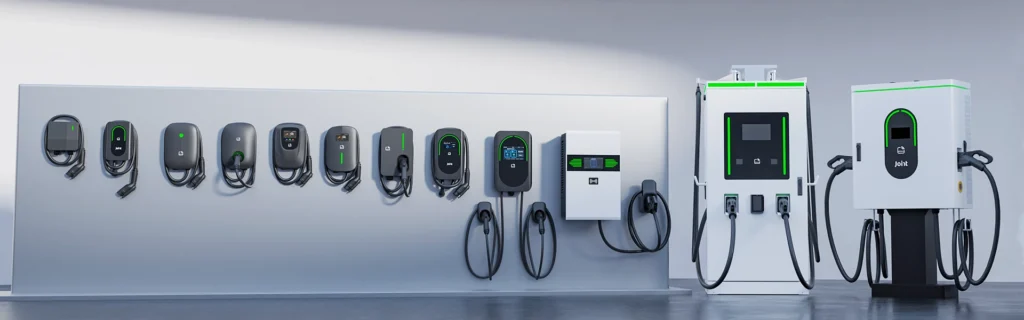
Installing an EV charger at home is no longer just a convenience — for many electric vehicle owners and property developers, it’s a smart investment that improves daily efficiency, property value, and future readiness. Whether you’re researching a level 2 charger home setup, exploring a level 3 charger at home, or looking for a reliable EV charger installer, this guide walks you through everything you need to know before making a decision.
This article is designed as a practical, commercial-intent guide — helping homeowners, installers, and businesses understand home EV charger installation, available technologies, costs, and how to choose the right solution.
1. What Is an EV Charger (EVSE)?
An EVSE charger (Electric Vehicle Supply Equipment) is the system that safely delivers electricity from your power source to your electric vehicle. EV chargers regulate power flow, protect against electrical faults, and ensure compatibility between the vehicle and the grid.
Common terms you may see include:
- EV battery chargers / battery charger for electric vehicles
- Vehicle AC charger
- DC electric car charger / car charger DC
The right EVSE depends on charging speed, vehicle compatibility, and your installation environment.
2. EV Charger Levels Explained (Level 1, Level 2 & Level 3)
Level 1 EV Charger (AC)
A level 1 home EV charger uses a standard household outlet.
- Power: ~1.4 kW
- Typical use: Overnight or backup charging
- Keywords covered: EVSE level 1 charger, level 1 PHEV charger, NACS level 1 charger
Pros:
- No complex installation
- Lowest upfront cost
Cons:
- Very slow charging
- Not ideal for full EVs
Level 2 EV Charger (AC)
A level 2 charger at home is the most popular solution for residential EV charging.
- Power: 7–22 kW (AC level 2 charger)
- Installation: Dedicated circuit + professional EV home charger installer
- Keywords covered: level 2 charger home, home L2 charger, level 2 AC charger
Pros:
- 5–10x faster than Level 1
- Ideal for daily home car charging
- Compatible with most EVs
Cons:
- Requires a professional car charger installer
Level 3 / DC Fast Charger at Home
A level 3 DC fast charger for home delivers direct current (DC) power to the vehicle battery.
- Power: 30–150 kW+
- Keywords covered: DC EV charger, EV DC fast charger, electric vehicle DC fast charger, level 3 charging at home
Reality check:
While interest in home DC charger for EV setups is growing, they are usually suited for:
- Luxury residences
- Commercial + residential hybrid sites
- Fleet depots or private parking facilities
Key limitations:
- High installation cost
- Grid capacity requirements
- Utility approvals often required
3. Home EV Charger Installation: Step-by-Step Overview
A professional EV charger home install typically includes:
- Site evaluation (power capacity, panel load)
- Charger selection (AC or DC)
- Electrical upgrades (if required)
- Charger mounting and wiring
- Safety testing and commissioning
Searching for experienced EV charger installers or car charger installers is critical to ensure compliance and long-term safety.
4. AC vs DC Charging at Home: Which Should You Choose?
| Feature | AC Level 2 Charger | DC Fast Charger |
| Typical use | Residential | Commercial / premium home |
| Cost | Moderate | High |
| Installation complexity | Medium | High |
| Charging speed | Fast | Ultra-fast |
For most homeowners, a level 2 charger home installation offers the best balance of speed, cost, and practicality.
5. Vehicle & Connector Compatibility
Before installing a charger, confirm compatibility with your vehicle:
- Type 1 charger – Common in North America
- CCS / Home CCS charger – AC + DC combined system
- NACS (Tesla) – Tesla charging stations at home
- CHAdeMO charger at home – Older Japanese EV models
Choosing the correct connector ensures safe and efficient charging without adapters.
6. Cost of Home EV Charger Installation
Typical pricing depends on charger type and site conditions:
- Level 1 home EV charger: Low cost, minimal install
- Level 2 charger at home: Moderate cost, professional install
- Level 3 DC charger for home: High cost, utility coordination
If you’re researching cheap EV charger installation, focus on Level 2 AC chargers with scalable features rather than underpowered systems.
7. Fast Home Charging: What’s the Fastest EV Charger for Home?
The fastest EV charger for home use is usually a high-power AC level 2 charger, optimized with:
- Smart load management
- Scheduled charging
- Vehicle-specific tuning
A true supercharger for home (DC fast charging) is possible but rarely cost-effective for standard residential use.
8. Choosing the Best EV Charger for Your Home
When comparing best car chargers for home, consider:
- Charging power (kW)
- Vehicle compatibility
- Installation environment
- Smart features (app, OCPP (Open Charge Point Protocol), load balancing)
- Warranty & after-sales support
Working with a qualified EV home charger installer helps ensure the system is future-proof and compliant.
9. Home EV Charging Points: Residential vs Semi-Commercial
Some properties benefit from multiple home charging points, such as:
- Apartment buildings
- Mixed-use properties
- Private parking facilities
In these cases, solutions may resemble EV station installation rather than a single charger setup.
10. Final Thoughts
From level 1 home EV chargers to advanced DC fast home charger installation, the right solution depends on your vehicle, daily driving needs, and electrical capacity. For most users, a level 2 charger at home offers the best return on investment, while DC charging is best reserved for specialized residential or commercial scenarios.
If you’re planning electric car charging installation, consulting an experienced EV charger installer is the safest way to ensure performance, compliance, and long-term reliability.
This guide is intended for homeowners, installers, and project planners evaluating EV charging installation options. Always consult licensed professionals for final installation decisions.
